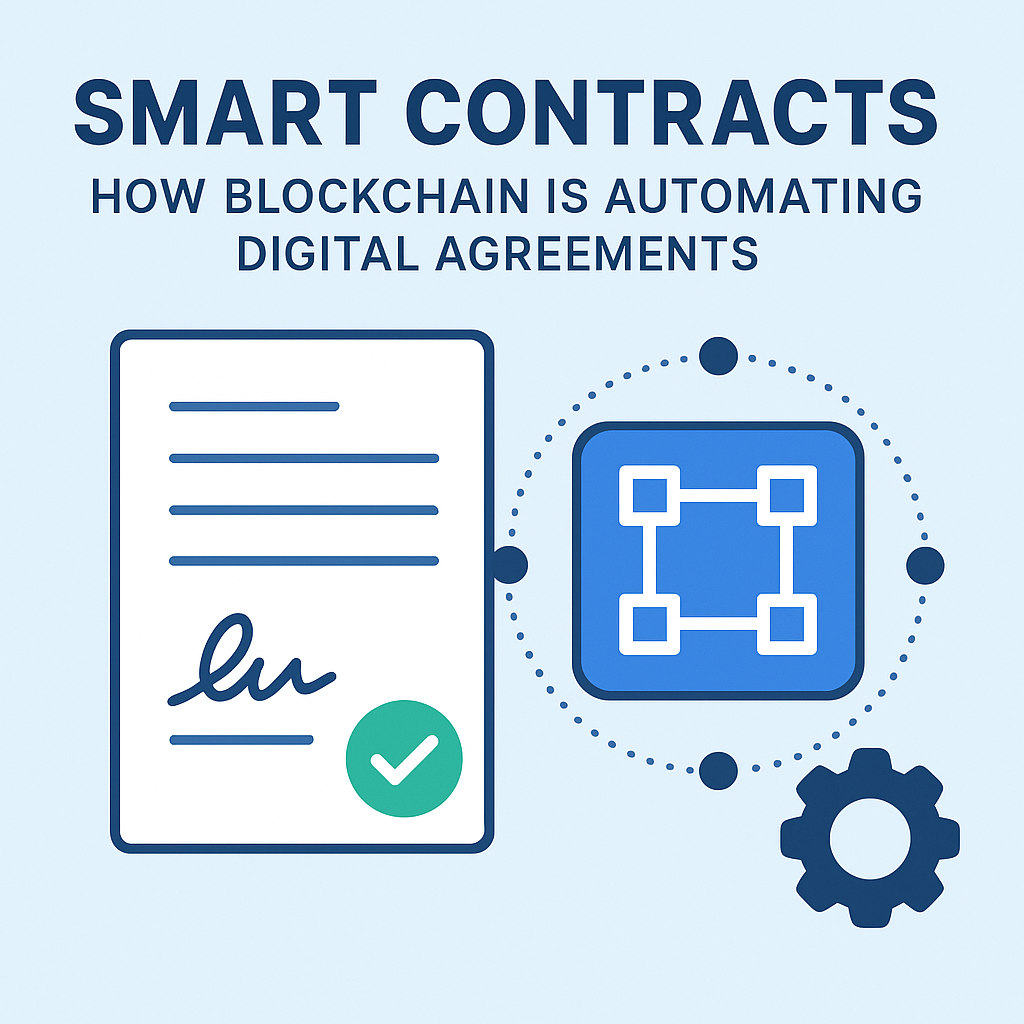
Smart Contracts: How Blockchain Is Automating Digital Agreements
Digital agreements are everywhere—leases, subscriptions, warranties, freelance invoices, insurance claims, supply-chain orders, and even music royalties. But anyone who has worked with contracts knows the friction: handshakes that aren’t enforceable, signatures that require manual verification, delays caused by back-and-forth emails, and disputes when the “truth” of a transaction isn’t shared by all parties.Enter smart contracts: self-executing digital agreements powered by blockchain. They can automatically perform actions when conditions are met, reducing paperwork, improving transparency, and cutting down the time it takes to finalize deals. In this post, we’ll explore what smart contracts are, how they work, why blockchain makes them reliable, where they’re being used today, and what to consider before adopting them.
What Are Smart Contracts?
A smart contract is a program (code) stored on a blockchain that automatically executes predetermined rules when specific conditions occur. Think of it as a digital contract that doesn’t rely on manual enforcement—once deployed, the code runs exactly as written.Unlike traditional contracts—where execution depends on people, legal systems, and sometimes litigation—smart contracts aim to automate the “if this, then that” logic. For example: “If a customer pays by the 15th, release the service access immediately.” Or: “If a shipment is confirmed as delivered, release payment to the supplier.”
How Blockchain Makes Smart Contracts Trustworthy
To understand why smart contracts matter, it helps to understand why blockchains are different from ordinary databases.
Distributed ledger: The contract and its state are stored across many computers (nodes), not just one server.
Immutability: Once a smart contract is deployed, it’s very difficult to alter. This reduces “version drift” and the risk of tampering.
Consensus: The network agrees on what happened, which helps ensure everyone shares the same transaction history.
Transparency (with design options): Many blockchain systems allow verification of transactions and contract execution, improving auditability.
In short, blockchain provides a shared, tamper-resistant environment where the contract logic can be executed reliably.
Smart Contracts vs. Traditional Contracts
Traditional contracts rely on human processes: drafting, signing, enforcement, and dispute resolution. Smart contracts shift part of that process into code. Here’s the key difference:
Traditional agreements: Rules are written in legal language and execution depends on people and courts.
Smart contracts: Rules are encoded into software and execution can happen automatically when conditions are met.
Important: Smart contracts don’t eliminate the need for legal frameworks. Instead, they complement them by automating execution. When real-world outcomes are involved (like delivery, compliance, or service quality), humans and legal systems may still play a role—especially if “truth” comes from off-chain data.
How Smart Contracts Work (Step by Step)
Most smart contracts follow a similar flow:
Deployment: Developers write contract code and deploy it to a blockchain network.
Contract state: The contract maintains state variables (like balances, ownership, and statuses) on the blockchain.
Triggering events: Transactions call the contract’s functions—such as “submit payment” or “confirm delivery.”
Condition checks: The contract checks whether rules are satisfied (e.g., deadlines passed, funds received, signatures verified).
Execution: If conditions match, the contract performs the defined action automatically (e.g., releasing funds, updating ownership, sending a token).
Finality and audit trail: All actions are recorded in the blockchain ledger, creating a verifiable history.
This automation reduces the time between agreement and execution, and it helps reduce manual errors.
Why Automation Matters for Digital Agreements
Let’s look at the pain points smart contracts address:
1) Faster execution
When agreements are automated, fewer steps are needed. Instead of waiting for a human to review documents and approve payments, the contract can release actions immediately after conditions are met.
2) Reduced intermediaries
Escrow, verification, and certain workflow approvals often involve middle parties. Smart contracts can replace some of those roles with code and verifiable on-chain records.
3) More transparency and auditability
Blockchain provides a chronological record of actions. That can make audits and dispute investigations more straightforward.
4) Less ambiguity
Contracts written in plain legal language can be interpreted in multiple ways. Smart contracts can encode rules precisely—though careful design is still essential.
Key Components of Smart Contract Systems
Smart contracts don’t exist in isolation. Several components determine how they function:
Accounts and wallets: Users interact with contracts using blockchain addresses and cryptographic keys.
On-chain logic: The contract code that executes rules.
Transactions: Actions submitted to the network to invoke contract functions.
Oracles (the bridge to the real world): Many contracts need external information—like weather data, stock prices, or delivery confirmations. Oracles provide this data to the contract.
Events and logs: Smart contracts often emit events that can be monitored by applications and dashboards.
The oracle concept is especially important because real-world data isn’t inherently “on-chain.” If the data feeding the contract is wrong or manipulated, the contract may execute incorrectly.
Common Use Cases for Smart Contracts
Smart contracts are already being used in multiple industries. Here are some high-impact examples:
Escrow and payment automation
Smart contracts can hold funds in escrow and release them automatically once services are delivered. This helps reduce non-payment risk and eliminates some of the delays caused by manual escrow processes.
Supply chain and logistics
In supply chains, payments can be linked to verifiable milestones—like “goods received,” “shipment delivered,” or “quality inspection passed.” Smart contracts can also help record provenance and reduce fraud.
Insurance and claims processing
Parametric insurance contracts can trigger payouts based on predefined events (for example, a certain level of rainfall). If the triggering data is provided by reliable oracles, claims can be processed faster.
Tokenized assets and ownership transfers
Smart contracts can manage ownership and transfer rules for tokenized assets (like real estate interests or collectibles). This can streamline administration and make ownership history more accessible.
Digital identity and access control
Some systems use smart contracts to handle permissions and authorization—such as granting access to services once a user meets requirements (age, membership status, or verification milestones).
Royalties and creator economics
Music, video, and content platforms often face challenges distributing royalties fairly and transparently. Smart contracts can automate splits based on measurable usage—when usage data is reliably captured and provided on-chain.
Benefits for Businesses and Individuals
Smart contracts can deliver value to both organizations and individuals.
Lower operational costs: Less manual processing for contract execution and reconciliation.
Consistency: The contract behaves the same way every time.
Programmable compliance: Policies can be encoded into workflows (e.g., spending rules or approval conditions).
Global accessibility: Participants can interact across borders without relying on the same local legal or banking systems.
For startups and freelancers, automation can reduce friction in getting paid and managing complicated agreements.
Challenges and Risks (What You Should Know)
Despite their promise, smart contracts are not magic. Several challenges can impact real-world use:
1) Bugs in code
If smart contract code contains vulnerabilities, the contract may behave unexpectedly. Because transactions are irreversible on many blockchains, bugs can be costly.
2) Oracle reliability
Since oracles bring off-chain data on-chain, the quality of that data matters. Weak oracle design can expose contracts to manipulation or incorrect execution.
3) Legal enforceability and jurisdiction
Smart contracts are software, but your business relationships may still depend on legal agreements. Organizations should clarify how the smart contract terms map to legal documents and dispute resolution mechanisms.
4) Privacy concerns
Blockchains often offer transparency. While some systems use privacy-enhancing techniques, public blockchains may reveal transaction activity. Sensitive agreements may require additional layers of confidentiality.
5) Governance and upgradeability
Some contracts need upgrades as requirements evolve. But changing deployed immutable code can be difficult. Teams must carefully plan upgrade patterns and governance processes.
Best Practices for Safer Smart Contract Adoption
If you’re considering deploying smart contracts for agreements, these practices can reduce risk:
Use formal auditing and testing: Engage security experts and use automated tools.
Minimize complexity: Simple contracts are often easier to verify and maintain.
Design for failure: Plan what happens if oracles fail or inputs are delayed.
Include emergency mechanisms carefully: Some designs include pause functions, but they must be governed properly.
Separate concerns: Keep business logic distinct from token custody or sensitive operations when possible.
Align with legal templates: Pair smart contract behavior with clear legal terms in contracts you can enforce.
What the Future Looks Like
Smart contracts are still evolving. Expect improvements in:
Interoperability: Cross-chain standards to let contracts communicate securely.
Oracles and verifiable data: More robust methods for bringing trusted real-world data on-chain.
Privacy-preserving smart contracts: Techniques to protect sensitive information while keeping verifiability.
Integration with enterprise systems: Bridges between blockchain logic and traditional business applications.
As these capabilities mature, smart contracts could become a standard layer for automating agreements—similar to how APIs revolutionized software-to-software integration.
Smart Contracts and AdSense-Friendly Takeaway
If your audience cares about tech, business, or innovation, smart contracts offer a compelling story: they turn legal-style “conditions” into automated execution. That means fewer delays, less manual reconciliation, and an auditable record of what happened.When designed carefully—especially with reliable oracles and thorough security reviews—smart contracts can automate workflows that previously required time, paperwork, and trust in intermediaries. In a world where digital agreements are constantly created and modified, automation isn’t just convenient—it can become a competitive advantage.
Conclusion
Smart contracts are helping blockchain move beyond cryptocurrency and into a broader mission: automating digital agreements with code. By combining transparent execution, decentralized trust, and programmable rules, smart contracts can streamline how parties pay, exchange value, and verify fulfillment.However, adoption should be thoughtful. The blockchain layer can be incredibly powerful, but contracts still depend on sound code, trustworthy data inputs, and alignment with legal realities. The future belongs to teams that treat smart contracts not as a shortcut, but as a disciplined way to build more reliable agreements for the digital economy.If you’d like, I can also help you tailor this post for your target audience (e.g., beginners vs. developers) or add an FAQ section to boost engagement and SEO.