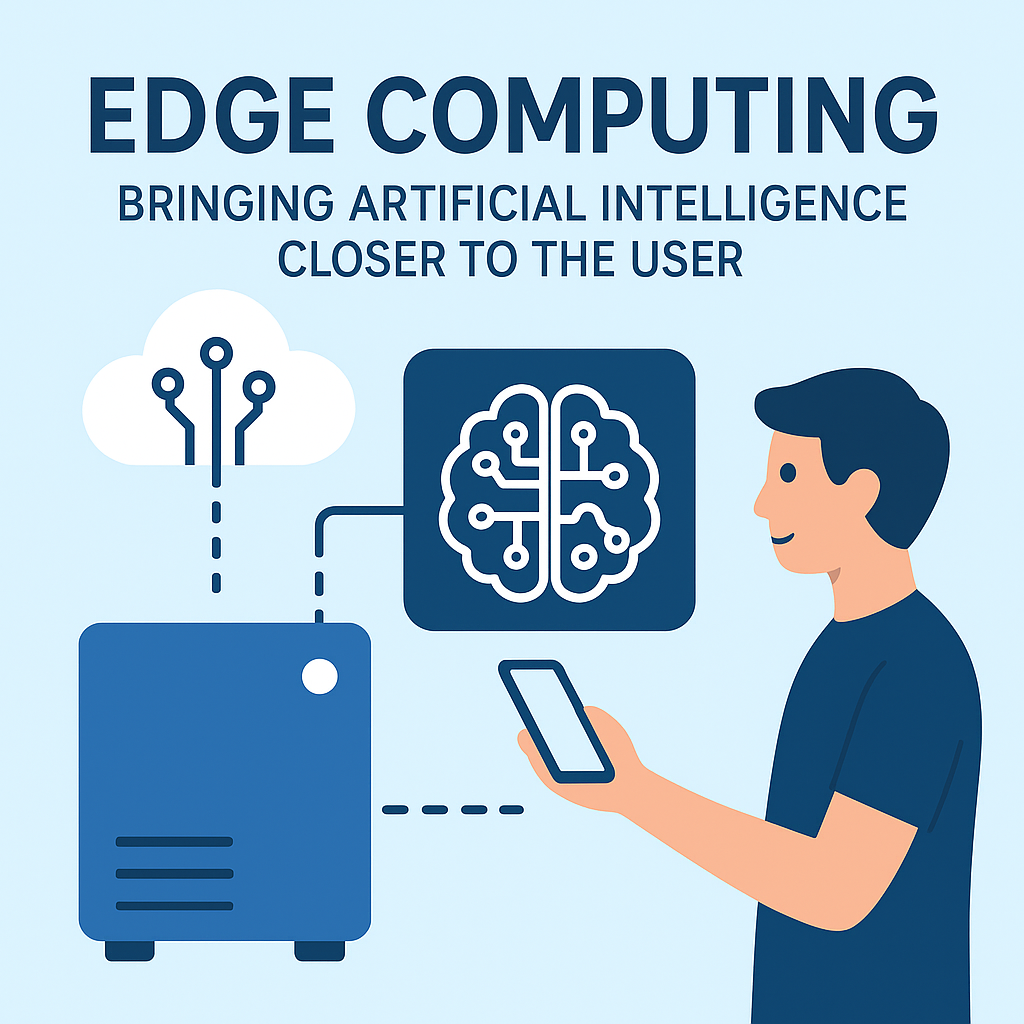
Edge Computing: Bringing Artificial Intelligence Closer to the User
Artificial Intelligence is getting faster, smarter, and more personal—yet many of the most exciting AI experiences still struggle with one fundamental problem: distance. When an AI model lives far away in the cloud, every request has to travel across networks, wait in queues, and return results later. For tasks like voice recognition, real-time video analytics, industrial monitoring, and augmented reality, delays—even small ones—can ruin the experience.This is where edge computing enters the story. Edge computing brings computation closer to where data is generated and where decisions must be made. Instead of sending every piece of information to a distant data center, edge systems process data locally, enabling AI to respond in near real time. The result? Lower latency, improved privacy, more resilient operations, and better user experiences.In this post, we’ll explore what edge computing is, how it supports AI, where it’s used, and why it’s becoming a cornerstone for modern digital transformation.
What Is Edge Computing?
Edge computing is a distributed computing approach in which data processing happens near the “edge” of a network—meaning near the source of data generation. The “edge” could be a device itself (like a phone, camera, or sensor), a local gateway, a factory network node, or a nearby micro–data center.To understand it, think of two traditional architectures:Centralized cloud model: Data is sent to a remote cloud server for processing, and results are returned afterward.Edge model: Data is processed locally first, and only necessary data (or summarized results) is sent to the cloud.In practice, many systems use a hybrid approach—edge for immediate decisions and cloud for training, large-scale analytics, and model updates.
Why “Closer to the User” Matters for AI
AI performance isn’t just about model accuracy. It’s also about responsiveness. Users experience AI through applications like chatbots, navigation, smart cameras, and healthcare monitoring. In these contexts, speed and reliability are critical.Here are key reasons edge computing is a game changer for AI:1) Lower latency When data is processed locally, the system avoids round-trip time to distant servers. This reduces delay and improves responsiveness.2) Better real-time decision-making Many AI tasks must act instantly—detecting a safety hazard on a factory line or triggering alerts from a wearable device.3) Bandwidth savings Instead of streaming all raw data to the cloud, edge devices can filter, compress, or extract features and send smaller amounts of information.4) Enhanced privacy and data governance Edge processing can keep sensitive data local. Only anonymized or aggregated results may be transmitted, which can reduce compliance risk.5) Resilience during outages If network connectivity is interrupted, edge systems can continue running. This is vital for remote locations, industrial sites, and mission-critical applications.
How Edge Computing Powers AI Workflows
Edge AI isn’t only about moving models to edge devices—it’s about reshaping the entire AI workflow. A typical system might involve:1) Data collection at the edge Sensors, cameras, microphones, IoT devices, and user devices generate data where it’s created.2) On-device or near-device inference The AI model runs locally to interpret the data: detecting objects, classifying events, recognizing speech, or predicting anomalies.3) Decision and automation The system acts immediately—sending an alert, controlling a machine, tagging a video clip, or adjusting an application experience.4) Cloud synchronization and training The cloud can perform heavy training, build larger analytics, and distribute model updates—often based on patterns observed across many edges.5) Continuous improvement Edge feedback loops help refine models over time, while maintaining fast response locally.
Edge AI in Action: Real-World Use Cases
Edge computing is already changing how AI is deployed across industries. Here are several areas where “AI closer to the user” makes a measurable difference.
1) Smart Retail and In-Store Analytics
Retailers use edge AI to analyze customer behavior and inventory in real time. Cameras can detect foot traffic patterns, identify out-of-stock shelves, and measure queue lengths. Because the processing happens locally, stores don’t need to transmit massive video streams continuously. They can also respond quickly—such as adjusting staffing levels based on demand.
2) Industrial IoT and Predictive Maintenance
Factories generate sensor data at high frequency. Sending everything to the cloud can be expensive and slow. Edge AI can detect anomalies—like unusual vibration patterns—immediately. This helps prevent downtime by alerting technicians before a failure occurs.
3) Autonomous and Assisted Driving
In vehicles, milliseconds matter. Edge-like processing occurs on-board using specialized hardware. AI helps interpret sensor inputs (cameras, radar, lidar) for lane detection, obstacle avoidance, and driver assistance. Cloud can support training and updates, but the vehicle must react instantly.
4) Healthcare and Remote Patient Monitoring
Wearable devices can analyze signals (heart rate, oxygen levels, ECG data) locally and alert users or clinicians quickly. Edge processing can also reduce privacy risks by limiting how much raw personal data leaves a device.
5) Augmented Reality (AR) and Virtual Reality (VR)
AR/VR experiences require low latency to reduce motion sickness and maintain immersion. Edge computing can help offload certain computations to nearby servers or local gateways while still keeping response time low. This improves the quality and smoothness of immersive applications.
6) Smart Cities and Traffic Optimization
Traffic lights, cameras, and roadside sensors can use edge AI to detect congestion and accidents. Local processing enables rapid responses and reduces reliance on constant connectivity. The cloud can then aggregate data to optimize longer-term city planning.
Edge Devices and Infrastructure: What Runs at the Edge?
Edge AI can run on a variety of compute platforms, including:Smartphones and personal devices: AI features like image enhancement, voice recognition, and real-time filters.IoT gateways: Devices that connect sensors to local processing and networking.Cameras and video analytics appliances: Hardware designed to process visual data quickly.Industrial controllers: Local computing for factory systems and robotics.Micro data centers: Small-scale data centers located closer to end users (e.g., at the network edge).To support AI at the edge, many systems use specialized hardware such as GPUs, NPUs (neural processing units), or AI accelerators. These chips are designed to run machine learning inference efficiently with low power consumption.
The “Edge + Cloud” Model: A Practical Hybrid Strategy
It’s tempting to think edge computing replaces the cloud. In reality, the strongest solutions usually combine both.Here’s a helpful way to think about the division of labor:Edge: Fast inference, real-time decisions, local data processing, and reduced bandwidth use.Cloud: Model training, centralized monitoring, large-scale analytics, and fleet-wide deployment management.For many organizations, this hybrid approach is also more cost-effective. You don’t need expensive cloud resources for every inference request. Instead, you can reserve the cloud for the tasks that truly benefit from large-scale compute.
Challenges and Limitations (And How to Address Them)
Edge computing is powerful, but it’s not effortless. To build reliable edge AI systems, teams must plan for several challenges.
1) Model optimization and size constraints
Edge devices have limited memory and compute. AI models often need optimization techniques like quantization, pruning, and knowledge distillation. Smaller models can run faster and more reliably at the edge.
2) Software updates and deployment at scale
When you have thousands of edge devices, updates must be secure and manageable. Organizations need strong MLOps and device management practices to roll out new models and patches safely.
3) Security risks at the edge
Edge devices are exposed to physical environments and can be easier to tamper with than centralized infrastructure. Secure boot, encrypted communication, access controls, and continuous monitoring help reduce risk.
4) Data consistency and observability
Debugging distributed systems is harder when issues can occur across devices. Logging, metrics, and tracing designed for edge environments improve visibility into performance and failures.
5) Managing latency trade-offs
Even edge systems depend on some network paths. If edge processing relies on remote services for certain tasks, latency may still increase. Designing for graceful fallback—such as offline mode—is often essential.
Why Edge Computing Can Improve Trust in AI
Trust is a major concern for modern AI. Users want to know that AI decisions are safe, fair, and private. Edge computing contributes to trust in several ways:Data minimization: Less raw data needs to leave the device or local site.Transparency opportunities: Edge systems can provide immediate feedback and context (e.g., “Why was this detected?”) using local logs and rule-based explanations.Reduced exposure: With fewer transmissions, there are fewer points where data can be intercepted.While edge computing alone doesn’t solve ethical challenges, it provides a technical foundation for privacy-preserving and user-centered AI designs.
Future Trends: What’s Next for Edge AI?
The edge computing ecosystem is evolving quickly. Here are trends likely to shape the next wave of AI products:More capable edge hardware: NPUs and AI accelerators continue to improve performance per watt, enabling bigger and more accurate models at the edge.Federated learning and privacy-first training: Instead of sending raw data to the cloud, edge devices can train locally and share updates, helping preserve privacy.Standardization of edge infrastructure: Better tooling and frameworks make deployments smoother across devices and environments.AI agent workflows at the edge: Future systems may combine local perception with task execution—like proactive maintenance scheduling or context-aware assistance.Increased use of digital twins: Local simulations and edge sensor data can power real-time models of physical systems in manufacturing, energy, and smart cities.
Conclusion: The Next Era of AI Feels More Human
Edge computing is bringing AI closer to where it matters most: the user, the device, and the moment. By processing data locally, it reduces latency, improves privacy, and enables resilient real-time intelligence—turning AI from something that responds later into something that responds now.Whether you’re building smart retail experiences, industrial monitoring tools, healthcare wearables, or AR applications, edge computing offers a powerful path to better performance and more meaningful user interactions. The cloud remains essential for training and large-scale insights, but the edge is where AI becomes immediate, practical, and truly personal.If you’re planning your next AI initiative, consider this: the best user experience isn’t only about smarter models. It’s also about faster decisions. Edge computing delivers both.