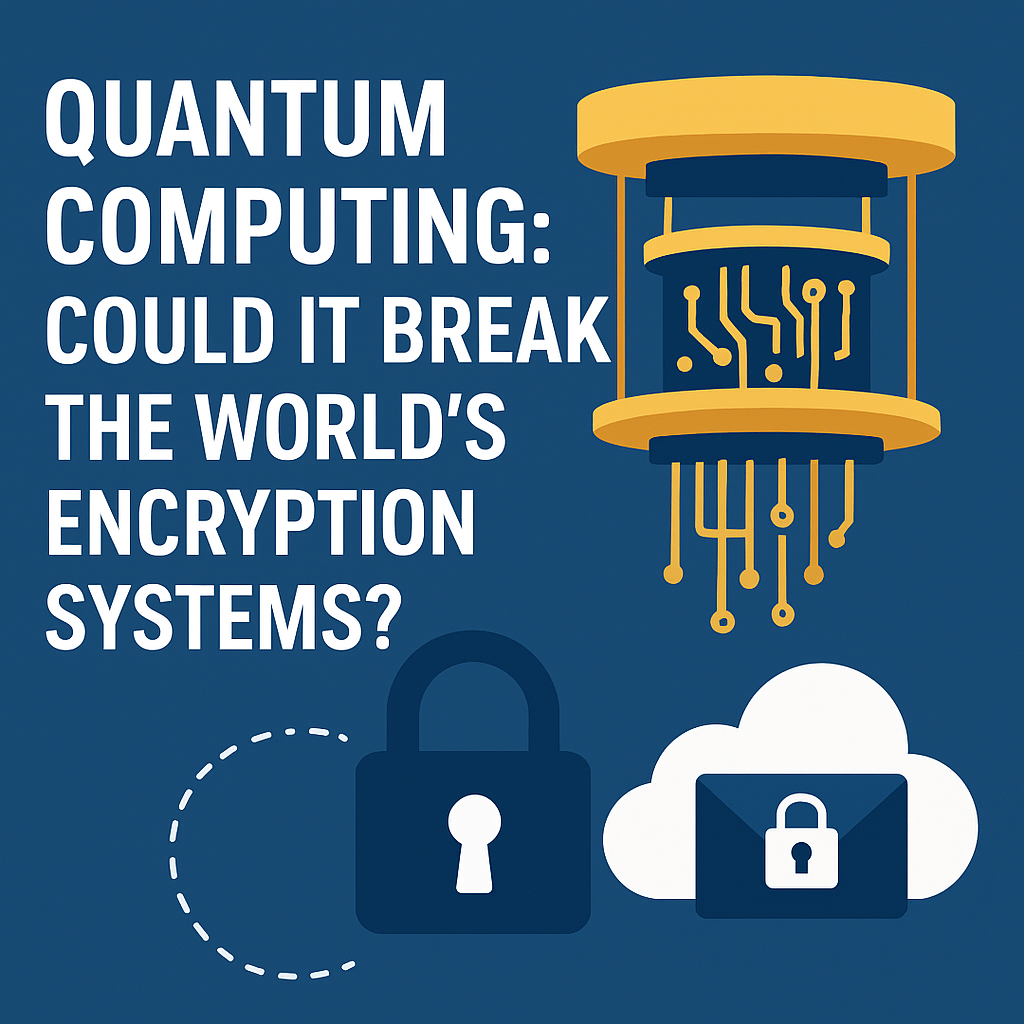
Quantum Computing: Could It Break the World’s Encryption Systems?
Encryption is one of the quiet foundations of modern life. It protects credit card payments, personal messages, government communications, and the data flowing through hospital networks and cloud services. But technology never stands still. Today, quantum computing is advancing from lab experiments toward systems that could eventually solve certain problems dramatically faster than today’s classical computers. That raises a big question: could quantum computers break the world’s encryption systems?The short answer is: possibly, but not all encryption, and not overnight. The bigger story is more nuanced—and it’s actually a good reason to pay attention now. Post-quantum cryptography (PQC), prepared defenses, and a growing migration effort are already underway. In this article, we’ll explore how quantum computing threatens some commonly used cryptographic schemes, why the risk depends on specific technical milestones, and what organizations and everyday users can do to prepare.
Understanding Encryption: Why It Works Today
Most of today’s “secure internet” relies on mathematical problems that are extremely hard for classical computers to solve. Two major workhorses are:1) Public-key cryptography — used for key exchange, digital signatures, and secure sessions (e.g., the kind used during HTTPS handshakes). Common families include RSA and elliptic-curve cryptography (ECC).2) Symmetric cryptography — used for bulk encryption of data, such as the Advanced Encryption Standard (AES). Here, the same key encrypts and decrypts.For RSA and ECC, security depends on problems related to integer factorization or discrete logarithms. For AES, security depends on brute-force resistance and the structure of the cipher.Classical computers cannot solve the underlying “hard problems” efficiently. That’s why encrypted data remains safe—assuming keys are generated correctly, implementations are secure, and the cryptographic algorithms haven’t been broken by other advances.
Enter Quantum Computing: A Different Kind of Machine
Quantum computers don’t just get “faster.” They operate on principles of quantum mechanics—like superposition and entanglement—to process information in fundamentally different ways than classical computers.In a simplistic sense, quantum systems can explore multiple computational paths at once, and certain algorithms can transform that exploration into meaningful speedups for specific problem types. Importantly, quantum computers do not provide a universal “faster for everything” advantage.The threat to encryption comes from a small set of quantum algorithms that target problems used in cryptography.
How Quantum Computers Could Break Popular Encryption
The most famous quantum threat is Shor’s algorithm. Shor’s algorithm can efficiently solve problems that are the foundation of RSA and many elliptic-curve cryptosystems.
1) RSA and Elliptic-Curve Cryptography: The Big Concern
RSA security relies on the difficulty of factoring a large composite number into its prime factors. Shor’s algorithm can factor those numbers efficiently on a sufficiently capable quantum computer.Elliptic-curve cryptography (ECC) security relies on discrete logarithm problems in elliptic curve groups. Shor’s algorithm can also solve these efficiently.What does that mean in practice?It means that if large-scale, fault-tolerant quantum computers become available, they could potentially compute the private keys associated with public keys used in RSA/ECC systems, enabling decryption of data and forging of signatures.That’s a serious problem because RSA and ECC are widely used in:• TLS/HTTPS for secure web browsing• Secure email (e.g., via signatures)• Code signing and software update authentication• VPNs and secure remote access• Authentication systems and certificate infrastructures
2) Digital Signatures Are Also at Risk
It’s not just about reading encrypted messages. Many systems rely on digital signatures to prove authenticity. If quantum computers can break the underlying math, attackers could potentially forge signatures, impersonate trusted parties, or distribute tampered software updates.That’s why migration to quantum-resistant cryptography isn’t only about confidentiality—it’s also about integrity and trust.
3) Symmetric Encryption (Like AES) Faces a Different, Smaller Threat
What about symmetric encryption like AES? Quantum computers don’t give the same kind of “break everything” advantage there. However, quantum algorithms such as Grover’s algorithm can speed up brute-force search.In practical terms, Grover’s algorithm can reduce the effective security strength of symmetric keys. That’s why post-quantum guidance often recommends increasing key sizes (for example, using larger AES keys) to maintain security levels.So while AES is not immune, the quantum threat is more manageable and less catastrophic than Shor’s algorithm’s impact on public-key systems.
When Would This Happen?
The most common fear is: “What if a quantum computer is built tomorrow and breaks everything?” Realistically, the timeline is uncertain, but there’s a reason the issue is being addressed now: cryptographic planning takes time.To run Shor’s algorithm at scale for real-world cryptography, quantum computers likely need:• Millions (or more) of high-quality qubits• Strong error correction (fault-tolerant quantum computing)• Low error rates and reliable operationToday’s quantum devices are still in the noisy intermediate-scale quantum (NISQ) era. They can demonstrate quantum behavior, but they don’t yet have the stability and scale needed to run cryptographic attacks against modern key sizes.That said, there’s a concept called “harvest now, decrypt later”. Attackers could capture encrypted traffic today and attempt to decrypt it later when quantum capabilities improve. Even if quantum attacks are years away, long-lived data and sensitive communications may be at risk.
“Harvest Now, Decrypt Later”: The Quiet Urgency
Imagine a company receives and stores encrypted records that must remain confidential for decades. If those records are encrypted with RSA/ECC today, a future attacker who gains access to a powerful quantum computer could decrypt them.This isn’t science fiction for all scenarios. It’s a realistic risk model for data with long confidentiality requirements—such as healthcare records, legal documents, state-level communications, and critical infrastructure data.
Post-Quantum Cryptography: The Practical Response
The good news is that the cryptographic community has been working on alternatives: post-quantum cryptography (PQC). PQC refers to algorithms believed to resist both classical and known quantum attacks.Importantly, PQC is not one single algorithm. It’s a collection of approaches based on different mathematical assumptions. Some notable categories include:• Lattice-based cryptography (considered among the most promising) • Hash-based signatures• Code-based cryptography• Multivariate polynomial cryptography• Isogeny-based cryptography (research continues)Standardization efforts have also accelerated, and many organizations are preparing for real deployment. For instance, the National Institute of Standards and Technology (NIST) has been selecting and standardizing quantum-resistant algorithms for different use cases.
Migration Isn’t Just “Replace One Algorithm”
Even though cryptography seems like a plug-and-play component, replacing public-key algorithms across the internet is complex. Why?Here are some practical challenges:• Protocol changes — Key exchange and certificate structures may need updates.• Performance and bandwidth — Some PQC schemes use larger keys or signatures.• Compatibility — Devices and systems must interoperate during the transition.• Implementation maturity — Secure implementation matters as much as the math.• Supply chain risk — Software signing, firmware updates, and third-party integrations all depend on cryptography.This is why “being ready” is more than a technical upgrade—it’s a long-term engineering and governance effort.
What About the Real-World Internet Today?
Current web security (HTTPS) is built on a mix of symmetric encryption (fast, bulk data protection) plus public-key mechanisms (to negotiate keys and authenticate servers). When RSA or ECC public keys are compromised, the secure session can be undermined.As quantum-resistant algorithms mature, organizations are moving toward hybrid strategies—using both classical and PQC methods during key establishment to hedge against uncertain timelines.In cybersecurity, “hybrid” can mean: if the quantum-resistant component remains secure, the session stays protected even if an older method is weakened in the future.
Does Quantum Computing Threaten Everything at Once?
No. The threat landscape is targeted. Quantum computers primarily threaten cryptosystems built on problems vulnerable to Shor’s algorithm. Meanwhile, many other security systems remain relevant:• Secure authentication protocols will need quantum-safe signatures or key establishment.• Symmetric encryption generally remains viable, with parameter adjustments.• Hash functions and message authentication are generally not “broken by default,” though they are part of broader protocol designs.• The bigger risk may come from system-wide trust: certificates, code signing, identity verification, and long-term data confidentiality.
How Organizations Should Prepare Now
If you’re responsible for IT, security, or technology strategy, the best time to prepare is before you have to. Here are actionable steps:
1) Inventory cryptography
Know where RSA/ECC are used: TLS libraries, VPNs, certificate management, signing systems, device authentication, and encryption at rest.
2) Categorize data by confidentiality lifetime
Not all data requires decades of confidentiality. High-sensitivity, long-lived data should receive the earliest quantum-resistant upgrades.
3) Plan for protocol and certificate transitions
Digital certificates and key management systems will need PQC-compatible support. That may involve changes to PKI and certificate validation workflows.
4) Test and evaluate PQC implementations
Before production deployment, validate performance, interoperability, and side-channel safety. Avoid “security by hype”—measure and verify.
5) Adopt hybrid approaches where appropriate
Hybrid modes can provide a smoother transition and reduce risk during the migration period.
What Can Individuals Do?
As an individual, you might not manage encryption protocols directly—but you can still reduce risk:• Use reputable services that support strong modern encryption.• Keep devices and apps updated. Cryptographic libraries get upgraded over time.• Be cautious with long-term sensitive data. If something must stay secret for decades, assume you’ll eventually need more robust protection.• Watch for announcements from your providers about “post-quantum” or “quantum-safe” updates.While consumers can’t implement PQC themselves easily, platform upgrades and service choices matter.
The Future: Quantum-Resistant Security as a New Normal
The prospect of quantum computing breaking encryption can sound alarming, but it also highlights something important: security is not static. Cryptography evolves because our computational models evolve.We’re already in the era of preparing quantum defenses. The migration to post-quantum cryptography is a long game, and early planning gives everyone time to adapt.Instead of asking only, “Will quantum break encryption?” a better question is: Are we building a future-proof security foundation?
Conclusion: A Real Risk, Managed Through Early Action
Quantum computing could break major encryption systems—especially those based on RSA and elliptic-curve cryptography—if and when sufficiently powerful, fault-tolerant quantum computers are built. That’s not a guaranteed timeline, but the “harvest now, decrypt later” risk makes the issue urgent enough to act today.Through post-quantum cryptography, hybrid deployment strategies, and careful migration planning, the industry can reduce the chance that encrypted data becomes readable in the future. The encryption systems powering the modern world are not helpless; they’re simply being prepared for a new computational era.Quantum computing may change the rules—but it doesn’t have to end security. The real breakthrough will be the transition: updating cryptography before quantum capabilities make older assumptions obsolete.