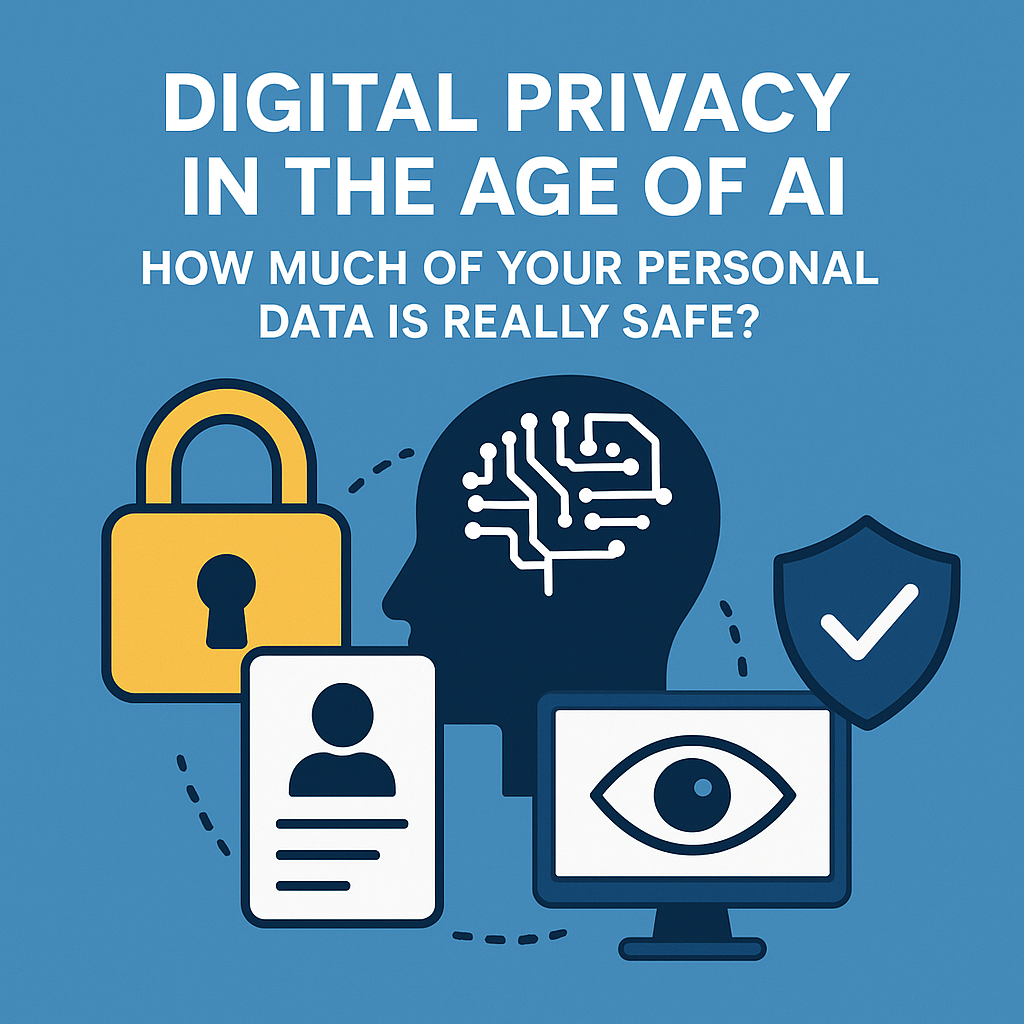
Digital Privacy in the Age of AI: How Much of Your Personal Data Is Really Safe?
AI is everywhere—writing emails, recommending products, detecting fraud, translating languages, and even generating images and videos that look real. But as artificial intelligence becomes more useful, it also becomes more dependent on data. That raises an urgent question for everyday people: How much of your personal data is really safe in the age of AI?In this post, we’ll break down what “privacy” means online, why AI changes the risk landscape, what types of data are most vulnerable, and—most importantly—what practical steps you can take to protect yourself. This isn’t fear-mongering; it’s empowerment. You don’t have to stop using the internet or avoid AI tools. You just need to understand the trade-offs and tighten your digital habits.
What “Digital Privacy” Actually Means
Digital privacy isn’t just about hiding your identity. It’s about controlling how your information is collected, used, stored, shared, and inferred. When you browse a website, sign up for an app, or upload a photo, your data can travel through many hands—sometimes invisibly.Here are the common “privacy surfaces” you might not think about:Data collection: Websites and apps gather information through forms, cookies, device identifiers, location services, and more.Data processing: Companies analyze your behavior—what you click, how long you watch, what you search, and which ads you interact with.Data sharing: Data can be shared with advertising partners, analytics vendors, cloud services, contractors, and sometimes other businesses in a corporate network.Data retention: Even if you delete something, backups and logs may keep it for a while. “Deleted” doesn’t always mean “gone forever.”Data inference: Even if you don’t share “sensitive” data directly, patterns can reveal it. For example, your browsing and purchase habits can suggest health conditions, political leanings, or financial status.AI makes inference even stronger. It can combine small signals into powerful predictions—sometimes more accurate than what a human analyst could achieve.
Why AI Changes the Privacy Game
Traditional data tracking already created privacy concerns. AI doesn’t replace that; it amplifies it. Here’s why.
1) AI can reuse data in ways you didn’t expect
Many AI systems are trained on large datasets. Depending on the service, training data might include user inputs, publicly available information, device telemetry, or third-party data. Even when services claim your data isn’t used for training, it can still be processed for personalization or safety checks.Key privacy issue: The purpose of processing may expand over time (for example, from “provide a feature” to “improve models” to “train future versions”).
2) AI can infer sensitive attributes from non-sensitive data
Even if you never type your medical condition, AI can sometimes infer it from your searches, app usage, location patterns, or purchases. This is called data inference. It’s one of the biggest threats because it means privacy risk isn’t limited to what you explicitly provide.
3) AI can increase re-identification risk
Some datasets are de-identified—meaning names are removed. But re-identification is still possible when data points can be combined (for example, by matching timestamped locations, device traits, or unique behavior patterns). AI can make these matches more efficient.
4) AI services may be shared across ecosystems
AI-powered apps often integrate with ad networks, analytics platforms, and social media. That ecosystem can create a chain of data sharing you can’t fully see.
So… How Much of Your Personal Data Is Really Safe?
The honest answer is: It depends. Your data can be safe in some circumstances and exposed in others. “Safe” depends on:Where your data lives: Is it stored securely with strong encryption, or accessible to many internal systems?Who has access: Are there strict permissions and auditing? Or is it broadly shared?What it’s used for: Is it used only for providing a feature, or also for analytics, ads, and training?How long it’s retained: Short retention windows generally reduce exposure.What the security posture is: Regular patching, incident response plans, and compliance standards matter.Even the best companies can be involved in breaches, misconfigurations, or third-party sharing that increases risk. In the AI era, the risk is not only about hackers. It’s also about the normal operation of platforms that collect and process data continuously.
What Types of Personal Data Are Most at Risk?
Not all data carries the same privacy weight. Some categories are more sensitive and more likely to be misused or inferred.
Sensitive data
This includes health information, biometrics (like fingerprints or facial scans), precise location tied to daily routines, financial details, and sometimes even children’s data.
Behavioral data
Clickstream data, browsing history, watch time, and app interactions may look harmless, but they can reveal a lot. AI personalization can also get extremely specific, making your behavior identifiable by patterns alone.
Location data
Location is powerful context. Even if your name isn’t attached, location trails can identify you. This is why location sharing is one of the highest-risk permissions on mobile devices.
Device identifiers
Advertising IDs, browser fingerprints, and unique hardware signatures can track you across sessions and sometimes across apps. AI can help link fragments of data into a consistent profile.
Social graph and content
What you post, who you interact with, who you follow, and what you “like” can all reveal private traits. AI-generated content also complicates consent: if your data is used to train models or build “styles,” your influence might persist beyond what you intended.
Common Privacy Myths in the Age of AI
Myth #1: “If I use incognito mode, I’m invisible.”
Incognito/private browsing can stop some local storage, but it doesn’t hide your activity from websites, your ISP, or your employer/school network. AI-based services can still log requests and infer identity from device and network traits.
Myth #2: “If the app is free, you’re the product.”
Often, yes. Many free services monetize through advertising, analytics, or data-driven targeting. AI improves targeting efficiency—meaning the economic incentive to collect data can be even stronger.
Myth #3: “Deleting an account deletes my data.”
Sometimes deletion is partial. Backups, logs, legal retention, and model training datasets can keep data longer than expected. Always check the privacy policy and deletion terms.
Myth #4: “AI companies don’t keep my prompts.”
Some do, some don’t, and many keep data for a period for moderation, debugging, or safety. Even if they don’t train on your inputs, the processing and retention policy matters.
Practical Steps to Protect Your Privacy (Without Quitting the Internet)
Now for the part that matters: what can you do today? You can’t eliminate risk, but you can reduce it significantly.
1) Audit your permissions
On your phone and computer, review permissions for location, microphone, camera, contacts, photos, and background activity. Turn off what you don’t need. Pay special attention to location—use “While Using” instead of “Always.”
2) Control your advertising tracking
Use built-in controls to limit ad personalization:On mobile: Disable ad personalization (where available) and reset advertising identifiers if offered.On desktop browsers: Adjust cookie settings and block third-party cookies.Consider: privacy-focused browser extensions (use reputable sources) that reduce tracking.
3) Use stronger authentication
Enable multi-factor authentication (MFA). This doesn’t directly stop data collection, but it reduces the chance someone can access your accounts and data in the first place.
4) Be careful with what you put into AI tools
If you use AI assistants, avoid sharing:Passwords, account numbers, or private documentsMedical details unless the tool explicitly explains strong privacy protectionsExact location details if it’s not necessaryInstead, use general descriptions. For example, talk about “my budget constraints” rather than uploading tax forms or including personal identifiers.
5) Choose services with clearer privacy controls
When possible, prefer platforms that:Offer transparent privacy settingsMinimize data retentionAllow opt-outs for data sharing and ad personalizationExplain training policies for AI featuresLook for plain-language privacy policies—not just legal jargon.
6) Encrypt where you can
Use secure messaging apps with end-to-end encryption for sensitive conversations. Encrypting storage (like enabling device encryption) also helps if your device is lost or compromised.
7) Keep your software updated
Security updates often patch vulnerabilities that could expose stored data. AI apps and browsers are software too—keeping them updated reduces risk.
8) Reduce the “data exhaust” you generate
You can’t stop all tracking, but you can reduce it:Browse less while logged into everything (or use separate profiles/accounts).Limit app background data permissions.Disable unnecessary analytics in your accounts when options exist.
How to Read an AI Privacy Policy Like a Pro
Privacy policies can be dense, but you can scan for key signals:What data is collected? (inputs, metadata, location, device identifiers)How is it used? (service delivery, personalization, ads, model training)Is it shared? (third parties, advertisers, affiliates)How long is it retained? (retention duration and criteria)Is there an opt-out? (ads, analytics, training)Security measures? (encryption, access controls, audits)If you can’t find answers to these questions, that’s itself a red flag.
The Future of Privacy: What Comes Next
AI is likely to get more powerful and more integrated into daily life. That means privacy will be a moving target. However, several trends could improve outcomes:Privacy-enhancing technologies (PETs): Techniques like differential privacy, federated learning, and secure enclaves can reduce exposure.Stronger regulation: GDPR-style rules and other data protection laws push companies toward clearer consent and stronger security.Better user controls: More platforms are offering dashboards to manage data sharing and ad personalization.Model governance: Responsible AI practices are increasingly expected, especially for systems handling sensitive information.Still, improvements in technology and policy won’t eliminate personal risk. That’s why your choices matter.
Bottom Line: “Safe” Is a Spectrum, Not a Switch
In the age of AI, personal data is rarely “fully safe” by default. But it can be safer than you think—and safer than it would be without your awareness.Focus on what you can control:Limit permissionsReduce trackingBe selective with AI inputsStrengthen account securityChoose tools with clear privacy practicesThe goal isn’t paranoia. It’s informed confidence—knowing what’s happening behind the scenes and taking steps to keep your personal life from becoming raw material for predictions you never agreed to.If you’d like, tell me your target audience (general readers, tech-savvy, parents, small business owners, etc.) and I can tailor the tone, examples, and even add a short FAQ section to strengthen the article for search and reader engagement.