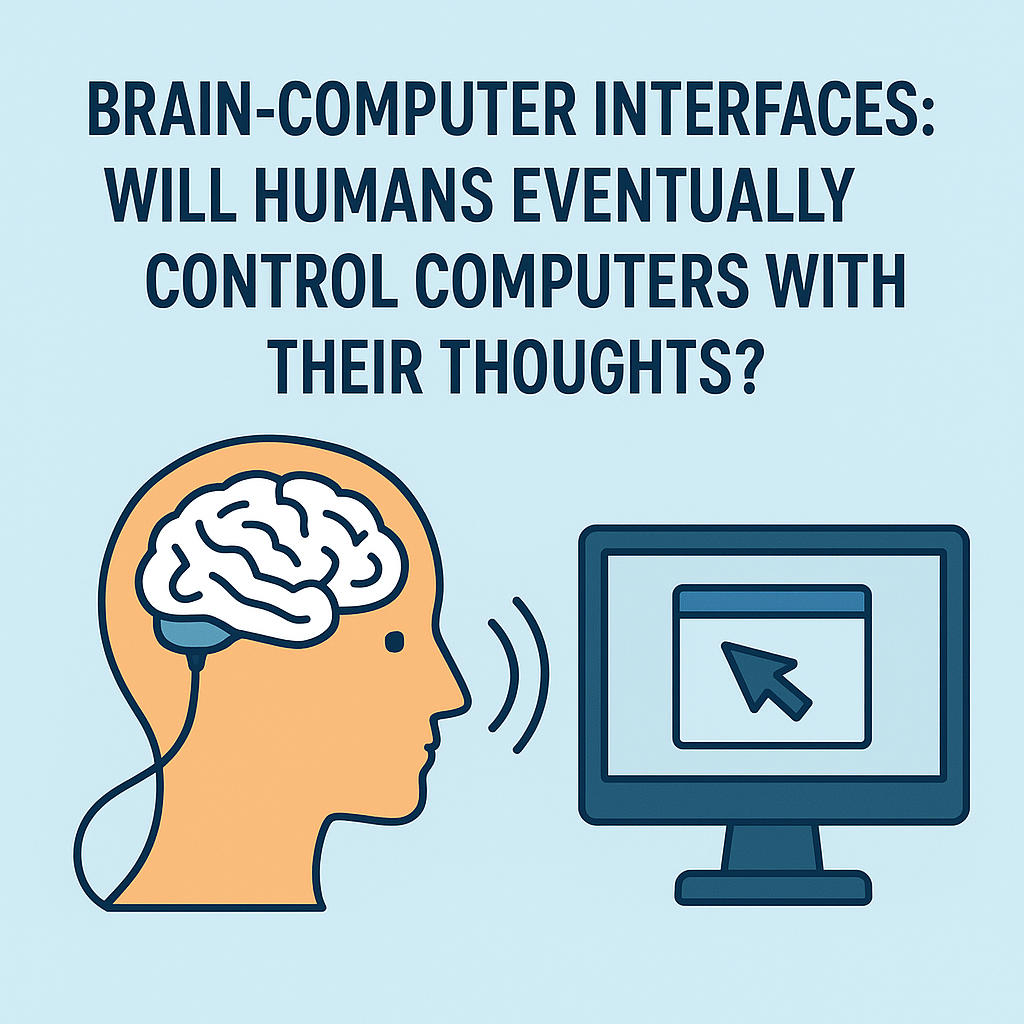
Brain-Computer Interfaces: Will Humans Eventually Control Computers With Their Thoughts?
Imagine sitting down at your desk, putting on a light headband, and thinking: “Open the report”. Without touching a keyboard or a mouse, the computer follows your command. It sounds like science fiction, but Brain-Computer Interfaces (BCIs) are pushing us closer to that reality—one experiment, one medical breakthrough, and one carefully trained algorithm at a time.BCIs are systems that translate brain activity into computer actions. They can help people who cannot use traditional input devices (like paralysis patients) communicate, control a cursor, or even select letters. In the long run, the most exciting question isn’t only whether we can read brain signals. It’s whether humans can eventually control computers smoothly, naturally, and at scale—with thoughts.
What Is a Brain-Computer Interface?
A Brain-Computer Interface is a technology that creates a communication pathway between the brain and an external device. In simple terms, it involves:1) Capturing brain activity (using sensors such as electrodes on the scalp, on the skin near the brain, or in more invasive cases).2) Decoding the signal (using machine learning or signal-processing methods).3) Translating the decoded information into commands (cursor movement, text selection, clicks, or robotic control).4) Feedback and adaptation (the user and system often improve together over time).Some BCIs are non-invasive (outside the skull), while others are invasive (implanted). Non-invasive options typically use EEG (electroencephalography), which measures electrical activity from the scalp. Invasive BCIs can measure more precise neural signals but involve surgery and long-term medical considerations.
BCI Today: More Practical Than You Might Think
While “thought-controlled computers” are not yet mainstream, BCIs already do important, real-world things. In clinical settings, research has shown that people can control cursors, spell out words, choose options on screens, and drive basic movements for communication or assistive technology.
How Thought-Control Works (In Plain Language)
“Thinking” is not a single, uniform signal. Your brain produces complex electrical patterns—rhythms, spikes, and patterns that vary by intention. A BCI works by finding consistent features in those patterns that correspond to actions.There are several common approaches:
1) Motor imagery
Users imagine moving a hand or foot. The brain produces recognizable patterns related to that intention. Over time, the system learns how a person’s motor imagery maps to commands like “move left” or “select.”
2) P300 event-related potentials
This method detects brain responses when a target appears, such as when letters flash on a screen. If you mentally focus on a letter, your brain generates a distinctive pattern. BCIs can exploit that to help users spell words.
3) Signal detection and classification
Machine learning models classify brain activity into categories (e.g., “yes/no,” “cursor up/down”). The system doesn’t “read thoughts” like a mind-reading device—it estimates likely intent from patterns.
Will Humans Eventually Control Computers With Their Thoughts?
The short answer: eventually, yes—at least in limited, specialized ways. The longer answer is more nuanced. Full, frictionless control of any computer task purely through thoughts remains a major engineering and neuroscience challenge. But progression is happening—especially in areas like assistive communication, cursor control, and single-application command systems.To understand what “eventual control” could mean, consider three levels:
Level 1: Basic commands
Examples: selecting letters, choosing menu items, moving a cursor slowly, controlling a limited set of device functions. This is already feasible in research and some clinical applications.
Level 2: Natural interaction
Examples: faster selection, reduced training time, better accuracy, and more fluid control—like using your mind as a primary input method alongside speech or eye tracking.
Level 3: Broad, everyday control
Examples: writing emails, navigating complex software, gaming, and managing multiple apps reliably without constant recalibration. This level requires breakthroughs in signal quality, decoding, user comfort, and robust real-world performance.Most experts believe we’ll move toward Level 2 first, and Level 3 will take longer. The key question is not only whether BCIs can decode brain activity, but whether they can do it reliably across different environments, over long time spans, and for many different users.
The Biggest Challenges Holding BCIs Back
Signal noise and variability
Brain signals are subtle and easily disrupted by noise (muscle movement, electrical interference, attention changes, fatigue, stress). Even two sessions in the same person can differ.
Accuracy vs. usability
If a BCI makes frequent mistakes, users lose trust—and the system becomes frustrating. Researchers are working to reduce false selections and improve consistency, but this is a hard problem outside controlled labs.
Training and calibration time
Many BCIs require time for the user and the system to “learn” each other. In the long term, we want plug-and-play interfaces that work with minimal setup.
Non-invasive limitations
EEG is safer and more accessible, but the resolution is limited. Invasive BCIs can capture more detailed signals but raise medical and ethical concerns.
Latency
Humans are sensitive to delay. If the computer responds too slowly, interaction feels unnatural and can cause cognitive strain. Improving speed and responsiveness is essential.
Invasive vs. Non-Invasive BCIs: What’s the Difference?
Non-invasive BCIs (often EEG) measure electrical signals from the scalp. They are generally safer, easier to deploy, and better suited for consumer research. However, they may struggle with fine-grained control.Invasive BCIs (implanted electrodes) can provide higher-quality data. They may be more capable of complex control, but involve surgical risks and long-term maintenance. For many people, the primary goal is medical: restoring communication or enabling control for those who need it most.The future likely includes multiple options: non-invasive tools for general interaction and selective medical-grade systems for high-precision tasks.
BCIs and Artificial Intelligence: The Decoder Revolution
One reason BCI progress has accelerated in recent years is machine learning. AI can detect patterns in brain signals that are difficult to interpret manually. In other words, the BCI becomes smarter at translation—turning brain activity into commands.Some systems use:Deep learning to model complex signal patternsAdaptive algorithms that update over time as the user changesPersonalized calibration that improves accuracy for each individualIn the future, we may see “personal neural profiles” that allow faster setup and smoother performance across apps.
How Might Thought-Control Computers Work in Daily Life?
Let’s explore plausible scenarios that don’t require mind-reading in the literal sense:
Scenario A: BCI + Eye Tracking = fast selection
Many interfaces already use gaze direction. Combining gaze with brain signals could reduce the “work” the user needs to do mentally—making selection quicker and more accurate.
Scenario B: Focus-based commands
Instead of controlling everything with pure intent, users might “focus” on highlighted options, while the BCI interprets those attention signals.
Scenario C: Mental shortcuts for repetitive tasks
Think of a BCI that accelerates actions like scrolling, selecting, or triggering common actions—while speech and gestures handle the rest.
Scenario D: Adaptive UI designed for brains
As BCIs mature, software will likely evolve. Interfaces could display tasks in ways that produce clearer brain responses—similar to how earlier assistive tech was designed around predictable input patterns.This “co-design” between brain signals and software could be a major breakthrough that makes BCIs practical for everyday use.
Gaming, Virtual Reality, and the “New Input Method”
It’s tempting to jump straight to video games. But gaming is actually a challenging environment for BCIs because it’s dynamic and requires fast reactions. Still, BCI researchers are experimenting with immersive control for VR and other interactive systems.In the long run, brain-based input could change how we interact with virtual environments: focusing, aiming, or selecting might become more direct. However, if the BCI requires constant mental effort or frequent corrections, it may not feel like a true upgrade.
Ethics, Privacy, and Brain Data Security
Any technology that measures brain activity raises serious ethical questions. Even if BCIs don’t “read your thoughts” like a movie, brain signals can still reveal patterns about attention, intent, and potentially mental states.Key concerns include:Privacy: Who owns the data? How is it stored?Consent: Are users fully informed about what’s being measured?Security: Could brain data be hacked or misused?Surveillance risk: Could BCIs be forced in workplaces or schools?Bias and fairness: Will systems work equally well across demographics and different neuroprofiles?For AdSense-approved educational content, it’s important to emphasize: the field must grow responsibly. Strong regulations and transparent research practices will matter as much as technical performance.
The Future Timeline: When Will This Be Mainstream?
No one can promise an exact date, but a reasonable outlook looks like this:Near term (years): improvements in non-invasive performance, better assistive communication tools, and more user-friendly setups.Medium term (decade-ish): more reliable consumer-grade BCIs for limited command sets, smoother integration with existing inputs (speech, gaze, controllers).Long term (beyond): broader control interfaces with reduced training and higher fidelity—possibly approaching “thoughtful control” in everyday computing for certain tasks.Remember: “mainstream” doesn’t mean everyone can control every app with perfect accuracy. It could first mean that BCI input becomes useful enough to replace certain physical actions for many users.
Will We Ever Achieve Perfect Mind-Reading?
It’s important to clarify a common misconception: most BCIs do not decode entire thoughts like a direct movie of someone’s mind. Instead, they interpret measurable brain patterns related to specific intents.Perfect mind-reading would require understanding and capturing extremely complex neural information at a scale that current technology cannot reliably do non-invasively. The goal of most BCI research is more practical: communication, control, and assistance.So the more realistic dream is not “reading thoughts,” but building systems that understand enough about intention to act accurately—like a highly trained translator between brain activity and computing actions.
What This Means for Human-Computer Interaction
Whether BCIs become the primary input method for everyone is uncertain. But even partial adoption could reshape how we think about computing. Input might become multimodal: brain + eye + voice + touch. The computer could become more adaptive, responding to intention rather than just commands.In many ways, BCIs represent a shift from keyboard-centric computing to meaning-centric computing. Instead of forcing people to translate intent into physical actions, the interface could translate intent into digital tasks.
Conclusion: The Thought-Control Future Is Closer Than It Sounds
Brain-Computer Interfaces are already moving from labs to real impact—especially for assistive communication and device control. The idea of humans controlling computers with thoughts is not a distant fantasy. It’s a technical and ethical journey toward more direct interaction.In the near future, BCIs will likely enable reliable, limited command control—spelling, selecting, cursor movement, and adaptive shortcuts. In the longer run, improvements in signal decoding, AI-based interpretation, and interface design could make brain-controlled computing feel more natural and accessible.So will humans eventually control computers with their thoughts? Yes, in meaningful ways. And as the technology matures, “thought control” may become less like mind-reading and more like a new form of input—one that expands what humans can do with technology.If you want, I can also create: (1) an SEO-focused version with a meta description and FAQ schema, (2) additional sections tailored for medical vs. consumer audiences, or (3) a shorter 700–900 word AdSense-friendly variant.