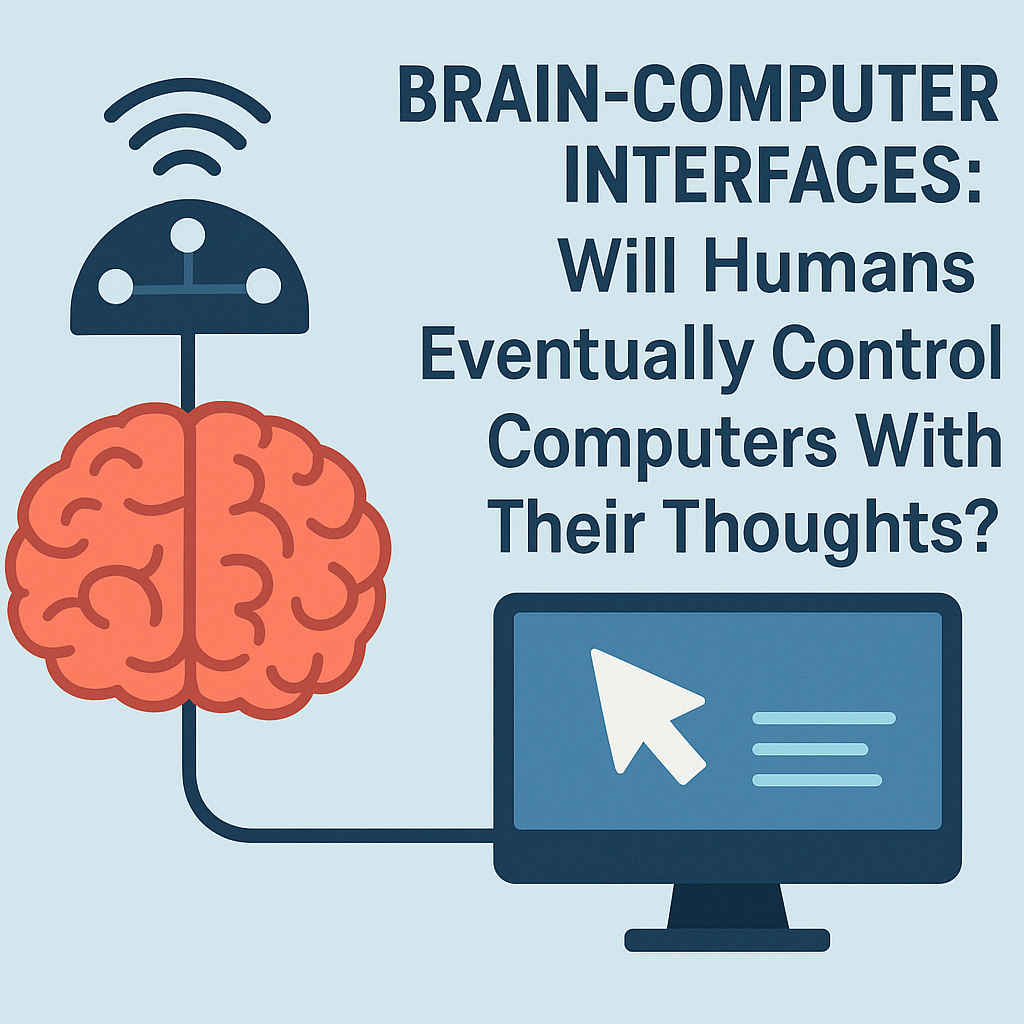
Brain-Computer Interfaces: Will Humans Eventually Control Computers With Their Thoughts?
Imagine sitting at your desk and moving a cursor—without a mouse, without a keyboard—simply by thinking. For years, that idea sounded like science fiction. But brain-computer interfaces (BCIs) are turning it into an increasingly real technology, enabling communication and control by translating patterns of brain activity into commands computers can understand.So will humans eventually control computers with their thoughts? The honest answer is: partly, and in some ways already. Today’s BCIs can help people type, communicate, and control assistive devices. In the future, they may offer more natural, faster control for a broader range of users. However, making thought-based control ubiquitous—safe, accurate, affordable, and comfortable—will require solving major technical and ethical challenges.
What Is a Brain-Computer Interface (BCI)?
A brain-computer interface is a system that connects the brain to an external device. Instead of relying on muscles (like speaking, typing, or moving a joystick), a BCI reads neural signals—electrical activity, measured either directly from the brain or indirectly from the scalp—and converts them into commands.BCIs generally involve four main steps:1) Signal acquisition: electrodes or sensors detect brain activity.2) Signal processing: the system filters and extracts meaningful patterns.3) Feature translation: algorithms map brain signals to actions (like cursor movement).4) Output: the computer or device performs the requested action (communication, control, selection, etc.).
How Do BCIs Read Thoughts? (Not “Mind Reading”)
A common misconception is that BCIs “read thoughts” like a movie. In reality, current BCIs don’t translate complex thoughts or entire sentences directly from brain activity. Most BCIs detect patterns related to attention, intent, motor imagery, or other cognitive states, then convert those patterns into restricted commands.For example:Motor imagery BCIs ask a user to imagine moving a limb. The brain activity changes in recognizable ways, allowing the system to interpret “left vs. right” or “move vs. stop.”P300 spellers detect brain responses to visual cues. When a user focuses on a letter on the screen, the brain generates a recognizable electrical signature. The system uses that signal to select the intended character.Steady-state visual evoked potentials (SSVEP) measure brain responses to flickering lights at specific frequencies, letting the user choose commands based on which stimulus the brain locks onto.In short: BCIs are control interfaces, not instant telepathy. But even “limited control” is transformative—especially for people who cannot communicate or move normally.
BCIs Today: From Assistive Communication to Real Control
BCI research has made significant progress. Some systems allow users with severe paralysis to communicate via text or select letters on a screen. Others help control robotic arms or cursor movements with high precision in controlled settings.
1) Communication for People With Disabilities
One of the most impactful uses of BCIs is communication. Technologies like the P300 speller have supported users in selecting letters and constructing words. More advanced approaches use neural decoding to enable faster communication—sometimes with continuous cursor control rather than step-by-step selection.
2) Cursor and Device Control
Motor-imagery and neural decoding systems can translate brain activity into cursor movement or navigation commands. This is a key milestone: “computer control with thoughts” becomes realistic when the interface supports continuous actions rather than just selecting a pre-defined option.
3) Brain Signals and Robotic Assistance
Some experiments explore direct control of robotic devices. In these cases, the BCI translates neural signals into commands like reach, grasp, or movement trajectories. While not perfect, these systems demonstrate that the brain can generate patterns that reliably correspond to intended actions.
Types of BCIs: Invasive, Non-Invasive, and Hybrid Approaches
BCIs vary widely depending on how they measure brain activity.
Invasive BCIs
Invasive BCIs use electrodes implanted in or on the brain. Because they capture neural signals more directly, they can potentially provide higher resolution and better control. The tradeoff is surgical risk, long-term maintenance concerns, and ethical considerations.
Non-Invasive BCIs
Non-invasive approaches—like EEG (electroencephalography)—use sensors placed on the scalp. They are safer and more accessible, but they generally have lower signal quality and are more affected by noise. Many non-invasive BCIs require training and may have slower speeds.
Hybrid BCIs
Hybrid systems combine different sensing methods and/or combine brain signals with other inputs. For instance, a user might control some aspects with brain activity and others with eye tracking or muscle-based signals. This can improve usability and reduce the cognitive load.
Will Humans Control Computers With Thoughts? The Practical Path to That Future
The “eventually” in the question matters. In the short term, brain-controlled interaction is likely to expand in specific areas:
1) Medical and Assistive Use First
Most realistic deployment begins where the benefits are immediate and the risk is justified—helping people communicate or regain some independence. As the technology matures, safer designs and improved decoding may make broader adoption possible.
2) Gradual Improvements in Accuracy and Speed
Thought-based control depends on signal quality and decoding algorithms. Over time, developers aim to:• Improve signal processing to reduce noise and increase reliability• Enhance machine learning models for better interpretation of intent• Reduce calibration time so users can get started faster• Increase bandwidth to support more complex actions (not just selecting letters)
3) Better User Training and Adaptation
BCIs often involve training both the user and the system. Eventually, interfaces may become more adaptive—learning from the user over time and requiring less conscious effort. This is a major factor in whether “thought control” feels natural rather than exhausting.
4) More Natural Interaction: From Commands to “Intent”
Current systems often map brain signals to discrete commands. A future “computer control with thoughts” may involve more fluid interaction—like shaping a cursor trajectory, controlling multiple dimensions, or interacting with objects in a virtual environment.
What Makes Thought-Based Control Hard?
To get from experimental demos to everyday control, several barriers must be addressed.
Signal Variability
The brain is not a stable signal generator. Stress, fatigue, attention, and even the device itself can change how signals appear. A high-performing BCI must handle variability across time and conditions.
Accuracy vs. Usability
If a system misinterprets intent too often, users will lose trust and the experience becomes frustrating. In real-world settings, the system must be robust to distractions and different cognitive states.
Wearability and Comfort
Non-invasive devices can be uncomfortable, require setup, or rely on good electrode contact. Invasive devices raise entirely different concerns, including surgical risks and long-term biocompatibility.
Latency (Response Time)
For interaction to feel intuitive, the BCI must respond quickly. High latency can break the sense of control and reduce performance.
Security and Privacy
Brain data is highly sensitive. Even if BCIs don’t read “full thoughts,” neural patterns could potentially reveal behavior, attention, or health information. Protecting this data—and ensuring it can’t be exploited—is essential for adoption.
Ethical Questions: Who Controls the Interface?
Even if BCIs become powerful, the ethical landscape will determine how they are used.
Consent and Autonomy
Users must maintain autonomy over when the device is active and what actions it triggers. The interface should not coerce or manipulate behavior.
“Thought Privacy”
The concept of privacy in BCIs is still evolving. Regulations may need to treat neural data as a special category of personal information.
Bias and Fairness
BCI systems trained on certain populations may perform differently for others. Ensuring inclusivity—across age, physical differences, and neurological variation—is critical.
Access and Cost
Even breakthroughs can widen inequality if the technology is expensive or limited to specific institutions. Public policy and responsible commercialization can help prevent a “neurotech divide.”
Possible Future Uses Beyond “Controlling Computers”
Thought-based control doesn’t have to be limited to typing or cursor movement. If BCIs become more reliable, they could support:• Learning and training tools: feedback loops that detect attention and adjust content.• Gaming and immersive VR: control based on intent rather than button presses.• Communication aids: faster, multilingual communication for people with speech impairments.• Smart prosthetics: more intuitive control of limbs and assistive devices.• Cognitive health monitoring: signals that help detect fatigue, stress, or neurological changes (with strong privacy safeguards).Importantly, many of these applications could improve quality of life long before fully generalized thought-controlled computers arrive.
What About “Mind Reading” and Complete Thought-Control?
It’s worth addressing the hype. While BCIs may decode certain neural states and intentions, full mind reading—accurately translating thoughts into words or images—is not something current science supports. The brain’s patterns are complex and context-dependent. Also, subjective experiences are not easily mapped to a universal decoding scheme.However, partial decoding—detecting intent, focus, or specific actions—is enough to enable powerful tools. The “computer control” future may rely on intention decoding rather than literal thought interpretation.
How Soon Could This Happen?
Predicting timelines is difficult, but here’s a realistic way to think about it:Near term (today to a few years): incremental improvements in assistive communication and device control, especially with hybrid approaches and better algorithms.Mid term (several years): more reliable, faster non-invasive or minimally invasive systems; broader experiments in consumer-adjacent applications (though likely still limited).Long term (decade+): the possibility of more natural, higher-bandwidth thought-based interaction—if safety, affordability, and usability keep improving.“Eventually” could mean that, for many people, thought-based control becomes common in specific contexts—clinics, rehabilitation, assistive tech—before widespread everyday consumer use.
The Bottom Line: Will We Control Computers With Thoughts?
Yes—in some forms, already. BCIs can translate brain activity into commands for communication and device control. Over time, we can expect more fluid interaction, faster performance, and more comfortable designs.But the path to universal “thought-controlled computers” is not automatic. It depends on solving technical challenges (signal quality, decoding, latency), addressing human factors (training, fatigue, user comfort), and handling ethics (privacy, consent, security, fairness).So instead of one dramatic leap, the future is likely to be a series of breakthroughs that progressively make brain-based control more accurate, accessible, and safe. The most exciting part is that every improvement brings us closer to a world where technology can respond to intent—sometimes before you even move a muscle.
FAQ: Quick Questions About BCIs
Are BCIs safe?
Non-invasive BCIs (like EEG) are generally considered safer than invasive implants, though they still require careful design to avoid discomfort or misuse. Invasive BCIs involve surgical risks and require long-term evaluation.
Do BCIs actually read thoughts?
Most current BCIs do not “read thoughts” in the sci-fi sense. They detect patterns associated with intent, attention, or imagined movements and translate them into commands.
Will I be able to control my computer with my mind one day?
Possibly. Thought-based control is already possible for specific tasks. Wider consumer-level adoption depends on improving performance, ease of use, and affordability while ensuring strong privacy protections.
What about privacy?
Neural data is sensitive. Future systems should use strong encryption, clear consent, and policies that restrict how brain data is stored and used.If you want to follow this topic, keep an eye on advances in signal processing, more robust non-invasive sensing, and human-centered design—because the real breakthrough won’t just be better decoding. It will be making brain-computer interaction feel natural, safe, and empowering.