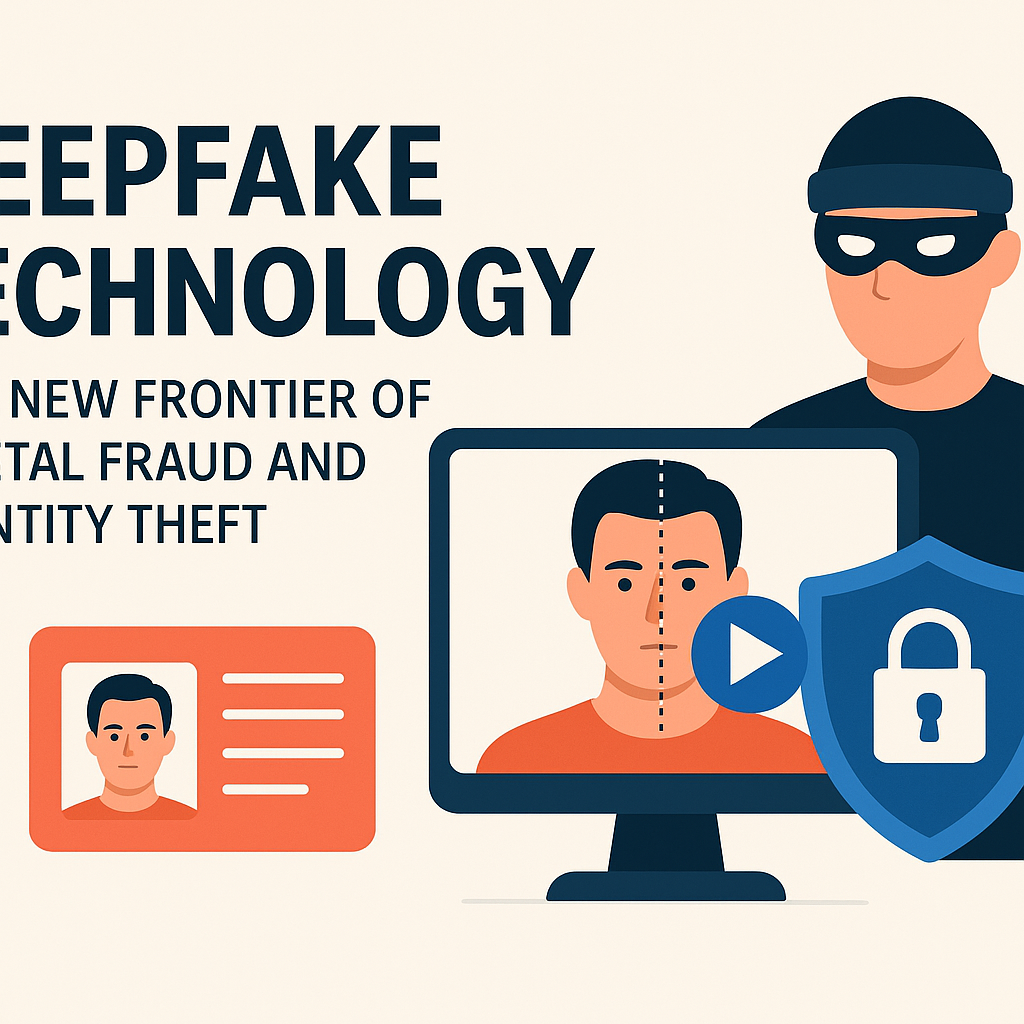
Deepfake Technology: The New Frontier of Digital Fraud and Identity Theft
Deepfake technology has moved from science-fiction to everyday reality. With the help of advanced AI tools, it’s now possible to generate highly convincing fake videos, audio recordings, and even “live” virtual identities. While deepfakes can be used for entertainment, creative storytelling, and accessibility, they have also become a powerful weapon in the hands of fraudsters—especially when it comes to digital fraud and identity theft.In this blog post, we’ll explore how deepfakes work, why they’re so effective, which fraud schemes they enable, and—most importantly—how individuals and businesses can protect themselves. If you’ve ever wondered how someone could impersonate your voice, mimic your face, or bypass verification systems that once seemed secure, this is the guide you’ve been looking for.
What Are Deepfakes?
The term deepfake comes from combining “deep learning” and “fake.” Deepfake technology uses machine learning models to create or alter content—such as:
Videos that replace a person’s face with someone else’s
Audio that imitates a person’s voice
Live impersonations where a person appears in real time via AI-generated visuals
Modern deepfake systems are capable of producing results that can look and sound remarkably real, even to the untrained eye. That realism is what makes deepfakes so dangerous for identity verification and financial security.
Why Deepfakes Are So Effective at Fraud
Traditional impersonation fraud relied heavily on social engineering—tricks like convincing someone over the phone, forging documents, or using stolen identity information. Deepfakes upgrade these methods by adding a new level of “proof.”Fraudsters don’t just ask for money anymore; they try to simulate legitimacy. They can use AI to create a convincing video of a CEO “approving” a payment or produce a voice message that sounds exactly like a family member requesting urgent help.Several factors make deepfakes particularly effective:
Trust bias: People tend to believe what they see and hear, especially when the content looks professional.
Emotional urgency: Many fraud messages include threats, emergencies, or time pressure to prevent verification.
Verification fatigue: In workplaces and customer support environments, people process messages quickly and may not have time for deeper checks.
Scarcity of expertise: Most users aren’t trained to detect synthetic media.
The Most Common Deepfake-Enabled Fraud Scenarios
Deepfakes can be used to commit a wide range of crimes. Below are some of the most common patterns seen today.
1) Voice Cloning and “Emergency” Impersonation
Voice cloning is one of the most widely abused deepfake techniques. A scammer might imitate a parent, spouse, or friend and claim there’s an emergency—like a car accident, a medical issue, or a sudden inability to access funds.The scam often includes a request for money via wire transfer, gift cards, prepaid debit cards, or cryptocurrency. The goal is to trigger panic and prevent the victim from verifying the claim through a second channel.
2) Video Impersonation for Business Email and Payment Fraud
In business settings, deepfake videos can be used to impersonate executives or employees during high-stakes moments—such as approving invoices, changing bank details, or authorizing refunds.A fraudster might send a “recorded” video message showing a manager instructing staff to transfer funds. Even if employees suspect something is off, time pressure and the appearance of authority can make them act quickly.
3) Synthetic Identity Creation
Identity theft isn’t always about stealing a real person’s information—it can also be about creating a synthetic identity that combines real and fake data. While deepfakes alone don’t produce a full synthetic identity, they can add a convincing “human layer” when fraudsters must validate identity using facial images, audio calls, or video interviews.For example, scammers may use AI-generated facial media to pass certain onboarding steps, especially in systems that rely heavily on document uploads or face matching without strong liveness checks.
4) Account Takeover Through “Proactive” Verification
Some fraudsters combine deepfakes with other techniques like phishing and social engineering. They may:
Call the victim while pretending to be a bank or support agent
Use a deepfake voice to confirm “security” questions
Encourage the victim to share one-time codes
Even when banks and platforms warn customers not to share verification codes, scammers can increase success rates when they sound exactly like someone trusted or when they create a realistic scenario.
5) Scare Tactics and Extortion
Deepfake pornography and fabricated compromising videos have become a well-known threat. In extortion schemes, criminals may send a victim a message claiming they have made a fake explicit video and threaten to distribute it unless money is paid.This is not just a “public embarrassment” risk; it can lead to serious emotional distress and financial harm. Many victims feel trapped because verifying the fake content can be difficult under time pressure.
How Deepfakes Affect Identity Verification
Most digital identity systems use a combination of factors. Deepfakes challenge several of them:
Face-based verification: AI-generated images can sometimes mimic a person’s appearance.
Voice biometrics: cloned audio can imitate speech patterns and tone.
Document and selfie checks: fraudsters may pair forged documents with synthetic facial media.
Human approval: even when systems flag anomalies, humans may override warnings under pressure.
That’s why modern defenses increasingly rely on liveness detection and multi-factor verification. A secure approach assumes that any single method can be manipulated—and builds verification in layers.
Can You Spot a Deepfake?
You can sometimes spot deepfakes by looking for inconsistencies, but it’s not always reliable. Many deepfakes improve rapidly and may pass basic “tells.” Still, here are a few signs that might indicate synthetic media:
Unusual blinking or eye behavior (eyes may look “off” or fixed)
Artifacting around edges (hairlines, glasses frames, or transitions)
Background inconsistencies (lighting, shadows, or motion mismatch)
Audio oddities (robotic cadence, inconsistent pronunciation, or mismatched background noise)
Timing and context issues (the message is urgent, unexpected, or asks for unusual action)
However, you should never rely solely on visual or auditory cues. The safest mindset is: treat unexpected synthetic-looking media as suspicious and verify independently.
Practical Protection Tips for Individuals
Deepfake fraud prevention starts with habits. Here are actionable steps you can take right now.
1) Verify via a second channel
If you receive a message that seems urgent—especially one requesting money—do not respond immediately. Instead, verify through a separate method. For example, if the message came by phone, call the person back using a number you already know. If it came via email, confirm using a known contact method.
2) Use multi-factor authentication (MFA)
Enable MFA on your email and financial accounts. If possible, use app-based authenticators or security keys rather than SMS alone. Deepfakes can increase the odds of social engineering, but strong MFA reduces account takeover.
3) Be cautious with voice and video apps
Avoid sharing sensitive personal details during calls, and assume that any recording could be used out of context. If you suspect your voice has been cloned, contact the platform and consider securing additional accounts.
4) Don’t share one-time codes
No legitimate institution will ask for your one-time verification code. Train yourself and your household to treat code sharing as a red flag.
5) Document and report quickly
If you’re a victim of deepfake extortion or identity fraud, gather evidence (screenshots, messages, timestamps) and report it promptly. Early action improves your chances of limiting damage.
Protection Tips for Businesses and Organizations
For companies, deepfake threats can scale quickly—especially when fraud targets employees with privileged access. A strong defense requires technology plus policy.
1) Use liveness detection and stronger identity checks
When verifying users via face or voice, businesses should use solutions designed to detect synthetic media. Liveness checks (like challenge-response prompts) are often more robust than static image or audio matching.
2) Implement “out-of-band” approval workflows
For high-value actions (wire transfers, bank detail changes, refunds), require approvals through a separate channel. For instance, payment authorization must be confirmed via an internal system—not via video messages alone.
3) Train employees for “urgent impersonation” scams
Short, frequent training beats one-time instruction. Employees should learn to recognize urgency, unusual payment requests, and identity mismatch cues—and know exactly how to report suspected deepfakes.
4) Monitor for anomalies
Use monitoring tools to detect unusual logins, atypical transaction amounts, new device usage, or odd communication patterns. Fraudsters often leave behavioral traces even if the media looks perfect.
5) Prepare incident response plans
Decide in advance what you will do if a deepfake impersonation occurs. A clear plan can reduce confusion and speed up containment.
How Technology Is Responding
The good news is that awareness and defensive tools are improving. Researchers and companies are working on:
Deepfake detection models that look for synthetic artifacts
Provenance systems that track media authenticity using cryptographic signatures
Watermarking techniques for generated content
Enhanced authentication methods that rely on multiple factors
While detection is improving, it’s important to remember that deepfake creation also evolves. The most resilient approach is not “detect every fake perfectly,” but rather “make fraud harder even if the fake is convincing.”
What to Do If You Suspect You’ve Been Targeted
If you think a deepfake has been used against you, act quickly:
Change passwords for email and affected accounts.
Enable or strengthen MFA where available.
Contact your bank/credit providers if money or identity verification was compromised.
Report content on relevant platforms, especially if it involves impersonation or explicit material.
Consider credit monitoring or an identity theft protection service if personal data was stolen.
Your goal is to limit financial exposure and prevent the attacker from continuing their access or leverage.
The Future of Digital Trust
Deepfake technology is reshaping the rules of digital trust. It raises an uncomfortable question: if a face and voice can be synthesized convincingly, what can we rely on? The answer is that trust will shift away from any single signal (like “it looked real”) toward systems that combine verification layers, provenance, and human procedures designed to slow down fraud.In the near future, we may see more standards for authenticity, stronger liveness testing, and more secure identity frameworks. But until those protections become universal, individuals and organizations must adopt practical safety habits today.
Conclusion: Stay Alert, Verify Faster
Deepfake technology is the new frontier of digital fraud and identity theft. It can impersonate voices, mimic faces, and create convincing content that pressures victims into action. The danger isn’t just that deepfakes exist—it’s that they exploit our natural trust in media and our tendency to react to urgency.By treating unexpected requests as suspicious, verifying independently through trusted channels, strengthening account security with MFA, and using robust business workflows, you can drastically reduce the risk of falling victim to deepfake-driven scams.In a world where “proof” can be fabricated, the most powerful defense is a verified process. Stay informed, stay cautious, and build verification into your routines—because digital fraud is changing, and your security strategy must evolve with it.