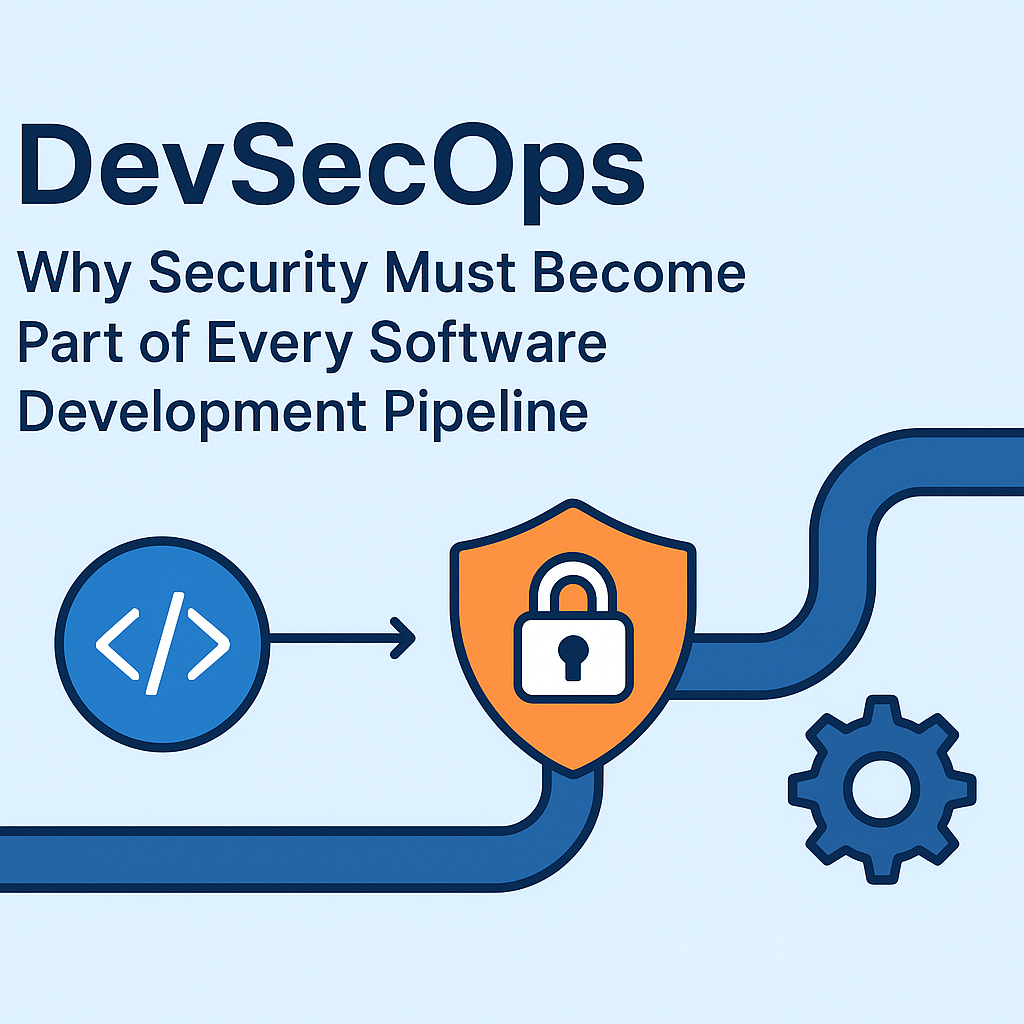
DevSecOps: Why Security Must Become Part of Every Software Development Pipeline
Security can’t be “added later.” If your organization still treats security as a final checkpoint—something that happens after development and testing are done—you’re not just taking a risk; you’re building one into your product. The modern reality is that software moves fast, attackers move faster, and vulnerabilities don’t wait for approval cycles. That’s why DevSecOps exists: to make security an integral part of every step in the software development lifecycle.In this guide, you’ll learn what DevSecOps really means, why it matters, how it fits into a pipeline, and which practical practices help teams reduce risk without slowing down delivery. Whether you’re a developer, a DevOps engineer, a security professional, or a product leader, this is your roadmap to building security into the systems you ship every day.
What Is DevSecOps?
DevSecOps is a philosophy and set of practices that bring security into DevOps workflows. The “Sec” in DevSecOps isn’t a separate stage at the end—it’s embedded throughout the pipeline. That means developers, operations teams, and security teams collaborate continuously, using automation and standard processes so security issues are detected early and fixed quickly.Traditional security models often rely on periodic reviews, manual checks, or late-stage penetration testing. Those approaches still have value, but they’re no longer enough. DevSecOps emphasizes shifting security “left” (earlier in the process) and also improving “right” practices (monitoring and response in production). The goal is not to slow down development—it’s to prevent avoidable vulnerabilities from ever reaching production.
Why Security Must Become Part of Every Pipeline
1) Vulnerabilities get expensive the later they’re found
The longer a security flaw survives in your workflow, the more expensive it becomes to address. Fixing a bug discovered during design is much cheaper than remediating one discovered after deployment—especially if it requires emergency patches, incident response, or customer-facing downtime.DevSecOps reduces the “time-to-remediate” by making security testing part of routine development. When you discover issues early, you can correct them while the context is fresh and the cost is low.
2) Software supply chains are larger than ever
Modern applications rely on open-source libraries, third-party services, container images, and cloud infrastructure. That “lego brick” approach accelerates development, but it also expands your attack surface.DevSecOps helps you manage risk across the supply chain by scanning dependencies for known vulnerabilities, verifying artifact integrity, and enforcing secure build practices.
3) Attackers target the weakest link
In real-world attacks, criminals don’t only hunt for the most complex vulnerabilities. They often exploit predictable weaknesses: exposed secrets, misconfigurations, outdated dependencies, insecure defaults, and improper access controls.When security is integrated into every stage of the pipeline, these common weaknesses are much harder to introduce and much easier to detect early.
4) Speed and security aren’t enemies
Security done manually is often slow. Security done repeatedly and automatically—through testing, scanning, and enforcement—is fast. DevSecOps aligns security with the same automation principles that make DevOps effective.Instead of saying “no” at the end, DevSecOps enables teams to ship confidently by reducing risk continuously.
The DevSecOps Pipeline: Security as a Built-In System
To understand DevSecOps, it helps to visualize a pipeline where security checks happen at multiple points. Below is a common flow you can adapt to your tooling and environment.
1) Plan and design: threat modeling and secure architecture
Before code is written, teams can reduce future vulnerabilities through threat modeling and secure design principles. Ask questions like: What are the assets we’re protecting? What threats could target them? What controls reduce the likelihood and impact?Even a lightweight threat modeling session at the start can help you avoid expensive redesigns later.
2) Code: secure coding standards and guardrails
Developers need guidance that’s practical, immediate, and enforceable. That means secure coding standards, linters, and automated checks that flag risky patterns as code is written.Examples include:
Static Application Security Testing (SAST) for vulnerable code patterns
Secret scanning to prevent credentials from entering repositories
Policy-as-code checks for secure configurations
3) Build: dependency and artifact security
Your build stage should verify that what you compile is safe to run. This is where dependency scanning, integrity verification, and secure build practices become essential.Common activities include:
Software Composition Analysis (SCA) to find vulnerabilities in third-party packages
Build-time checks for licensing and risk compliance
Artifact signing and checksum validation to prevent tampering
4) Test: dynamic testing and security-focused validation
Even with strong code and dependency checks, you still need runtime validation. That’s where Dynamic Application Security Testing (DAST) and security regression tests can identify issues in deployed environments or test environments that mimic production.In addition, you can run:
Infrastructure scanning for misconfigurations (e.g., cloud policy checks)
Container image scanning for known vulnerabilities
Fuzzing or targeted tests for critical endpoints
5) Release: policy gates and controlled deployment
A key DevSecOps concept is “security gates.” These are automated policies that allow deployments only when certain security conditions are met. For example: no critical vulnerabilities in dependencies, no unsigned images, and no exposed secrets.Security gates should be designed thoughtfully. If they’re too strict or poorly tuned, teams will bypass them. The best gates are clear, measurable, and focused on risk reduction.
6) Run: monitoring, detection, and incident response
DevSecOps doesn’t stop at deployment. Production environments are where you learn what works, detect real-time threats, and respond effectively.In the “run” phase, teams often implement:
Runtime Application Self-Protection (RASP) or WAF rules
Security logging and alerting (SIEM integration)
Infrastructure monitoring and threat detection
Automated incident workflows
When security is built into monitoring, you can detect attacks and vulnerabilities faster—before they become major incidents.
“Shift-left” means moving security earlier. But “right” matters too: continuous monitoring, patching, and incident response are crucial. DevSecOps is best understood as security across time—not a one-time event.
Automate what you can, standardize what you can’t
Manual security reviews don’t scale. Automated scanning and enforcement should handle repetitive tasks like detecting known vulnerabilities or insecure configuration patterns.For tasks that require human judgment—like risk acceptance decisions—standardize the process with templates and clear criteria.
Treat security as code (policy-as-code)
Infrastructure and security policies can be stored as code and versioned like application code. This approach makes security reviewable, testable, and consistent across environments.Tools and frameworks that help with policy-as-code let teams enforce rules such as:
No public storage buckets
Only trusted base images
Least-privilege IAM permissions
Make developers security owners, not security dependents
DevSecOps succeeds when developers are empowered. Security should be a collaboration, not a handoff. Provide training, secure templates, good tooling, and feedback loops so engineers learn and improve continuously.
Reduce noise with smart thresholds and exception processes
A common failure mode is overwhelming teams with alerts. If every scan produces dozens of warnings, the organization eventually ignores security tooling entirely.DevSecOps teams refine scan configurations, prioritize findings by severity, and implement exception workflows that require justification and time-bound risk acceptance.
Key Benefits of DevSecOps
Fewer vulnerabilities in production
The earlier you detect issues, the fewer make it to runtime. Security checks embedded in the pipeline catch risky patterns before they become real-world problems.
Faster, safer releases
Automation reduces delays. Instead of waiting for security reviews at the end, teams get continuous feedback. That makes it easier to maintain fast delivery while improving security outcomes.
Better compliance and audit readiness
Many compliance frameworks require evidence of secure development practices. DevSecOps generates audit trails: scan results, build records, deployment logs, and policy enforcement history.That documentation can dramatically reduce friction during audits.
Improved security culture
When security is part of daily development, people naturally learn more about threats, secure patterns, and secure operations. The result is a culture where security awareness is normalized, not exceptional.
Common DevSecOps Challenges (and How to Overcome Them)
“We already have security tools.”
Having tools isn’t the same as building security into the workflow. The question is whether scans are automated, enforced through gates, and supported by clear remediation processes.
Tool sprawl and conflicting findings
If different tools flag the same issue repeatedly or produce inconsistent results, teams become frustrated. Consolidate where possible, standardize severity scoring, and tune policies.
Limited security expertise within development teams
Bridge the skills gap with training, secure coding workshops, and “security champion” programs. Also, involve security engineers early so they can help define rules and remediation paths.
Fear of slowing down deployments
DevSecOps should be designed to reduce friction, not create new bottlenecks. Start with high-impact checks (like secrets scanning, dependency scanning, and basic SAST) and expand maturity over time.
A Practical Starting Plan: Where to Begin
If you’re implementing DevSecOps from scratch, focus on the smallest set of changes that deliver meaningful security improvements quickly.
Step 1: Secure your repositories
Enable secret scanning, enforce code review rules, and block pushes of credentials. Most breaches begin with something exposed or mishandled.
Step 2: Scan dependencies and containers
Add SCA and container image scanning to your pipeline. This reduces the risk of known vulnerabilities entering builds.
Step 3: Add SAST and basic security linting
Run SAST early in the pipeline and fail builds only for high-severity issues at first. Track false positives and tune rules.
Step 4: Implement security gates with clear remediation
Make policies enforceable. Provide developers with actionable guidance and owners for common fixes.
Step 5: Improve runtime monitoring
Enhance logging and alerting so security events are visible in production. DevSecOps is continuous; your pipeline is only one part of the security strategy.
Conclusion: DevSecOps Is How Modern Teams Stay Ahead
DevSecOps isn’t a buzzword—it’s a necessary evolution. Security must be continuous, automated, and integrated into the development pipeline because that’s where software is created and where risk can be prevented. When security is embedded at every stage—design, code, build, test, release, and run—teams can ship faster with fewer vulnerabilities, stronger compliance, and a healthier security culture.The biggest shift is mindset: stop treating security as a final approval step. Start treating it like quality—something built in from the beginning. When security becomes part of every pipeline, you don’t just reduce incidents. You build products that earn trust from customers, regulators, and the people who rely on your software every day.If you’re ready to begin, pick one or two pipeline improvements and implement them end-to-end. DevSecOps maturity grows through iteration. Start small, measure results, and keep moving security upstream—until safe shipping becomes the default.