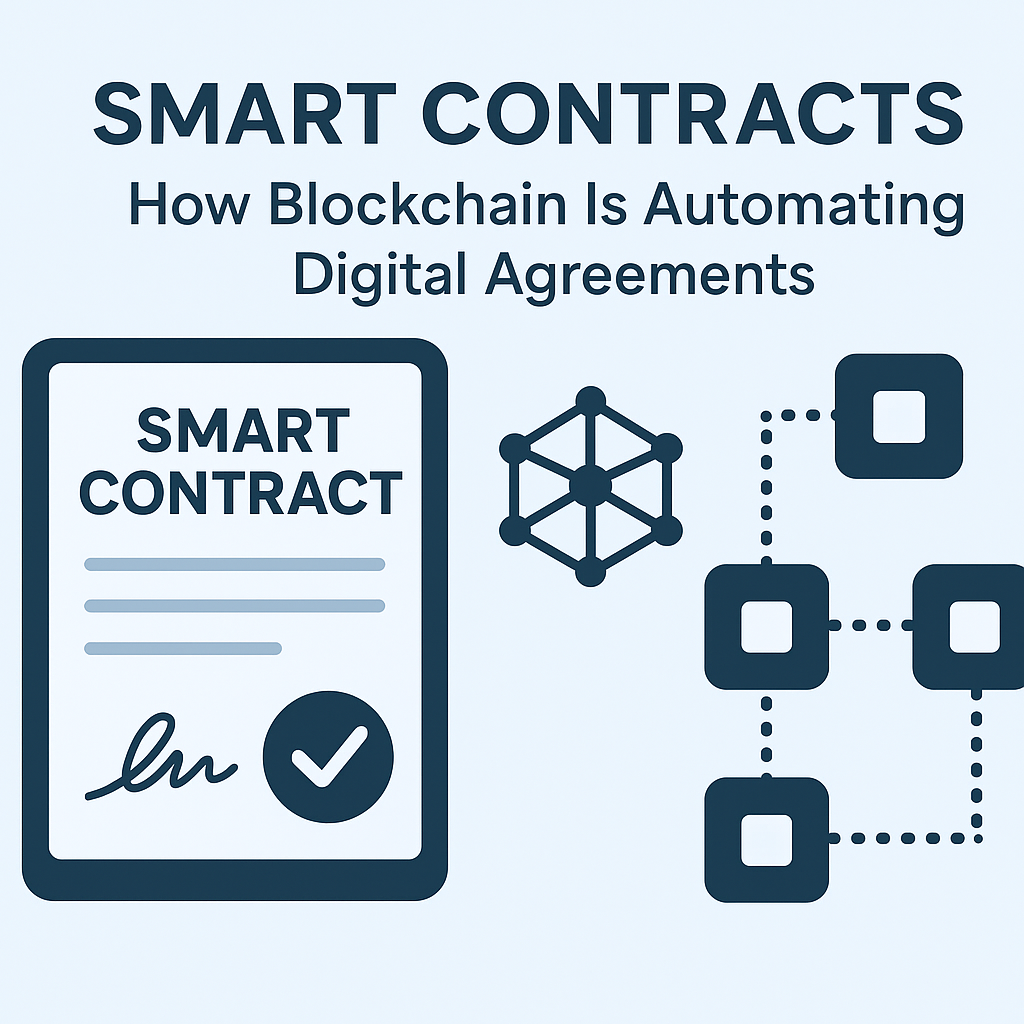
Smart Contracts: How Blockchain Is Automating Digital Agreements
Digital agreements power modern life—leases, online purchases, freelance work, insurance claims, subscription renewals, even charity donations. Yet the process of forming, verifying, and enforcing those agreements often still feels manual: paperwork, signatures, spreadsheets, compliance checks, and long waiting periods for outcomes to be confirmed.That’s where smart contracts come in. Built on blockchain technology, smart contracts aim to automate agreement execution—so that when predefined conditions are met, the next steps happen automatically and transparently. The result can be faster transactions, fewer disputes, and lower administrative costs.In this post, we’ll explore what smart contracts are, how they work, where they’re used, why blockchain matters, and what practical considerations—like security and regulation—you should keep in mind.
What Are Smart Contracts?
A smart contract is a computer program stored on a blockchain that runs exactly as written. Instead of relying on a human to interpret the agreement and perform the next action, the code defines rules and automatically executes the appropriate behavior when conditions are met.Think of a smart contract as a self-executing digital agreement. Traditional contracts might say: “If payment clears, ownership transfers.” In a smart contract, that logic can be encoded into code that monitors payment status and triggers ownership transfer without manual intervention.Important note: the term “smart contract” can be misleading. It’s not a legal contract by itself in every jurisdiction. Instead, it implements contractual logic in software. Many real-world systems still require legal frameworks to interpret, validate, and govern outcomes when edge cases arise.
Why Blockchain Makes Smart Contracts Possible
At their core, smart contracts need a trustworthy environment. Blockchain offers that by providing a distributed ledger—a shared database maintained by a network of computers. Once data and contract code are deployed to the blockchain, they’re difficult to alter without leaving traces.Here’s what blockchain contributes to smart contract automation:1) Immutability (with caveats): Many blockchains make it extremely difficult to change contract code after deployment. This improves predictability for participants.2) Transparency: Transaction histories and (often) the contract logic are visible to network participants, reducing “trust me” dynamics.3) Decentralization: No single company controls the contract’s execution. The network enforces the rules.4) Consensus: The blockchain agrees on the state of the system (e.g., who paid, when ownership changed), making outcomes consistent.
How Smart Contracts Work (Step by Step)
Most smart contract workflows look something like this:1) Agreement terms are written as code: Developers translate business logic into a programming language compatible with the blockchain.2) The contract is deployed: The program is uploaded to the blockchain network. Its address becomes a unique identifier.3) Users interact with the contract: People send transactions to the contract—such as depositing funds, confirming an action, or submitting data.4) Conditions are checked: The contract evaluates predefined rules. For example, “If deposit received and deadline passed…”5) Actions execute automatically: The contract updates state, transfers tokens, issues receipts, or triggers other outcomes.6) The result is recorded: Execution details are stored on the ledger, enabling auditing and verification.Unlike traditional systems where a server owner might run the code, blockchain-based smart contracts are typically executed by multiple network nodes. That makes the results consistent across participants.
What Can Smart Contracts Automate?
Smart contracts can automate agreements wherever there are clear rules, measurable events, and an incentive alignment among parties. Here are common categories:
1) Payments and Escrow
Escrow is a classic use case. A buyer deposits funds into a smart contract. When the contract receives proof that goods were delivered (or service milestones were met), it releases payment to the seller. If not, it refunds the buyer.This reduces the need for intermediaries—like escrow firms—though many setups still use additional services for dispute resolution or validation.
2) Tokenized Assets and Ownership Transfer
When assets are represented digitally (e.g., tokenized real estate, collectibles, or tokenized shares), smart contracts can automate transfer rules—such as transfer restrictions, settlement schedules, or royalty payments.For example, an NFT smart contract might distribute royalties automatically to creators whenever tokens are resold.
3) Subscription Renewals and Usage-Based Billing
Some subscription services can use smart contracts to manage payments based on usage thresholds. If a user crosses a usage limit, the contract triggers a billing event automatically.This is especially relevant for machine-to-machine payments, where manual invoicing can be slow.
4) Insurance Claims
In principle, insurance can use smart contracts to automate claims for predefined events—like flight delays or weather conditions. However, this requires reliable data inputs, which often involves oracles (more on that next).
5) Supply Chain and Compliance
Smart contracts can coordinate payments based on shipping milestones and automate document checks. For instance, when a shipment arrives and receives confirmation, payment can be released.Blockchain also helps with traceability—who touched an item, when, and under what conditions.
The Role of Oracles: Bridging Real-World Data to Code
Blockchains can only “know” what’s fed into them. Most real-world agreements depend on external data—prices, weather, shipping status, identity verification, or event confirmations. That’s where oracles come in.An oracle is a service that brings off-chain data on-chain in a verifiable way. For example, an oracle might fetch weather data and provide it to a smart contract so the contract can determine whether an insurance claim should be paid.This creates a key design challenge: if the oracle provides incorrect data, the smart contract can execute the wrong outcome. For that reason, reputable oracle networks and robust validation methods matter.
Benefits of Smart Contracts for Digital Agreements
Smart contracts can deliver advantages across speed, cost, and trust:
Faster Execution
Because contract logic runs automatically, you can reduce the time between agreement and outcome. Settlement can occur in minutes or seconds rather than days.
Lower Administrative Costs
Automation reduces manual processing—fewer intermediaries, fewer paper trails, and fewer human checks.
Reduced Disputes (When Done Well)
If contract logic and terms are clear and the data inputs are reliable, the outcome can be more deterministic. That can reduce ambiguity and help with auditing.
Auditability and Transparency
Blockchain records create a verifiable history of actions. When questions arise—“What happened? When did it happen? Who triggered it?”—the data is often available.
Programmable Rules
Traditional legal agreements are often hard to operationalize precisely. Smart contracts allow complex conditional logic to be encoded directly into execution.
Challenges and Risks You Should Know
Smart contracts are powerful, but they’re not magic. To responsibly use blockchain automation for digital agreements, it’s crucial to understand risks.
1) Smart Contract Bugs
If the code has vulnerabilities or logical errors, the contract can behave unexpectedly—and those mistakes may be irreversible once deployed. Several high-profile incidents in the blockchain ecosystem highlight why rigorous testing and audits are essential.
2) Immutability vs. Upgradability
Many blockchains make contract code difficult to change. That’s great for trust, but problematic if bugs are discovered. Teams often use patterns like proxy contracts or versioned contracts to improve flexibility.
3) Oracle Reliability
If a smart contract relies on external data, the oracle becomes a critical dependency. Using decentralized or well-audited oracle solutions can mitigate—but not eliminate—risk.
4) Legal and Regulatory Uncertainty
Smart contracts raise questions about enforcement: Are they legally recognized as contract terms? How do jurisdictions interpret decentralized execution? Regulatory status varies by region and use case.
5) Privacy Concerns
Blockchain transparency can conflict with sensitive agreement data. While some blockchains or systems provide privacy features (e.g., encryption, permissioned networks, or zero-knowledge proofs), designers must consider privacy from day one.
Where Smart Contracts Are Being Used Today
Smart contracts are already transforming multiple sectors, including:Decentralized finance (DeFi): Lending, borrowing, and trading protocols use automated contract logic to manage collateral, liquidations, and interest calculations.Digital identity and access: Some systems use smart contracts to manage permissions, authentication workflows, or credential verification.Gaming and digital collectibles: NFTs and tokenized game assets can automate royalties, ownership transfers, and on-chain rewards.Real-world asset (RWA) experiments: Tokenized securities and assets explore automated settlement and governance.Enterprise pilots: Companies test supply chain tracking, audit trails, and contract automation using blockchain platforms.While adoption varies, the trend is clear: automation and verifiable execution are increasingly valuable as digital transactions grow more complex.
How to Build Smarter Smart Contract Systems
If you’re considering using smart contracts to automate agreements, here are practical best practices:
Start With Clear Requirements
Before writing code, define the agreement logic precisely. What events trigger actions? What happens if conditions fail? What if data is missing?
Use Audits and Testing
Professional code review, security audits, and extensive testing reduce the likelihood of costly failures.
Plan for Data and Oracles
Identify the external data sources your contract depends on. Evaluate oracle trust, update frequency, and failure modes.
Consider Upgrade Strategies
Even if you value immutability, build in safe ways to respond to necessary changes—especially early in a product’s life cycle.
Integrate Legal and Compliance Steps
Smart contracts work best when paired with legal frameworks: clear dispute handling, definitions of evidence, and regulatory compliance where needed.
Common Misconceptions About Smart Contracts
Let’s clear up a few myths:“Smart contracts replace legal contracts.” Not always. They can encode parts of an agreement, but legal language often still governs interpretation and disputes.“Smart contracts are always secure.” Security depends on code quality, audits, and the reliability of dependencies like oracles.“All blockchain data is private.” Public blockchains are transparent by design. Privacy requires additional design choices.“Smart contracts are instantly integrated into every business process.” Adoption takes planning, infrastructure, and sometimes regulatory approval.
The Future of Automated Digital Agreements
Smart contracts represent a shift from “agreements that require enforcement” to “agreements that enforce themselves through code.” As tooling improves, audits become standard practice, and more reliable oracles and identity systems emerge, smart contract automation is likely to expand.We may see increased use in cross-border commerce, where disputes and settlement delays are especially costly. We may also see more hybrid approaches: smart contracts handle the mechanical execution while legal and human oversight manage ambiguous or exceptional cases.Ultimately, smart contracts aren’t just about blockchain—they’re about trust, automation, and efficiency. By transforming how agreements are executed, blockchain technology is helping build a future where digital promises can be carried out quickly, transparently, and consistently.
Final Thoughts
Smart contracts are one of the most practical applications of blockchain technology. They automate digital agreements by turning contractual logic into executable code, recording every step on a tamper-resistant ledger, and enabling faster outcomes with fewer intermediaries.Still, success depends on careful design: robust security practices, trustworthy data inputs, thoughtful privacy strategies, and alignment with legal requirements. When those pieces come together, smart contracts can meaningfully improve how we conduct transactions and manage obligations in the digital world.If you’re exploring smart contracts for payments, escrow, insurance, supply chain processes, or any agreement-heavy workflow, start small: map the business rules, test the logic thoroughly, and build toward a system that is both automated and dependable.Want to discuss a specific use case? Tell me your industry (e.g., real estate, e-commerce, freelance services, logistics, or insurance) and the agreement type you want to automate—I can help outline a smart contract approach and the key requirements.