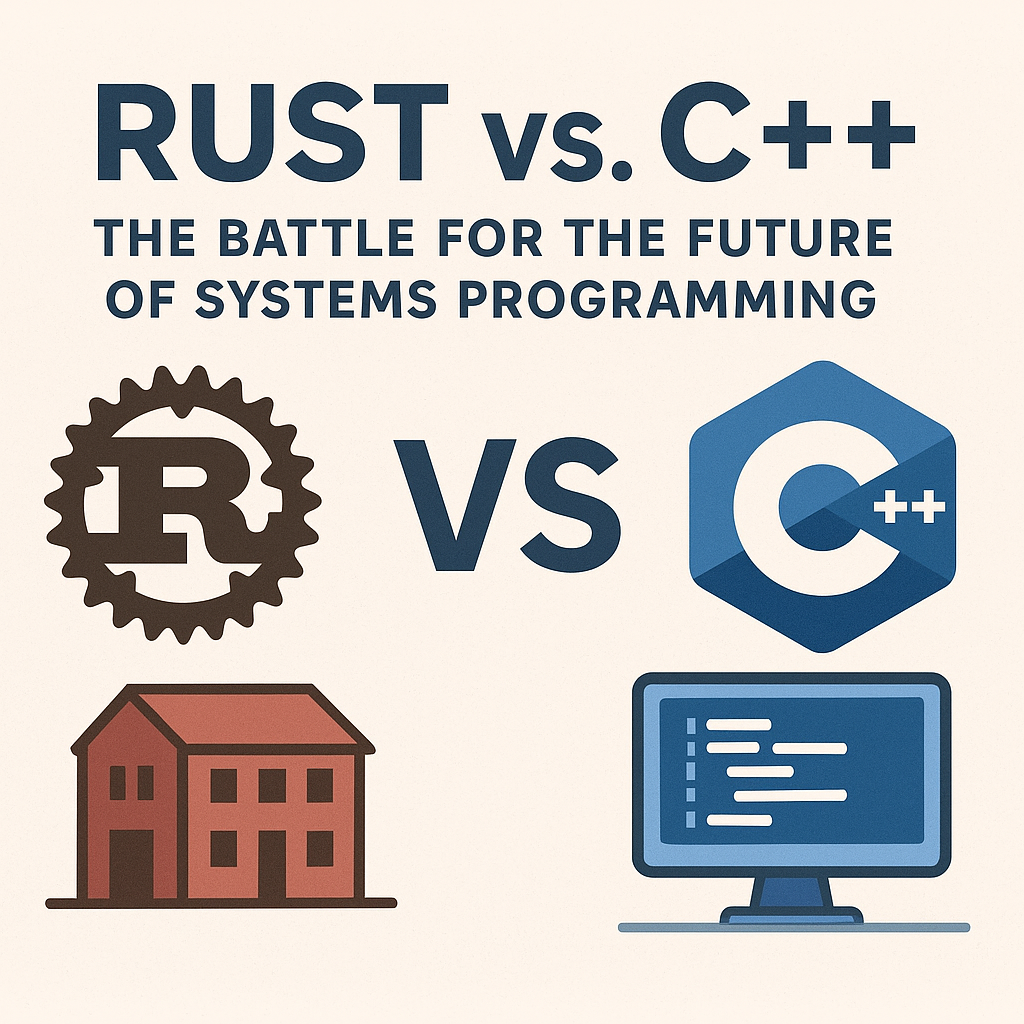
+: The Battle for the Future of Systems Programming+
Rust vs. C++: The Battle for the Future of Systems Programming
Systems programming is where performance, reliability, and safety collide. For decades, C and later C++ have served as the backbone of operating systems, game engines, embedded firmware, browsers, and high-frequency trading infrastructure. But today, a new challenger has captured the industry’s attention: Rust. With its modern approach to memory safety, concurrency, and developer ergonomics, Rust is rapidly becoming a serious contender for the next era of systems programming.So what’s really happening in the Rust vs. C++ showdown? Is Rust poised to replace C++ entirely, or will the two languages coexist—each winning different niches? In this post, we’ll explore the technical differences, real-world tradeoffs, ecosystem maturity, performance considerations, and practical adoption strategies for teams planning their future toolchains.
Why Systems Programming Needs More Than Speed
When people say “systems programming,” they often think about raw speed. But modern systems demand more than performance. They require:1) Memory safety to prevent buffer overflows, use-after-free, and data races.
2) Predictable performance with minimal runtime overhead.
3) Correct concurrency as multi-core parallelism becomes unavoidable.
4) Maintainability so large codebases can evolve without becoming fragile.
5) Security hardening built into the language and tooling.C++ can be extremely fast and expressive, but safety largely depends on discipline and tooling. Rust aims to make many classes of bugs difficult or impossible to write in the first place, shifting correctness from “careful habits” to “enforced invariants.” That fundamental difference fuels the current debate.
A Quick History: From C++ Dominance to Rust’s Disruption
C++ has dominated systems programming because it offers:• Manual control over memory and layout
• Zero-cost abstractions
• Extensive compiler optimizations
• Immense ecosystem depth
• Backward compatibility and institutional knowledgeHowever, C++ also carries complexity. Features like raw pointers, manual lifetime management, undefined behavior, and subtle concurrency pitfalls can lead to catastrophic security and reliability issues.Rust emerged from a vision: keep the power and performance of low-level languages while providing stronger safety guarantees. Instead of relying on developer memory management discipline alone, Rust introduces ownership rules and a compiler-enforced model that prevents many common memory errors.
Core Technical Differences: Ownership vs. RAII
Rust’s Ownership Model
Rust’s most distinctive feature is its ownership system. At a high level, Rust ensures that each value has a clear owner, and that memory is automatically freed when ownership ends. Key concepts include:• Ownership: one owner per value at a time
• Borrowing: temporary access without taking ownership
• Lifetimes: compile-time tracking of how long references remain validThis model enables Rust to catch use-after-free, double frees, and many data races at compile time—before they reach production.
C++ and RAII (Resource Acquisition Is Initialization)
C++ achieves robust resource management via RAII, where resource lifetime is tied to object lifetime. This pattern—paired with smart pointers like std::unique_ptr, std::shared_ptr, and containers like std::vector—can significantly improve safety.But C++ remains more flexible. The language doesn’t prevent all undefined behavior or memory misuse by default. If developers use raw pointers incorrectly or mishandle object lifetimes, the compiler may not save you.
Concurrency: “Make Data Races Hard” vs. “Be Careful”
Concurrency is one of the most expensive sources of bugs in modern systems. Data races, deadlocks, and subtle timing problems can be extremely difficult to reproduce.Rust treats thread safety as a first-class concern through its type system. Many concurrency errors are prevented through borrowing rules and trait bounds like Send and Sync. In other words: the compiler can often guarantee that a type can be safely transferred across threads or referenced concurrently.C++ can also support safe concurrency, but it requires discipline and careful use of synchronization primitives (mutexes, atomics, locks, etc.). While modern C++ encourages better patterns, it cannot globally enforce the same level of correctness for all concurrency scenarios.
Performance: Do Rust and C++ Compete on Speed?
Performance is where many comparisons get heated, but the reality is more nuanced. Both Rust and C++ are compiled languages that aim for zero-cost abstractions. In many benchmarks, Rust performance is competitive with C++—especially when optimizations are enabled and code is idiomatic.Rust can introduce overhead if you choose certain patterns (for example, heavy use of dynamic dispatch or unnecessary cloning). Likewise, C++ can degrade performance when abstractions aren’t understood or when undefined behavior triggers suboptimal outcomes. Both languages reward expertise.Where Rust often shines is in the cost of development-time bugs. Even if raw runtime performance is similar, Rust can reduce time spent hunting memory corruption issues, security vulnerabilities, and concurrency races.
Memory Safety and Security: The Real “Battlefront”
The biggest reason Rust is gaining ground is security. Memory corruption vulnerabilities—like buffer overflows, use-after-free, and double-free—remain a major threat. Rust reduces the surface area by eliminating many dangerous patterns through:• Compile-time borrow checking
• Ownership-based lifetime enforcement
• No null-by-default references (Rust has Option)
• Better defaults that avoid widespread reliance on raw pointersC++ has improved with the years: safer standard library components, sanitizers, and guidelines. Teams can use tools like AddressSanitizer, UndefinedBehaviorSanitizer, and static analysis to catch problems early. But these require configuration, ongoing maintenance, and consistent adoption across large teams.Rust’s philosophy is to make many classes of vulnerabilities harder to express. This is a compelling proposition for companies operating in high-security environments.
Ecosystem and Tooling: Maturity Matters
Rust’s Growing Ecosystem
Rust’s package ecosystem (Cargo and crates.io) has expanded rapidly. Today, Rust has strong support in areas such as:• Web services and APIs (Actix Web, Axum)
• Systems utilities (ripgrep-like tooling, async frameworks)
• Embedded and bare-metal development (embedded-hal, device crates)
• Networking and performance-focused services
• Developer tooling (formatters, linters, profilers)Rust also benefits from a coherent toolchain story: rustc, Cargo, formatting, linting, and reproducible builds are designed to work together.
C++’s Depth and Ubiquity
C++ benefits from decades of industrial adoption. If you need:• Specialized libraries (ML frameworks, GPU tooling, robotics)
• Platform integration
• Toolchain compatibility
• Large legacy codebases and expertiseC++ has an unmatched head start.One reason C++ remains dominant is that switching languages can be expensive. When a language already powers your product line, infrastructure, and hiring pipeline, migration becomes a strategic decision—not just a technical one.
Interoperability: Can Rust and C++ Work Together?
One of the most practical points for teams is that Rust and C++ don’t have to be enemies. They can interoperate. Rust can call C++ (with careful bindings) and C++ can call Rust via FFI approaches.Common migration strategies include rewriting performance-critical modules in Rust while keeping surrounding infrastructure in C++. This lets teams gradually gain safety benefits without rewriting everything at once.For large organizations, “hybrid architectures” are often the fastest path to measurable improvements.
Developer Experience: Learning Curve and Everyday Friction
Rust has a reputation for a steep learning curve. Ownership, borrowing, and lifetimes can feel unintuitive at first—especially for developers used to C++’s flexibility.However, the compiler’s error messages and tooling have improved significantly. Many teams report that after the initial learning phase, Rust makes it easier to reason about code correctness. The language nudges developers toward safe patterns, and the compiler acts like a persistent reviewer.C++ also has a learning curve, particularly because it’s a multi-paradigm language with a wide variety of styles. But C++ developers often already know the mental model of pointers, object lifetimes, and RAII. That prior knowledge can reduce friction in existing teams.
Where Rust Might Win (and Why)
Rust is a strong fit for:• New services where reliability and security matter
• Components that handle untrusted input (parsers, network services, tooling)
• Concurrency-heavy systems that benefit from compile-time guarantees
• Projects aiming for long-term maintainability
• Security-sensitive environments (infra, cryptography, sandbox-like tooling)
• Teams that want “safety as a default” across the codebaseRust is also attractive when you want performance similar to C++ but with safer defaults to reduce operational risk.
Where C++ Still Holds the Advantage
C++ remains ideal for:• Extremely mature ecosystems and specialized hardware integrations
• Game engines and performance-critical graphics pipelines
• Legacy systems and massive existing codebases
• Situations requiring deep platform-specific control and long-standing library compatibility
• Teams with extensive C++ expertise and established development workflowsIn many industries, C++ is not just a language—it’s the foundation of tooling, expertise, and operational processes.
The Future: Coexistence, Not Replacement
The most realistic takeaway is that Rust vs. C++ is not a “one will win everywhere” story. The future is more likely to look like:• Rust grows in new projects and safety-critical modules
• C++ remains dominant where it already has ecosystem gravity and legacy depth
• Hybrid systems expand as organizations modernize incrementally
• Tooling and best practices in both languages converge toward safer defaultsOver time, we may even see cross-pollination of ideas: C++ continues to add safer abstractions, while Rust continues to improve ergonomics and expand its ecosystem. Ultimately, both languages will shape how systems programming evolves.
Adoption Playbook: How Teams Decide
If you’re evaluating Rust for your organization (or considering C++ for future work), focus on practical criteria:• Codebase type: new greenfield vs. legacy modernization
• Performance constraints: where latency and throughput matter most
• Risk profile: how costly memory safety bugs are for your domain
• Hiring and training: availability of experienced developers
• Ecosystem fit: do you have libraries you need?
• Interop needs: will you need to integrate with existing C/C++ components?
• Toolchain readiness: CI, build pipelines, profiling, and debugging workflowsA common winning strategy is to start with a small, well-bounded component—like a parser, a networking layer, or a performance-critical subsystem—and measure both technical success and team productivity.
Conclusion: Choosing the Right Weapon for the Job
Rust and C++ are both powerful systems programming languages, but they represent different philosophies. C++ offers unmatched maturity, deep ecosystem integration, and flexible low-level control. Rust offers strong memory safety guarantees, concurrency correctness via the type system, and a compiler-driven approach to preventing dangerous bugs.The “battle for the future” is happening in real time, and the outcome is likely not total replacement—it’s distribution. Rust will keep expanding in areas where safety and correctness are critical. C++ will keep dominating where its ecosystem, legacy, and performance culture are entrenched. And many organizations will build the next generation of systems by combining the strengths of both.In the end, the smartest decision isn’t “Rust vs. C++.” It’s “What tradeoffs are we willing to accept—and what risks can we afford?” Whether you choose Rust for its safety guarantees or C++ for its ecosystem depth, the future belongs to teams that write reliable, maintainable, high-performance software.
Frequently Asked Questions (FAQ)
Is Rust slower than C++?
Not inherently. Rust is compiled to native code and can achieve performance comparable to C++. Actual outcomes depend on how code is written and optimized.
Will Rust replace C++?
Probably not fully. More likely, Rust will replace some C++ components in new projects and targeted modules, while C++ remains dominant in legacy-heavy and ecosystem-driven domains.
Can Rust be used in embedded systems?
Yes. Rust has a growing ecosystem for embedded development, including tools for bare-metal targets, though maturity can vary by hardware platform.
Can they be used together in the same product?
Yes. Rust and C++ can interoperate via FFI. Many migration plans start by rewriting specific components while keeping existing infrastructure.