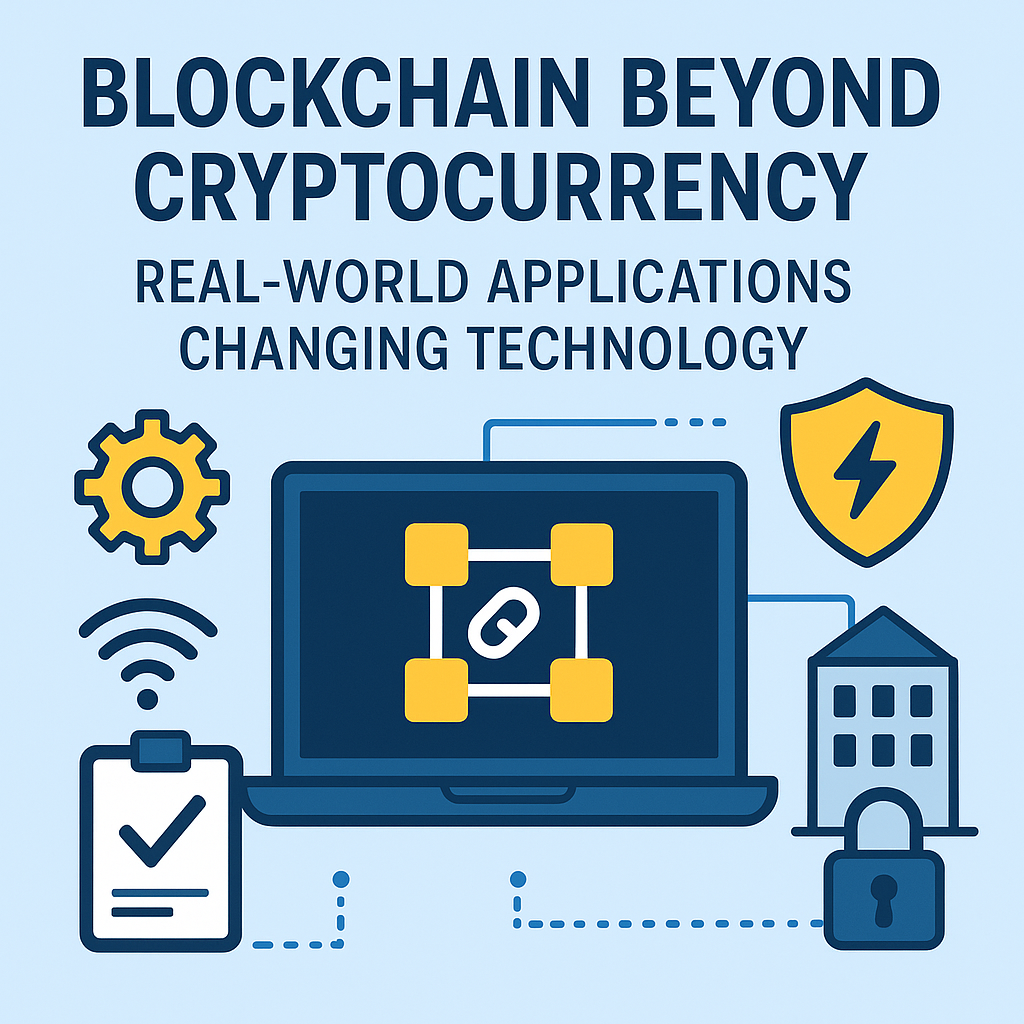
For years, blockchain has lived in the shadow of cryptocurrency headlines. But while Bitcoin, Ethereum, and other digital coins brought the technology into public awareness, blockchain’s real impact is spreading far beyond trading screens. Today, organizations across finance, healthcare, supply chains, energy, government, and entertainment are using blockchain’s core strengths—immutability, transparency, shared consensus, and programmable rules (smart contracts)—to solve problems that traditional databases and centralized systems struggle to handle.In this post, we’ll explore how blockchain is moving beyond speculation and toward practical, measurable value. You’ll learn what makes blockchain different, where it’s being adopted in the real world, what challenges still remain, and what the future could look like when trust becomes a built-in feature of the internet.
Why Blockchain Is More Than a Cryptocurrency Trend
Blockchain is essentially a distributed ledger: multiple computers (nodes) maintain a shared record of transactions or events. Instead of one company or server controlling the data, the network collectively verifies and stores it. Each new “block” is linked to the previous one using cryptography, making records extremely difficult to alter retroactively.This design offers several capabilities that matter outside of money:1) Tamper-resistant records: Once information is confirmed and added, changing it would require overwhelming network consensus.2) Shared truth: Multiple parties can agree on the same version of events without trusting a single intermediary.3) Traceability: Transactions can be audited end-to-end, which is especially valuable in regulated industries.4) Smart contracts: Software logic can automatically execute agreements when conditions are met.These features are what enable blockchain applications to improve accountability, reduce fraud, streamline workflows, and create new models for coordination between organizations.
Smart Contracts: The “Automation Layer” of Blockchain
Smart contracts are one of the most exciting blockchain capabilities. They are self-executing programs stored on a blockchain that run when specific conditions are satisfied. Think of them as verifiable automation—code that can be audited by many parties rather than controlled by a single platform.In practice, smart contracts can automate:• Payment releases when milestones are reached• Escrow and dispute resolution logic• Tokenized access permissions (for example, license management)• Multi-party agreement execution across organizationsThis is particularly powerful in environments where coordination is expensive and trust is scarce—like insurance claims, cross-border logistics, and compliance-heavy supply chains.
Below are some of the most meaningful real-world use cases showing how blockchain is reshaping systems beyond cryptocurrency.
1) Supply Chain Transparency and Anti-Counterfeiting
Supply chains are complex networks involving manufacturers, distributors, shipping companies, warehouses, customs agencies, and retailers. That complexity often creates “blind spots” where errors, theft, or counterfeit products slip through.Blockchain can act as a shared audit trail across stakeholders. For example, a shipment can be recorded at key checkpoints—manufacturing, loading, shipping, customs clearance, and delivery. Because the ledger is tamper-resistant, it becomes harder to alter origin records or mask product history.Industries using these approaches include:• Food and beverage (traceability for contamination risks)• Luxury goods (proving authenticity)• Pharmaceuticals (preventing fake drugs)• Automotive and electronics (verifying components)While blockchain won’t “magically” guarantee accurate data entry, the combination of blockchain with trusted data sources—like IoT sensors, barcode/QR scanning, and supplier verification—can dramatically improve provenance and accountability.
2) Cross-Border Payments and Trade Finance
Even outside crypto, blockchain can reduce friction in financial processes. Cross-border payments often involve multiple intermediaries, slower settlement times, higher fees, and fragmented record-keeping.Blockchain-based systems can enable near real-time settlement and shared transaction visibility among banks and payment providers. In trade finance, smart contracts can automate parts of the process—such as releasing payments when documents are verified or when shipping milestones occur.Benefits include:• Faster settlement• Reduced paperwork and reconciliation effort• Better audit trails• Improved compliance and traceabilityIn other words, blockchain can function like a modern coordination layer for global commerce.
3) Healthcare Data Sharing and Patient-Centric Records
Healthcare is a field where data moves between many stakeholders—hospitals, labs, insurers, pharmacies, and patients. But many systems are siloed, making it difficult to securely share records while maintaining privacy and compliance.Blockchain-based approaches can support:• Secure audit logs of when records were accessed• Immutable histories of lab results and diagnoses• Permissioned access controls (who can view what, and when)• Interoperability across providersIn practice, many healthcare designs don’t store entire medical files directly on-chain. Instead, they may store cryptographic hashes or pointers on-chain, while the actual data resides in secure off-chain systems. This can improve privacy while maintaining verifiability.The big value proposition is not just “decentralization,” but better trust, transparency, and governance across healthcare ecosystems.
4) Identity Verification and Anti-Fraud
Identity is the foundation of digital life—logins, transactions, onboarding, verification, and compliance checks. But identity systems are often fragmented, vulnerable to breaches, and costly to maintain.Blockchain-enabled identity solutions can give users more control over credentials and allow organizations to verify claims without repeatedly re-collecting sensitive information. These approaches often align with:• Digital credentials (verifiable proofs)• Selective disclosure (share only what’s needed)• Tamper-resistant credential historyThis can help with:• KYC (Know Your Customer) and onboarding• Reducing identity fraud• Streamlining access to services• Lowering compliance overheadFor AdSense-friendly readers, the key takeaway is simple: blockchain can reduce the cost and risk of verification—without forcing everyone to start from scratch each time.
5) Energy Grids, Renewable Integration, and Peer-to-Peer Trading
Modern energy systems are shifting toward renewables like solar and wind, which are variable by nature. Managing these systems requires reliable tracking of generation, consumption, and settlement.Blockchain can support energy data integrity and enable new marketplace structures where households or businesses can trade energy—often called peer-to-peer energy trading. Smart contracts can automate settlement when energy is produced and consumed within defined constraints.Potential benefits include:• Better transparency in energy accounting• Automated payments for renewable generation• More efficient coordination between grid participants• Enhanced auditability for regulatorsIn short, blockchain can help energy networks become more dynamic, programmable, and trustworthy.
6) Government Services, Voting Integrity, and Public Records
Governments require systems that are secure, transparent, and resilient. Blockchain’s ledger model can support public record verification and auditable processes.Possible applications include:• Land registry and property records (reducing tampering and disputes)• Notarization of documents• Proof-of-existence for legal artifacts• Transparent procurement and compliance trackingVoting is often discussed in blockchain circles, but it’s also one of the most sensitive and complex use cases. Many experts emphasize that secure voting requires more than a tamper-resistant ledger—end-to-end security, identity verification, and usability are critical. Still, blockchain can play a role in parts of the process, such as audit trails or verifiable reporting.
7) Media, Licensing, and Royalties for Creators
Creative industries frequently struggle with rights management. Creators may face delayed or unclear royalty payments, disputes over licensing terms, or difficulties proving ownership.Blockchain-based platforms can help by:• Storing rights metadata and licensing terms• Automatically distributing royalties based on smart contract rules• Creating tamper-resistant ownership and transaction history• Supporting transparent attribution and auditabilityThis doesn’t eliminate all challenges—content verification, legal frameworks, and industry agreements still matter—but it can create a clearer infrastructure for payment automation and provenance.
8) Logistics Automation with Tokenized Assets and Verifiable Events
Beyond tracing products, blockchain can coordinate logistics operations. For example, a shipping container can be represented as a digital “asset” with its status recorded on-chain as it moves through a network. Smart contracts could automate operational steps based on verifiable events.Imagine a workflow where:• Insurance triggers automatically if a shipment reaches a risk threshold• Payment releases after verified delivery confirmation• Customs documentation is validated and logged for auditThese automations can cut delays and reduce disputes between parties.
How Blockchain Improves Trust Without Requiring Everyone to Trust Everyone
A useful way to understand blockchain beyond crypto is to view it as “trust infrastructure.” Traditional systems often rely on one party maintaining the database, meaning the other participants must trust that party’s integrity. Blockchain changes the structure: instead of one controller, many participants verify changes.That doesn’t mean blockchain is automatically perfect. Data still needs to be entered correctly. But blockchain can ensure that once data is recorded and consensus is reached, it becomes consistent and difficult to rewrite quietly.
Types of Blockchain Networks: Public vs. Private vs. Permissioned
Many people assume “blockchain” always means public networks like Bitcoin. In reality, businesses often use permissioned or private blockchains tailored to their compliance needs.• Public blockchains: open to anyone, highly decentralized, great for broad transparency.• Permissioned blockchains: participants are known/approved; governance and privacy can be better aligned with enterprises.• Consortium blockchains: multiple organizations share responsibility for the network.This flexibility helps industries adopt blockchain without exposing sensitive operations unnecessarily.
Challenges and Reality Checks (Because Innovation Should Be Honest)
To keep your blog post credible and informative, it’s important to address limitations. Blockchain isn’t a universal cure, and real deployments face hurdles.1) Data quality: Blockchain can’t fix bad inputs. If incorrect data is written, it becomes permanently verifiable—making it harder to correct.2) Integration costs: Legacy systems may require major changes to connect with blockchain workflows.3) Scalability and performance: Transaction throughput, latency, and costs must meet real business needs.4) Regulation: Compliance requirements vary across regions and industries.5) Privacy: Public ledgers can expose transaction patterns unless designed carefully (e.g., permissioned networks, encryption, off-chain storage).That said, many organizations succeed by using blockchain selectively where it adds unique value—like shared audit trails, verification, and programmable agreements—not everywhere.
The Future: Blockchain as a Layer of Trust Across the Internet
So what comes next? The most likely future is not “blockchain replaces everything,” but “blockchain becomes part of how systems coordinate.” We may see:• More real-time settlement in financial services• Better identity and credential verification for online and regulated activities• Transparent provenance across global supply chains• Automated compliance and audit trails for industries that must prove every step• Smart-contract-driven workflows that reduce manual reconciliationAs blockchain matures, it’s also becoming more accessible through tooling, standards, and developer frameworks. And importantly, many solutions are being built with an enterprise mindset: governance, security, privacy, and measurable outcomes.
Conclusion: The Biggest Blockchain Story May Not Be Crypto
Blockchain’s most transformative potential is not confined to cryptocurrency markets. It’s about building systems where trust is shared, records are verifiable, and agreements can execute automatically through smart contracts. From supply chain traceability to healthcare auditability, from identity verification to energy marketplaces, blockchain is steadily moving into the infrastructure layer of modern technology.If you’re watching blockchain with curiosity, the smartest approach is to look for use cases, not hype. The future belongs to organizations that solve real problems—using blockchain where it genuinely improves trust, transparency, and automation.And as more industries adopt distributed ledger technology, blockchain may become less of a headline and more of a quiet, powerful standard—one that helps the digital world behave more like the reliable infrastructure we expect from the physical world.