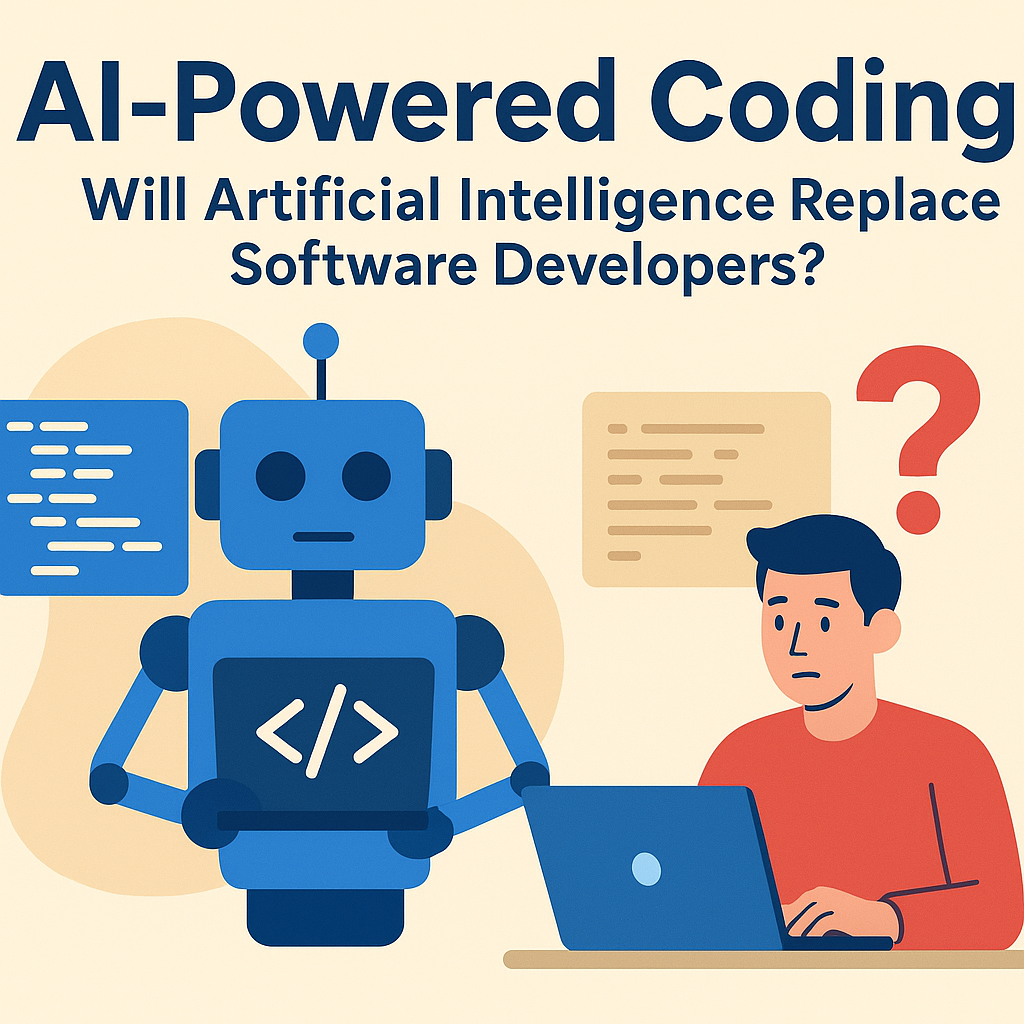
AI-Powered Coding: Will Artificial Intelligence Replace Software Developers?
Artificial Intelligence is moving faster than many people expected—and nowhere is that acceleration more visible than in software development. From autocomplete tools that “guess” your next line of code to AI assistants that can generate entire functions from plain-language prompts, it’s easy to wonder: Will artificial intelligence replace software developers?The honest answer is: AI will change software development dramatically, but it’s unlikely to fully replace software developers in the near future. Instead, the relationship between developers and AI is shifting toward augmentation—where AI handles repetitive or boilerplate work and humans focus on architecture, product decisions, security, and real-world problem solving.
Why AI Is Suddenly Everywhere in Coding
AI-powered coding tools have become mainstream for a simple reason: they’re useful. Modern AI systems can learn patterns from huge codebases and then help generate code quickly. Many tools now support features such as:
Code completion and suggestions
Natural language to code (“Generate a REST endpoint for…“)
Code refactoring and optimization suggestions
Test generation (unit tests, integration tests, edge cases)
Debugging assistance and explanation of errors
These capabilities reduce friction. Developers spend less time writing repetitive boilerplate and more time thinking about higher-level requirements. Still, “faster” doesn’t automatically mean “better,” and it doesn’t eliminate the need for human judgment.
AI Can Write Code—But Who Ensures It Works?
To decide whether developers will be replaced, it helps to examine the full software development lifecycle. Writing code is only one part of building software. Real-world systems require:
Understanding the problem and stakeholder needs
Designing system architecture (scalability, maintainability, performance)
Modeling data correctly and handling edge cases
Ensuring security and privacy compliance
Writing tests and verifying correctness
Deploying reliably and monitoring production
Responding to incidents, regressions, and user feedback
AI can help with the mechanics of coding, but the responsibility for correctness and outcomes still falls on a team. Bugs happen—even when AI writes code that looks convincing. When software fails in production, it’s not enough that the code compiles. It must behave correctly under real constraints.
The Key Difference: Code Generation vs. Software Engineering
There’s an important distinction between generating code and engineering software. AI is often strongest at code generation because that’s what it’s trained to do. But software engineering includes decisions that are harder to “learn” from patterns:
1) Requirements are messy
In real teams, requirements evolve. Users change their minds. Compliance rules appear mid-project. AI can draft code from a prompt, but it can’t guarantee that the prompt accurately captured business goals or user intent. Humans translate ambiguity into concrete plans.
2) Architecture requires trade-offs
AI can suggest solutions, but architects must decide trade-offs: cost vs. performance, simplicity vs. extensibility, vendor lock-in vs. portability. These decisions depend on product strategy and team constraints, not just code patterns.
3) Security demands context
Security isn’t only about avoiding obvious vulnerabilities. It’s about understanding the system’s threat model, data sensitivity, authentication flows, logging practices, and regulatory obligations. AI may recommend secure patterns, but humans verify them and ensure the design aligns with policy and risk tolerance.
4) Production behavior is unpredictable
Even the best AI-assisted code needs real-world testing. Latency spikes, intermittent network failures, database quirks, concurrency issues—these are the kinds of problems humans are trained to debug systematically.
So, Will AI Replace Software Developers?
Let’s break the question into what “replace” could mean.
Will AI replace developers as in “no more human coders”?
Highly unlikely in the near term. Software development requires accountability, domain knowledge, and coordinated decision-making. Companies don’t just need code; they need outcomes, responsibility, and maintainability.
Will AI reduce the number of developers needed for certain tasks?
Yes, absolutely. AI can speed up:
Writing boilerplate and basic CRUD operations
Generating unit tests
Drafting documentation and comments
Refactoring obvious patterns
This means teams may accomplish more with the same headcount—or shift developers toward more complex work.
Will AI change developer roles?
Definitely. Many developers will become “AI-assisted engineers,” spending more time on:
Prompting and steering AI tools effectively
Reviewing AI-generated code for correctness and style
Designing systems and APIs
Developing test strategies and verification plans
Ensuring security, reliability, and compliance
Improving existing systems rather than starting from scratch
What AI-Powered Coding Looks Like in Practice
Imagine a typical development task: building a feature that allows users to upload files. A traditional process might involve several hours of planning, writing controllers, handling storage, validating inputs, and writing tests.With AI-assisted coding, the workflow can change:
You describe the feature in plain language (including constraints).
AI drafts endpoints, validation, and error handling scaffolds.
You review the code for security risks (e.g., file type validation, size limits, path traversal).
You add production-specific logic (storage providers, CDN links, audit logs).
AI helps generate unit tests and edge cases, which you still validate.
Notice what happens: AI accelerates scaffolding, but the “definition of done” is still managed by humans. The feature must be secure, reliable, and consistent with the rest of the product.
The Skills Developers Will Need in an AI-Driven Era
If you’re a developer wondering what to learn next, here are high-impact skills that complement AI tools:
1) Prompting and specification
Writing good prompts is less about cleverness and more about clarity. Developers will need to describe constraints, expected inputs/outputs, edge cases, and coding standards.
2) Code review discipline
AI can generate code quickly, but speed can hide mistakes. Strong code review practices—linting, static analysis, peer reviews—remain essential.
3) Testing strategy
AI may write tests, but engineers decide whether tests truly cover the right scenarios. Focus on edge cases, failure modes, and regression protection.
4) System design and architecture
AI may propose architectures, but designers must evaluate them against cost, latency, scalability, maintainability, and operational complexity.
5) Security fundamentals
Understanding OWASP principles, secure authentication/authorization, encryption basics, and threat modeling becomes even more valuable when AI is writing code that might introduce subtle vulnerabilities.
6) Domain knowledge
Many “hard” software problems are not syntax problems—they’re domain problems. Whether it’s fintech rules, healthcare workflows, logistics constraints, or game design economics, humans have the advantage.
Business Perspective: What Companies Want From AI Coding
From a leadership standpoint, companies adopt AI coding tools to achieve:
Faster time-to-market
Lower costs for repetitive development tasks
Higher developer productivity
Better consistency in code style and testing
Improved onboarding for new team members
However, businesses also need risk management. AI tools can introduce unknowns: licensing questions, data privacy considerations, and the possibility of incorrect logic. That’s why organizations still rely on software developers to implement governance, review standards, and safe deployment processes.
AI Risks: Why Replacement Isn’t Simple
To fully answer “will AI replace developers,” we must address risks:
Hallucinations and incorrect assumptions
AI can produce code that “looks right” but fails logically. Developers catch these errors through testing and review.
Security vulnerabilities
If AI follows the wrong pattern—like weak authentication handling or unsafe input processing—it can create real vulnerabilities. Human oversight is critical.
Licensing and IP concerns
Organizations must ensure their AI usage doesn’t create legal or compliance issues. Developers and legal teams may need to set policies for AI-generated code reuse.
Maintenance over time
AI-generated code can be harder to maintain if it isn’t aligned with the project’s style, architecture, and conventions. Humans ensure long-term coherence.
The Future: Collaboration Between Humans and AI
Instead of replacement, the more likely future is collaboration. We can expect:
Developers using AI to draft code, then refining it like editors
AI-assisted testing and automated refactoring becoming standard
More emphasis on architecture, reliability, and security
New roles around AI tooling, evaluation, and internal governance
Faster onboarding for junior developers through AI-supported learning
In that world, developers won’t vanish. They’ll become more powerful. The baseline requirement—building correct systems under real constraints—still demands human engineering judgment.
What This Means for Your Career (or Your Team)
If you’re an individual developer, don’t panic. The best strategy is to learn how to use AI effectively and strengthen your engineering fundamentals.If you’re a team lead or business owner, consider adopting AI tools with guardrails:
Require code reviews and automated checks
Use secure development guidelines and threat modeling
Set policies for AI-generated code usage and documentation
Measure productivity, quality, and bug rates—not just speed
Conclusion: AI Will Transform Software Development, Not Eliminate It
AI-powered coding is real, and it’s already changing how we write software. But the question “Will artificial intelligence replace software developers?” doesn’t have a simple yes/no answer because it depends on what you mean by replace.AI will replace some parts of coding—especially repetitive tasks, boilerplate, and certain drafting steps. Yet software development is more than generating code. It’s understanding problems, making architectural trade-offs, securing systems, ensuring reliability, and delivering value to users.In the near future, the most realistic outcome is that developers will not disappear—they will evolve. AI will become a powerful co-pilot, and the developers who thrive will be the ones who combine AI assistance with strong engineering fundamentals, critical thinking, and accountability.Final thought: If AI can draft the code, humans still decide what “the right code” actually means.