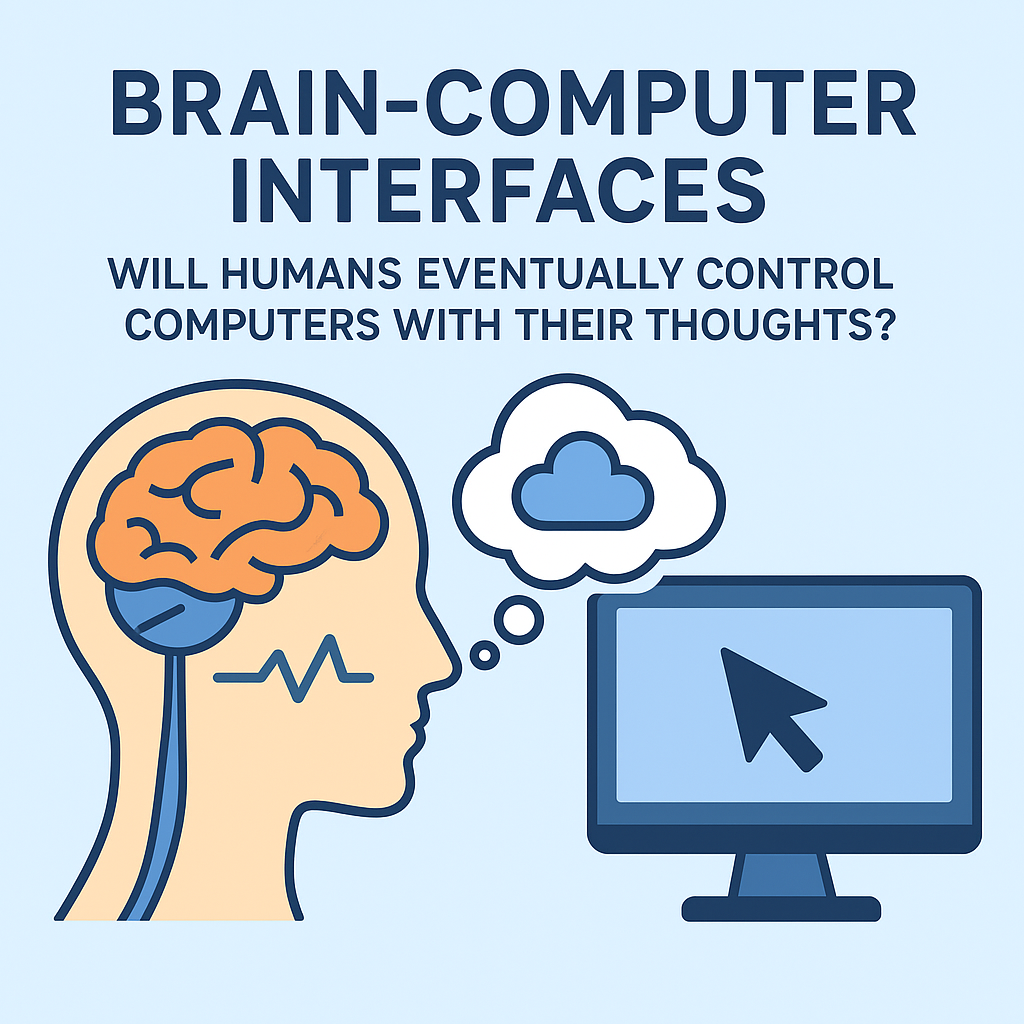
Brain-Computer Interfaces: Will Humans Eventually Control Computers With Their Thoughts?
Imagine sitting down at your desk and, without moving a muscle, navigating a screen simply by thinking. For decades, that idea has lived in science fiction. Today, it’s closer to reality than ever—thanks to brain-computer interfaces (BCIs). These technologies translate brain signals into commands that computers can understand, enabling everything from typing to controlling a cursor.So will humans eventually control computers with their thoughts? The honest answer is: in some ways, yes—already. But the bigger, more universal version of the question (“everyone controlling any computer perfectly, instantly, and reliably”) is still years away, even if progress is accelerating quickly.In this article, we’ll explore what brain-computer interfaces are, how they work, where they’re being used today, what’s holding the technology back, and what the future could look like—along with the ethical, medical, and practical concerns that must be addressed for BCIs to become mainstream.
What Is a Brain-Computer Interface (BCI)?
A brain-computer interface is a system that detects signals from the brain and converts them into commands for an external device, such as a computer cursor, a prosthetic limb, or a communication app.BCIs typically include three major components:
A sensor (electrodes on the scalp, an implanted device, or other methods that measure neural activity)
Signal processing (algorithms that filter noise and interpret patterns)
Output (a computer interface, robotic device, or communication system)
The key challenge is the “translation” step: turning complex, noisy brain activity into consistent, meaningful instructions.
Types of BCIs: Invasive vs. Non-Invasive
BCIs come in different forms, and the trade-offs matter. In general, the more closely the system can measure brain activity, the higher the potential accuracy—but the higher the risks and costs.
1) Invasive BCIs
Invasive BCIs use electrodes implanted in or on the brain tissue. Because they can capture more detailed neural signals, invasive systems can potentially provide higher bandwidth (more information per unit time), enabling finer control—like faster typing or precise cursor movement.However, invasive BCIs involve surgery and long-term medical considerations, such as infection risk, device durability, and long-term signal stability as the body reacts to implants.
2) Partially Invasive BCIs
Some systems use electrodes placed near the brain surface rather than deep in the tissue. These designs aim to balance signal quality with reduced invasiveness.
3) Non-Invasive BCIs
Non-invasive BCIs typically use technologies like EEG (electroencephalography), which records electrical activity from the scalp. These systems are safer and easier to access, but they often have lower signal clarity and limited accuracy due to scalp filtering and other sources of noise.Non-invasive BCIs can still be useful for many applications—especially for assistive communication—but they may struggle with the high precision needed for “general computing” in the way most people imagine.
How Do BCIs Read Your Thoughts? (It’s More About Patterns Than Mind-Reading)
A common misconception is that BCIs “read thoughts” like a mind-reader. In reality, most BCIs interpret neural signals that correlate with intent, such as imagining moving a hand, focusing on a certain visual stimulus, or producing patterns associated with specific letters.Here’s what that typically looks like:
Signal acquisition: The device records brain activity.
Feature extraction: Algorithms find patterns (e.g., changes in frequency bands, event-related potentials).
Model decoding: Machine learning models map those patterns to outputs (cursor movement, letter selection, yes/no choices).
User calibration & adaptation: Many systems require training—both the model and the user—to improve reliability.
So instead of “reading your thoughts,” BCIs usually decode your brain’s signals associated with control.
What Can BCIs Do Today?
BCIs are no longer purely theoretical. They’re being used in research and, in some cases, clinically—especially for people with severe motor impairments.
Assistive communication
Some BCIs can help users spell words or select letters by focusing on specific targets on a screen. One classic approach is the “P300 speller,” where certain brain responses occur when a user notices a flashing letter. The system detects that response and outputs the chosen character.
Cursor control and direct interaction
Certain systems allow users to move a cursor by imagining movements or by modulating brain activity in ways the decoder can interpret. While still limited compared to typing with a keyboard, the progress has been remarkable.
Prosthetics and robotics
Some experimental BCIs aim to control robotic arms or prosthetic limbs by decoding neural activity tied to movement intention. The potential here is enormous: regaining function for people with paralysis.
Rehabilitation and neurofeedback
Beyond control, BCIs can support therapeutic approaches, such as neurofeedback—training the brain to adjust patterns associated with attention, relaxation, or motor recovery.
So—Will Humans Eventually Control Computers With Their Thoughts?
Let’s break this into two versions of the question: likely in limited form soon and unlikely to be universal anytime soon.
Likely outcomes: “Yes, but not exactly like sci-fi”
It’s plausible that within the next decade(s), BCIs will become more common in specific contexts:
Medical and assistive use: Communication and control for people with disabilities is the most realistic near-term path.
Specialized computing: Think of systems that control a limited interface—like selecting options, scrolling, or clicking—rather than full general-purpose computer control.
Training-based improvements: As algorithms improve and systems learn from user-specific patterns, accuracy and speed will rise.
In other words, humans will likely control certain computer functions with their thoughts in a practical way, especially with targeted design and supportive training.
Why “full thought-to-PC control” is hard
To control a computer naturally, a system must handle several major hurdles:
Signal complexity: Brain activity is dynamic, influenced by attention, fatigue, stress, and context.
Noise and variability: Even with identical intent, signals can vary day-to-day and session-to-session.
Latency: Fast control requires decoding quickly enough to feel responsive.
Bandwidth needs: Typing, browsing, gaming, and multitasking require high information throughput—harder than yes/no or simple cursor movement.
User training: Many BCIs need calibration. Reducing or eliminating training time is a key barrier.
Non-invasive BCIs face additional challenges
Non-invasive systems like EEG are appealing because they don’t require surgery. But scalp-level signals are often weaker and less specific. That doesn’t make non-invasive BCIs useless—it just means they may excel at slower, simpler tasks or require advanced detection methods and careful experimental design.
The “Future Brain Interface” Trends to Watch
Several trends could accelerate brain-computer interfaces and bring more realistic “thought control” experiences closer:
Better machine learning and personalization
Modern decoding is increasingly powered by deep learning and adaptive algorithms that learn from the user. If models can stay robust despite day-to-day changes, BCIs become far more practical.
Hybrid interfaces (BCI + traditional inputs)
Instead of replacing keyboards or mice entirely, future systems may combine brain signals with eye tracking, voice, facial movements, or hand gestures. This would reduce the burden on decoding and improve accuracy.
Improved sensors and signal processing
New electrode designs, better amplification, noise reduction methods, and advanced filtering techniques could increase signal quality dramatically—even for non-invasive devices.
Closed-loop systems
A “closed-loop” BCI provides feedback to the brain, allowing users to adjust more effectively. Feedback could be visual (cursor response), auditory, or even sensory. The more the system helps the user learn control, the faster users can gain reliable performance.
Ethical Questions: Privacy, Consent, and “Brain Data” Security
As BCIs progress, ethical concerns move from theoretical to urgent. Brain data is uniquely sensitive. It can reflect mental states, attention, and potentially more—depending on the system’s capabilities.
Brain privacy
Who owns brain data? How is it stored? Could it be used for advertising, insurance decisions, or employment screening?Regulators will likely need new frameworks to treat brain data as a special category—more sensitive than standard health data.
Informed consent
Users must fully understand risks, limitations, and how their signals will be processed. This is especially important for invasive devices where there are physical risks.
Security and hacking risks
If a BCI can control a computer, it becomes a target. Security measures must protect against unauthorized access, malicious commands, or data manipulation. Strong encryption and robust authentication should be built in—not added later.
Bias and fairness
Decoding models could behave differently across populations if training data isn’t representative. Ensuring fairness and minimizing bias will be critical, especially if BCIs become widely used.
Will Everyday People Use BCIs?
This is one of the biggest public questions. For mainstream adoption, BCIs would need to be:
Safe (especially for long-term use)
Affordable
Easy to set up (minimal calibration/training)
Reliable across situations (sleep, stress, movement)
Comfortable for daily wear
At the moment, many non-invasive consumer-style devices still struggle to provide the precision and consistency needed for full “thought-controlled computing.” Meanwhile, invasive BCIs are far more limited due to medical risk and regulatory requirements.However, it’s possible that instead of a single “BCI for everyone,” we’ll see a spectrum: medical devices where they’re clearly beneficial, and consumer tools that offer limited but useful “brain-assisted” interaction.
What Would a Thought-Controlled Computer Actually Feel Like?
Even if BCIs become advanced, the experience may not feel like teleporting your intentions into the computer. It could be more like learning a new communication channel.Think of it as mastering a skill:
Your brain generates control signals based on intent.
The system interprets those signals with probability, not certainty.
You receive feedback, and you adjust—sometimes consciously, sometimes through habit.
Over time, your “mental control language” becomes more consistent. The more adaptable the system and the clearer the feedback, the more natural it can feel.
The Bottom Line
So, will humans eventually control computers with their thoughts? The most accurate answer is:Yes—at least for certain tasks, and in specific contexts, humans can already influence computers using brain signals. With continued advances in sensors, decoding algorithms, feedback systems, and ethical safeguards, thought-based control could become more capable and accessible over time.But fully general, effortless, sci-fi-style control for everyone is not guaranteed soon. The brain is complex, signals vary, and the technology must be safe, secure, and fair.
Where This Technology Can Make the Biggest Difference
Regardless of whether BCIs become mainstream like smartphones, they have powerful potential to change lives. For people who currently cannot communicate or control devices through conventional methods, BCIs may offer independence, expression, and connection.In the long term, the question may evolve from “Can we control computers with thoughts?” to “What new forms of human-computer communication can we build—and how do we do it responsibly?”The future of computing might not replace keyboards and mice immediately. It may instead add a new channel—one that listens to the brain and turns intention into action. And if we get it right, the day could come when the line between thinking and doing becomes dramatically shorter.