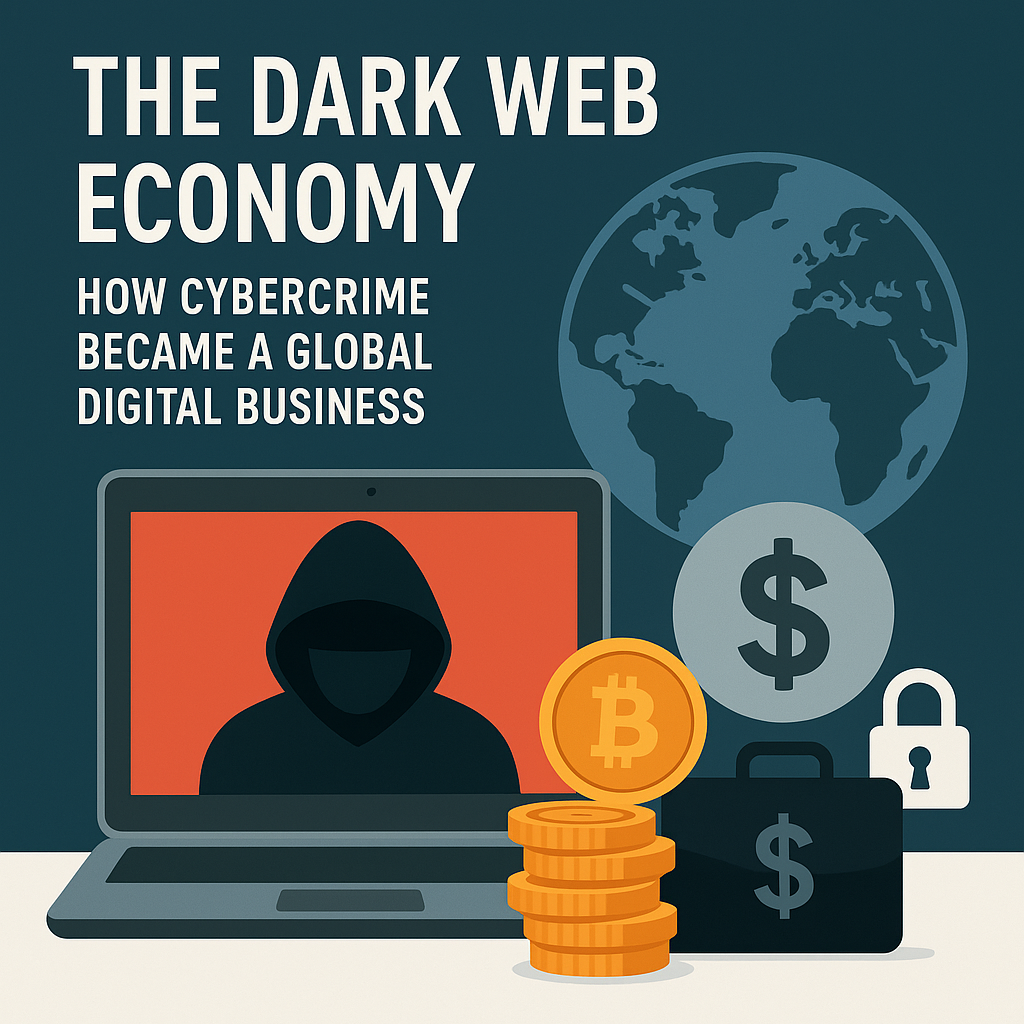
The Dark Web Economy: How Cybercrime Became a Global Digital Business
The dark web is often portrayed like a mysterious underworld hidden behind anonymous browsers and encrypted tunnels. But beneath the myths is a more practical reality: the dark web has grown into an ecosystem that behaves—at least in economic terms—like a sophisticated digital marketplace. In this economy, cybercrime is not just an occasional act of mischief; it has become a structured business model with products, supply chains, “customer support,” and international distribution.In this article, we’ll explore how cybercrime evolved into a global digital business. We’ll also cover what drives the dark web economy, how criminals monetize trust and anonymity, and what defenders, everyday users, and policy makers can do to reduce harm.
What Is the “Dark Web,” Really?
The dark web is a small part of the internet that is intentionally not indexed by standard search engines. Access typically requires specialized software and configurations that help users avoid direct identification and routing visibility.It’s important to note: anonymity tools can be used for legitimate privacy needs as well—such as protecting dissidents in oppressive environments. However, the dark web is also where a significant portion of illegal commerce and criminal facilitation takes place, because anonymity can reduce the perceived risk of law enforcement.
From “Hacking” to “Business”: The Economic Shift
For years, cybercrime was stereotyped as the work of lone hackers chasing bragging rights. While individual skill still matters, the modern dark web economy has moved toward a more scalable model. Cybercriminals learned something crucial: crime can be managed like a business.That shift has several economic drivers:
Lower barriers to entry: People don’t need deep technical knowledge to start profiting; they can buy tools and services.
Modular supply chains: Different roles handle different parts—initial access, malware delivery, laundering, and monetization.
Repeatable demand: Victims—consumers, organizations, and governments—are constantly being targeted.
Global reach: Online markets allow criminals to operate across borders instantly.
How Cybercrime Marketplaces Work
One reason the dark web economy functions like a business is because it often resembles legitimate e-commerce. There are “catalogs,” “vendors,” product listings, reviews, dispute mechanisms, and pricing systems.Common marketplace categories include:
Credentials and access: Stolen logins, session data, and remote access offerings.
Malware and exploit kits: Tooling that can be rented or sold with instructions.
Ransomware services: Platforms that pair malware with affiliate recruitment and victim targeting.
Fraud services: Identity documents, carding services, and account takeover support.
Infrastructure: Hosting, anonymizing services, and “bulletproof” connectivity claims.
Even when the products are illegal, the structure reduces uncertainty for buyers. In business terms, it decreases “transaction costs” for criminals.
Trust, Reputation, and “Customer Support” in a Criminal Marketplace
In legitimate businesses, trust is built through reviews, warranties, and predictable customer service. The dark web mirrors these patterns in its own way.Many platforms rely on escrow-like systems (so buyers feel safer) and on reputation scores (so users can judge whether a vendor delivers). Some sellers provide instructions, “updates,” or troubleshooting—because failure means fewer profits and worse reputation.This is a key point: cybercriminals are not only selling illegal goods. They’re also selling reliability. When a buyer believes they’ll get what they paid for, the marketplace becomes more efficient—and grows.
The Role of Anonymity and Encryption
Anonymity technologies help reduce attribution. Encryption can protect communications and operational details. Together, these tools create a “friction buffer” between criminals and investigators.However, anonymity doesn’t make anyone invincible. Law enforcement and threat researchers frequently use mistakes, metadata, server traces, financial patterns, and human behavior to connect actions to identities. Still, the perceived difficulty of attribution can be enough to sustain profitable operations.
Cryptocurrency: Liquidity for the Underground Economy
Cryptocurrencies are often discussed in the same breath as the dark web. While crypto is not inherently illegal, it has features that can support underground commerce: global transfer, pseudonymous addresses, and fast settlement.In the dark web economy, crypto can function like the payment rails of a global marketplace—especially where traditional banking routes may be harder or riskier. Criminals may also use laundering services to further obscure transaction trails.From an economic viewpoint, what matters is that criminals can convert stolen value into spendable assets and reinvest into more operations. That reinvestment is what turns crime into an industry.
Affiliate Models: Why Cybercrime Scales So Fast
One of the most significant ways cybercrime became a global digital business is through affiliate programs. Instead of a single group running everything, affiliates handle distribution and victim access while the “core” operators provide the payload or platform.This structure looks like legitimate online marketing:
Recruitment: Affiliates are signed or invited into operational networks.
Attribution and reporting: Targets, methods, and outcomes can be tracked to some degree.
Revenue sharing: Profits are split based on performance and roles.
Affiliate models multiply output. If one distribution method fails, there are others. If one group gets disrupted, new affiliates can take over. The “business” is more resilient than a single band of hackers.
Ransomware: The Business Model That Took Off
Ransomware turned a chaotic criminal activity into a repeatable revenue stream. Rather than hoping for one-off theft, ransomware campaigns aimed for direct monetization: compromise systems, encrypt or disrupt data, then demand payment.From a marketplace perspective, ransomware offers clear pricing incentives: the attackers can standardize the operation, automate parts of it, and scale through affiliates. Victims often face time pressure, negotiation uncertainty, and operational disruption—factors that can increase the likelihood of payment.Crucially, ransomware doesn’t just target “tech-savvy” victims. It hits hospitals, schools, local governments, logistics providers, and businesses of every size. The wider the victim base, the larger the potential customer market.
Data as Currency: Identity Theft and Account Takeover
Another reason the dark web economy thrives is that data has become a valuable commodity. Stolen credentials can be used repeatedly, not just once. A single set of login details can unlock email accounts, banking portals, cloud drives, and more.In this economy, data behaves like an asset class. It can be sold, packaged, and used to generate revenue through:
Account takeover (using stolen logins to perform transactions or send fraudulent messages)
Social engineering (targeting victims by leveraging personal details)
Credential stuffing (trying stolen credentials at scale across sites)
Because credentials and personal information can be monetized in multiple ways, criminals prefer them over many other types of stolen goods.
Supply Chains in Crime: Specialization and Outsourcing
Modern cybercrime often reflects a principle common in legitimate industries: specialization improves efficiency. Different groups may focus on specific tasks, such as:
Finding vulnerabilities or purchasing access
Developing malware or exploit tooling
Distributing payloads (phishing, malvertising, or other methods)
Operating “service” layers (fraud automation, hosting, or anonymized support)
Laundering or cashing out proceeds
When roles are specialized, the criminal economy becomes more productive and harder to fully dismantle. Even if one component is disrupted, other parts may continue operating.
Why the Dark Web Economy Became Global
The global nature of the dark web economy isn’t just because criminals can travel online. It’s driven by several structural factors:
Time zone independence: Market activity and operations can occur 24/7.
Cross-border infrastructure: Services and buyers exist in many countries simultaneously.
Language reach: Marketplaces support multilingual communities, increasing demand.
In effect, cybercrime became a global digital business because the internet removed geographic constraints while leaving economic incentives intact.
The Impact: Real-World Harm and Hidden Costs
Cybercrime’s economic logic doesn’t exist in a vacuum. Victims pay in multiple ways:
Direct losses: Stolen funds, ransom payments, and fraud charges.
Operational disruption: Downtime, system rebuilds, and incident response.
Reputational damage: Customers lose trust, vendors may pause relationships.
Security debt: Organizations invest to recover but may still face future risk due to lingering gaps.
These costs add up to a massive burden on economies, healthcare systems, and essential services.
How to Reduce Risk (Without Blowing the Lid Off Criminal Playbooks)
Preventing harm doesn’t require “catching” everyone in the dark web. It requires raising security and resilience in places where attackers look for weakness.
For Individuals
Use multi-factor authentication (MFA) wherever possible.
Choose unique passwords and consider a password manager.
Be cautious with unexpected links and attachments, especially from urgent or unexpected messages.
Keep devices updated to reduce vulnerability windows.
For Organizations
Implement email security and strong identity controls (MFA, conditional access).
Adopt zero-trust principles to limit lateral movement if accounts are compromised.
Maintain offline or immutable backups and test restoration.
Train staff for phishing-resistant practices and response workflows.
Monitor logs and network behavior to detect anomalies early.
Law Enforcement and Threat Research: The Counter-Economy
Cybercrime resembles a business, which means defenders can counter with business-like strategies. Disruptions, takedowns, and international coordination aim to reduce revenue and increase operational risk for criminal operators.Threat researchers also play a crucial role by identifying patterns, tracking malware campaigns, publishing indicators of compromise, and helping organizations respond faster.Importantly, disrupting a criminal economy doesn’t only mean arresting individuals. It also means reducing trust in marketplaces, interrupting monetization flows, and making operations more costly than profitable.
What the Future Might Look Like
The dark web economy will likely keep evolving. As security controls improve and public awareness rises, criminal groups may:
Move toward more scalable automation and “service” layers
Exploit supply chain weaknesses and identity systems
Use more adaptive techniques to evade detection
Shift to new ecosystems as older infrastructure is disrupted
However, the economic truth remains: crime scales when demand exists and defenses lag. Strengthening resilience at the identity, endpoint, and backup layers can reduce the viability of many business models used by attackers.
Conclusion: Understanding the Dark Web Economy Helps Us Defeat It
The dark web economy is powerful because it’s not just about secrecy—it’s about commerce. Cybercrime has become a global digital business by adopting the mechanics of real markets: specialization, pricing, trust signals, scalable distribution, and recurring revenue streams.When we understand these economic patterns, we can respond more effectively. Individuals can protect accounts and reduce exposure. Organizations can improve detection, harden identity, and maintain reliable recovery options. Policy makers and law enforcement can target not only attackers, but the systems that let cybercrime operate like an industry.In the end, disrupting a criminal marketplace is about raising the cost of wrongdoing and reducing the profitability of every step—from access to monetization. That’s how we weaken the dark web economy and make the internet safer for everyone.