Serverless Computing: Is the Traditional Backend Becoming Obsolete?
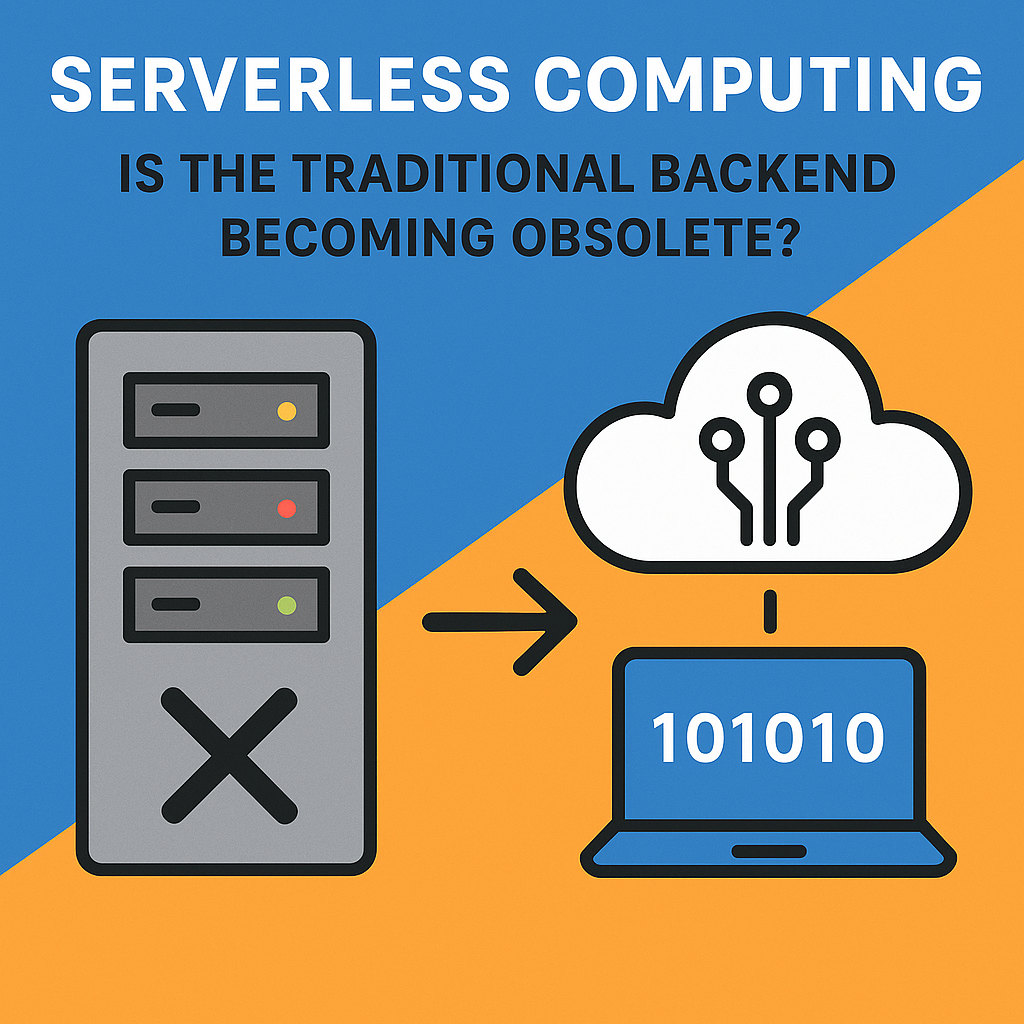
For years, “backend development” has meant servers—physical machines, virtual machines, containers, load balancers, and a long chain of operational chores. You provision capacity, patch operating systems, scale up when traffic spikes, and scale down to avoid paying for idle resources. It’s not that the traditional approach is “bad.” It’s that it can be slow, expensive, and operationally heavy—especially for teams that want to build features quickly and iterate in response to users.Enter serverless computing. In a world where developers increasingly expect instant deployment, elastic scaling, and near-zero maintenance, serverless has shifted the conversation. But does it mean traditional backends are becoming obsolete? The honest answer: not exactly. It means the backend landscape is changing—and serverless is becoming a major (sometimes default) option for many workloads.In this post, we’ll explore what serverless really is, why it’s gained so much momentum, which traditional backend patterns it challenges, where it shines, and where you might still need the reliability and control of a conventional architecture. By the end, you’ll have a clear, practical view of whether “serverless first” is the future—or just a smart strategy for specific problems.
What “Serverless” Actually Means
Despite the name, serverless does not mean “no servers.” Servers still exist in the data center—just not in your hands. With serverless platforms (commonly cloud offerings from major providers), you write code and deploy it to a managed environment. The cloud provider handles infrastructure provisioning, server management, scaling, patching, and (often) deployment workflows.Serverless typically appears in forms like:Functions-as-a-Service (FaaS): You deploy individual functions that run in response to events (HTTP requests, message queue events, scheduled jobs, file uploads, database changes, etc.). Examples include AWS Lambda, Azure Functions, and Google Cloud Functions.Backend-as-a-Service (BaaS): Managed services such as authentication, databases, storage, and analytics that reduce the amount of backend code you must maintain.Managed event-driven architectures: Systems built around event streams and triggers rather than continuously running services.So when people ask whether traditional backends are becoming obsolete, the real question is: are continuously running servers replacing event-driven, on-demand execution? Often, the answer is “some of the time, yes.”
Why Serverless Is Taking Over—Even for Serious Production Systems
Serverless is appealing because it aligns with how modern teams build software: fast iteration, automated operations, and flexible cost models. Here are the key drivers:
1) Automatic scaling without manual work
Traditional backends require you to plan scaling—whether by adding more instances, tuning autoscaling thresholds, or managing container clusters. Serverless platforms scale “to the request,” often scaling to zero when there’s no traffic. For spiky workloads, this can be a game changer.
2) You pay for execution, not idle capacity
With classic servers, you generally pay for time running—even when usage is low. Serverless often charges based on number of requests and compute time consumed. That can drastically lower costs for variable traffic and background jobs.
3) Less operational overhead
Operating systems patching, runtime upgrades, scaling policies, and failure recovery are major sources of developer and DevOps time. Serverless pushes many of those tasks to the provider. Your team can focus more on the product and less on plumbing.
4) Faster deployments and iteration cycles
Functions can be deployed independently. This can reduce deployment risk and encourage modular design. Instead of coordinating a monolithic release, you can roll out small changes quickly.
5) Built-in integrations for event-driven systems
Serverless is naturally compatible with modern architectures: message queues, event buses, streaming platforms, and managed storage. When your backend reacts to events, serverless can be a very clean fit.
Is the Traditional Backend “Obsolete”? Not Quite
Traditional backend systems—whether monoliths, microservices on Kubernetes, or containerized applications—are still essential in many contexts. Serverless does not automatically replace them. Instead, it redefines what portions of your system should be “always-on,” what can be event-driven, and what can be handled by managed services.
Where Traditional Backends Still Win
1) Workloads requiring long-running processes
Some applications need background workers that run continuously for hours or depend on persistent in-memory state. Serverless can support long tasks, but not always as efficiently as a dedicated service designed for that purpose.
2) Very high throughput with predictable patterns
For certain stable workloads, traditional services may be more cost-effective. Serverless can be extremely scalable, but cost models differ. If you run steady, high-volume traffic with consistent compute needs, a well-tuned container or VM-based service can still be competitive.
3) Complex orchestration and custom runtime control
Some organizations require deeper control over networking, libraries, runtime behavior, or specialized performance tuning. Serverless may impose constraints (for example, limitations on deployment packages or execution environments). You can work around many issues, but not all.
4) Strong preference for stateful services
Serverless pushes developers toward stateless design. While stateful patterns are possible (e.g., using managed databases and caching layers), applications that rely heavily on local state may find traditional approaches more straightforward.
Where Serverless Excels
Serverless is often the “best fit” when the workload is event-driven, bursty, or difficult to predict. It also shines for teams that want to reduce operational complexity.
Perfect Serverless Use Cases
APIs and lightweight web services: HTTP-triggered functions can handle REST or webhook-based endpoints.Background processing: Image resizing, video transcoding, invoice generation, report creation, and scheduled maintenance jobs.Event-driven workflows: When something happens (order placed, payment succeeded, user registered), trigger the next step automatically.Real-time data ingestion: Stream events into processing functions, route to queues, or write to analytics stores.Dev/testing environments: Temporary services that need quick deployment and minimal infrastructure management.
The Real Trend: Hybrid Architectures
The most practical answer is often hybrid. Many production systems use both serverless and traditional services side by side. For example:Use serverless for spikes and event triggers: Let functions process events from queues and handle webhooks.Use containers/VMs for steady or stateful workloads: Keep a “core” service running for consistent workloads, custom runtime control, or long-running logic.Use managed data services everywhere: Databases, caching layers, object storage, and messaging systems can be managed regardless of compute type.This is why “traditional backend becoming obsolete” is too simplistic. Instead, we’re seeing a shift in allocation: serverless handles the flexible parts, while traditional services remain valuable for specialized requirements.
Challenges of Serverless (And How to Address Them)
Serverless is not magic. It changes how you design, deploy, and observe systems. To get production-grade results, you’ll need to consider these common challenges:
Cold starts
Depending on the platform and configuration, a function may experience a delay the first time it runs after being idle. This is often mitigated with platform settings, provisioning strategies, and architectural patterns like caching or warming where appropriate.
Vendor lock-in concerns
Serverless platforms differ in programming models, event sources, IAM policies, and deployment tooling. You can reduce lock-in by using portable patterns, abstracting interfaces, and carefully managing infrastructure-as-code—but some dependency will remain.
Monitoring and debugging complexity
Distributed systems can be hard to debug even with traditional services. With serverless, you may need more disciplined tracing, structured logging, correlation IDs, and centralized observability tools.
Execution time limits and resource constraints
Most function environments impose limits on runtime duration and memory. For long tasks, you may need orchestration (step functions/workflows), async queues, or background worker services.
Designing for statelessness
Serverless pushes developers toward stateless execution. That’s generally a good design practice, but it requires thinking about where state lives (databases, caches, object storage) and how to handle concurrency.
How to Decide: Serverless vs. Traditional Backend
If you’re evaluating whether to adopt serverless, use a decision checklist. Ask:Is my workload event-driven? If yes, serverless is often a great match.Does traffic spike unpredictably? Serverless can handle bursts without pre-provisioning.Can tasks be broken into small, independent units? Functions and workflows pair well with modular code.Do I need long-running processes or persistent state? Traditional services may fit better.How important is cost predictability? Serverless can be cost-efficient, but usage-based costs require careful monitoring.What are my deployment and observability requirements? Ensure you have robust tooling for tracing, metrics, and alerting.In many cases, you’ll find that serverless is not an “all or nothing” choice. It’s a tool to optimize parts of your architecture.
What This Means for Developers and Teams
One reason serverless feels like “the future” is that it changes team dynamics. Instead of managing servers, developers often:Design around events: Build systems that react to changes rather than poll constantly.Embrace modularity: Functions encourage small, focused responsibilities.Think in workflows: Use managed orchestration for multi-step processes.Invest in observability: Centralized logs, metrics, and tracing become essential.Use infrastructure-as-code: Deploy reproducibly and avoid configuration drift.This is a cultural shift as much as a technical one. Teams that adapt well to event-driven thinking often get faster development cycles and fewer operational distractions.
Conclusion: The Traditional Backend Isn’t Going Away—But It’s Changing
So, is the traditional backend becoming obsolete? Not in the sense of disappearing overnight. Traditional backends still matter for predictable, stateful, long-running, or highly specialized workloads. But serverless is absolutely changing how many teams architect new systems.The better way to frame the shift is this: serverless is making backend development more flexible, more elastic, and often more cost-effective—especially for event-driven and spiky workloads. Meanwhile, traditional backends continue to serve as the foundation for certain needs, particularly when full control, persistent services, or complex orchestration is required.In the coming years, expect more hybrid architectures: serverless for the responsive edges and workflows, traditional services where continuous computation and custom runtime control provide clear advantages. The future likely won’t be “serverless or nothing.” It will be “choose the right tool for each part of the system.”If you’re building today, don’t treat serverless as a trend to blindly chase. Treat it as an architectural option with clear strengths—and tradeoffs. Start small with a function-based feature or background workflow, measure the results, and expand where it truly fits. That’s how the next generation of backends will be built: pragmatic, modular, and designed for change.