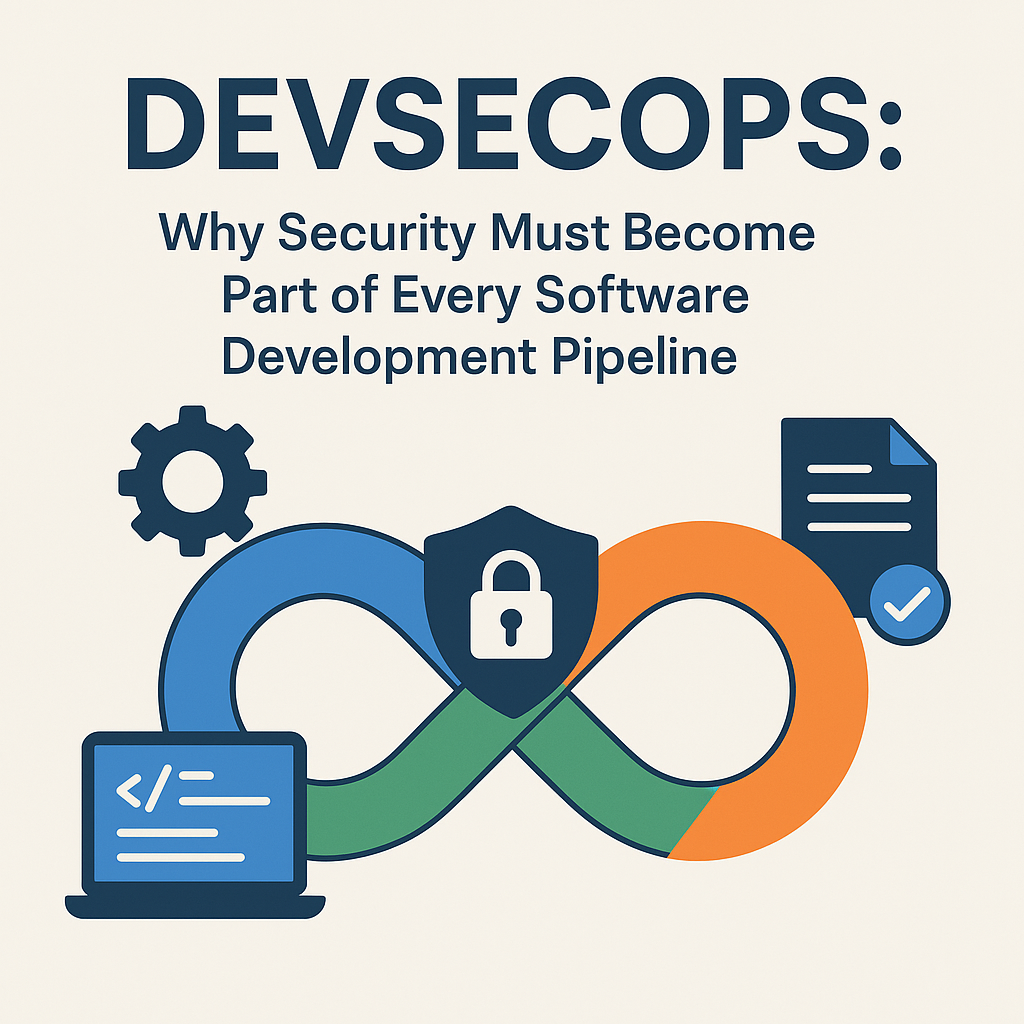
DevSecOps: Why Security Must Become Part of Every Software Development Pipeline
Security can no longer be an afterthought bolted onto the end of the software lifecycle. For years, teams treated security like a gate you pass through—penetration tests near release, vulnerability scanning after code merges, and security reviews that happen when the schedule is already under pressure. The problem is simple: by the time a critical vulnerability is discovered, it’s often too late and too expensive to fix. That’s exactly why DevSecOps exists—and why security must become part of every software development pipeline.DevSecOps doesn’t mean “security as a department.” It means security as an integrated system: people, processes, and tools working together continuously. In this post, we’ll explore what DevSecOps really means, why it matters, how it improves outcomes, and how to implement it in a practical, AdSense-friendly way that’s useful for engineers, leaders, and anyone who cares about building safer software faster.
What Is DevSecOps?
DevSecOps is the practice of embedding security into the Dev (development) and Ops (operations) workflow. The “Sec” is not a separate sprint at the end. Instead, security activities are automated and integrated into each stage of the pipeline—planning, coding, building, testing, deployment, and monitoring.You can think of DevSecOps as a shift from “find and fix” to prevent and detect early. It changes where security checks happen and when remediation occurs. Instead of discovering issues late in the cycle, developers get feedback while code is still fresh, making changes cheaper and less disruptive.
Why Security Must Be Part of Every Pipeline
Security is a continuous requirement, not a one-time event. Here are the main reasons it must be woven into every pipeline stage.
1) Software moves too fast for traditional security
Modern software delivery uses frequent releases, continuous integration (CI), and continuous delivery/deployment (CD). Traditional security processes often rely on manual review cycles that can’t keep up with rapid iteration. If security can’t run at pipeline speed, it becomes a bottleneck—or worse, it gets skipped.
2) The cost of fixing vulnerabilities increases dramatically over time
The earlier you find a problem, the cheaper it is to fix. Fixing a security flaw after deployment may require emergency patches, incident response, data recovery, customer communication, and reputational repair. By contrast, catching issues during code review, unit testing, or build time prevents the vulnerability from ever becoming production reality.
3) Attackers target gaps in the delivery chain
Security issues rarely begin with infrastructure alone. Attackers exploit weak code, insecure dependencies, misconfigurations, and faulty deployment logic. Even a secure application can be compromised if your pipeline allows malicious packages, unsafe secrets handling, or insecure container builds.DevSecOps recognizes the entire delivery chain as part of the threat model.
4) Compliance is easier when security is continuous
Regulations and standards (like PCI DSS, HIPAA, SOC 2, and ISO 27001) increasingly expect evidence of ongoing security controls—not just annual reviews. When security checks run continuously, you get consistent audit trails: scan results, policy enforcement, and change history.
How DevSecOps Works in Practice
A successful DevSecOps pipeline is designed to catch risk early and enforce good security defaults. The exact tools vary by organization, but the workflow often includes the following components.
1) Security in the Code Stage
Security starts where code is written. Developers should receive immediate guidance, such as:• Static Application Security Testing (SAST): Analyzes source code for known patterns of vulnerabilities (e.g., injection flaws, insecure functions, broken access control).• Secure coding guidelines + linters: Enforce best practices automatically (for example, avoiding unsafe deserialization or weak cryptography).• Dependency scanning: Identifies risky or vulnerable libraries and flags outdated packages.In well-run DevSecOps teams, developers don’t wait for security teams to discover issues—they’re alerted during code review and local development.
2) Security in the Build Stage
When code is compiled into artifacts (binaries, container images, packages), DevSecOps checks should continue:• Software Composition Analysis (SCA): Goes beyond basic dependency checks by examining package metadata and known vulnerability databases.• Container and image scanning: Detects vulnerabilities in base images, OS packages, and misconfigurations.• IaC scanning: Infrastructure as Code (Terraform, CloudFormation, etc.) is analyzed for risky settings before provisioning occurs.Crucially, build-stage security helps prevent compromised artifacts from entering deployment.
3) Security in the Test Stage
Testing is where DevSecOps becomes even more effective. Security should be validated like functionality—automatically and repeatedly.Common test-stage security practices include:• Dynamic Application Security Testing (DAST): Tests running applications for vulnerabilities from an attacker’s perspective.• Fuzz testing: Attempts to crash or break application logic by sending unexpected inputs.• Secrets scanning: Ensures keys, tokens, and passwords aren’t accidentally committed to version control.• Threat modeling as lightweight documentation: Teams can incorporate fast, structured reviews for high-risk features.Instead of treating security tests as optional, DevSecOps makes them part of the acceptance criteria.
4) Security in the Deployment Stage
Deployment is where configuration mistakes and risky privileges can create immediate exposure. DevSecOps reduces that risk with:• Policy as Code: Enforces rules like “no root containers,” “TLS must be enabled,” or “only approved roles may access storage.”• Environment-specific controls: Ensures production uses stricter settings than development.• Supply chain security: Verifies artifact integrity using signed builds, checksums, and provenance (for example, via SBOMs and signing frameworks).This prevents the “works on my machine” problem from becoming “breach in production.”
5) Security in Monitoring and Incident Response
DevSecOps doesn’t stop after deployment. Real security requires ongoing visibility.After release, teams use:• Runtime application self-protection (where applicable): Detects abnormal behavior.• Security monitoring and alerting: Correlates logs, metrics, and security events.• Vulnerability management workflows: Tracks findings, prioritizes remediation, and verifies fixes.• Post-incident learning: Improves pipeline checks based on what was exploited.In DevSecOps, security improves continuously because the pipeline gets smarter over time.
The Business Benefits of DevSecOps
Security work can feel abstract until you connect it to measurable outcomes. DevSecOps delivers value across reliability, speed, and risk.
Reduced breach risk
Automated detection and earlier fixes reduce the chance that known vulnerabilities become exploitable.
Faster delivery with fewer emergencies
Security checks integrated into CI/CD reduce last-minute firefighting and help teams ship confidently.
Lower operational cost
When fewer incidents occur, incident response costs drop and engineers spend more time building than recovering.
Better audit readiness
Continuous evidence—scan logs, policy enforcement, and change history—simplifies audits and compliance reporting.
Common DevSecOps Challenges (and How to Fix Them)
DevSecOps isn’t “set it and forget it.” Teams often hit hurdles. Here are common challenges and practical solutions.
Challenge: Tool overload
Many organizations buy scanners and tools without a strategy. The result: noisy alerts and low trust.Fix: Start with a prioritized threat model and choose tools that map to real risks. Tune thresholds and integrate results into developer workflows (pull requests, dashboards, and tickets).
Challenge: Security gatekeeping
If security becomes a manual barrier, developers learn to bypass it.Fix: Automate approvals when policy is met. Keep human review for exceptions and high-risk changes.
Challenge: Lack of developer buy-in
Developers may see security as extra work unrelated to feature delivery.Fix: Provide secure coding guidance, reduce false positives, and make fixes easy. The best DevSecOps teams empower developers with “fix suggestions,” not just warnings.
Challenge: Inconsistent security across environments
Security checks sometimes exist in staging but not production—or vice versa.Fix: Use consistent pipeline stages and policy enforcement across environments, with stricter controls where necessary.
A Practical Roadmap to Implement DevSecOps
If you want DevSecOps to be real (not just a concept), use a phased rollout.
Phase 1: Establish secure foundations
• Define security goals and top risks.• Set up secret scanning and basic dependency scanning.• Add SAST and configure it for pull requests.
Phase 2: Strengthen the pipeline
• Add container and IaC scanning.• Integrate policy as code.• Implement SBOM generation and artifact signing.
Phase 3: Improve feedback loops
• Tune alerts to reduce noise.• Automate remediation steps where possible.• Expand DAST and fuzzing for high-risk apps.
Phase 4: Operationalize security
• Enhance monitoring and runtime detection.• Build vulnerability management workflows with SLAs.• Run security retrospectives based on real incidents and findings.
What “Good” Looks Like: The DevSecOps Mindset
At its core, DevSecOps is cultural as much as technical. It’s about shared responsibility:• Developers own secure outcomes.• Operations ensures safe deployments and reliable systems.• Security provides guidance, controls, and continuous improvement.When everyone shares the goal—shipping valuable software without compromising safety—the pipeline becomes a protective mechanism rather than a risky conveyor belt.
Conclusion: Security Isn’t a Phase—It’s a Pipeline Capability
DevSecOps is the evolution of modern software delivery. It acknowledges a hard truth: vulnerabilities don’t wait politely for a scheduled security review. Instead, they emerge continuously—from code changes, dependency updates, infrastructure modifications, and deployment mistakes.By integrating security into every software development pipeline stage, teams catch issues early, reduce breach risk, improve compliance readiness, and deliver faster with confidence. The best time to secure software is not at the end of the release cycle—it’s at the beginning, inside the pipeline, every time.If you’re starting your DevSecOps journey, begin small: add secrets scanning, dependency checks, and automated feedback in pull requests. Then build outward—policy as code, IaC scanning, supply chain security, and continuous monitoring. In DevSecOps, progress is iterative, and security becomes part of how you deliver value.