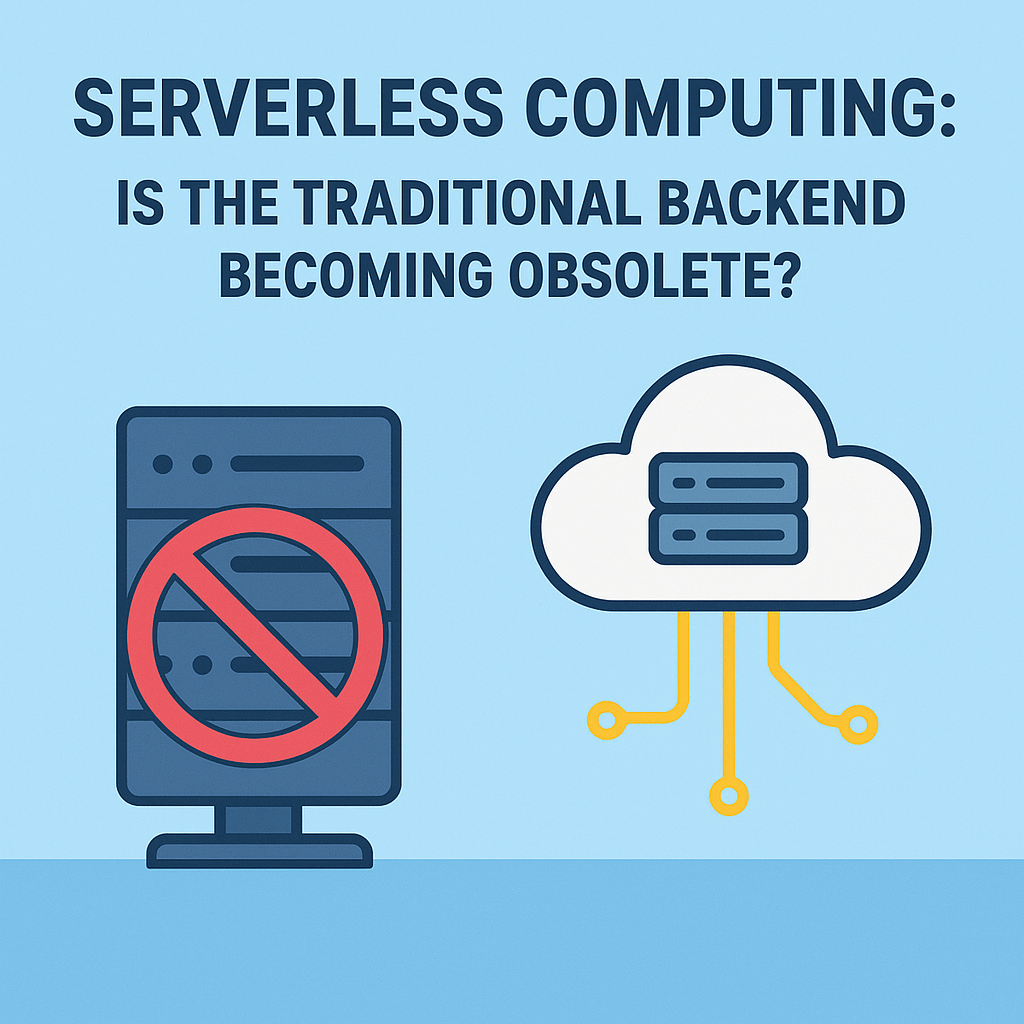
Serverless Computing: Is the Traditional Backend Becoming Obsolete?
For decades, building a “real” backend meant buying (or provisioning) servers, installing operating systems, configuring networking, and keeping everything patched and running. Then came virtualization, and later containers—each promising more flexibility and less operational pain. Now, another shift is accelerating: serverless computing. But if you’re wondering whether serverless means the traditional backend is becoming obsolete, the honest answer is: not exactly. What’s really happening is more nuanced—some parts of backend development are being replaced, others are being redesigned, and many teams are adopting a hybrid model.In this article, we’ll explore what serverless is, why it’s trending, where it truly shines, where traditional backends still matter, and what this means for developers, startups, and enterprises. You’ll also learn practical considerations like cost, security, performance, developer experience, and operational trade-offs—so you can make informed decisions instead of chasing buzzwords.
What Is Serverless Computing?
“Serverless” is a bit of a misnomer. You still rely on servers—just not the ones you manage directly. In serverless architectures, you typically build applications using cloud-managed compute such as:• Function-as-a-Service (FaaS): You write code in small units (functions) that run in response to events (HTTP requests, database changes, message queue events, scheduled tasks).
• Backend services that handle scaling and operations: managed databases, queues, event buses, object storage, authentication services, and more.The cloud provider automatically handles provisioning, scaling, and (most of) the operational overhead. Instead of maintaining servers 24/7, you run code only when it’s needed—often billed per request or per compute duration.
Why Serverless Feels Like a “New Backend Paradigm”
Traditional backends are typically built on a model like this: provision servers → deploy application → configure autoscaling → monitor → patch → update → maintain. Even with modern orchestration (Kubernetes, managed container services, CI/CD pipelines), there’s always operational work.Serverless changes the “who does what” equation:• Provisioning: handled by the provider
• Scaling: automatic based on demand
• Maintenance: runtime and infrastructure managed by the provider
• Deployment: smaller units deployed independently (often faster iteration)That’s a big deal for teams that want to focus on features rather than operations. It’s also a big deal for businesses that need rapid scaling without building a complex operations team.
So… Is the Traditional Backend Becoming Obsolete?
Here’s the key idea: traditional backends are not disappearing—but they’re evolving. Many organizations are replacing server infrastructure management with cloud services and shifting from “always-on” systems to event-driven, demand-based compute.Think of it this way:• Obsolete: The idea that every backend must run on dedicated servers you manage continuously
• Still relevant: Backend design concepts like APIs, authentication, data modeling, caching, observability, reliability, and security
• Changing: How compute is executed and scaled, how deployments are structured, and how teams handle operationsIn many cases, the “backend” becomes a combination of serverless compute plus managed data and messaging systems. But the backend still exists—just implemented differently.
Where Serverless Excels
1) Event-Driven Workloads
Serverless is a natural fit for event-driven systems. If your application reacts to events like “user signed up,” “file uploaded,” or “payment succeeded,” serverless functions can run precisely when needed.Examples include:• Image and video processing when uploads occur
• Webhooks from third-party services
• Processing messages from a queue or event stream
• Scheduled jobs (e.g., daily reports, periodic cleanup)
2) Variable Traffic
When traffic is spiky—high one hour, low the next—traditional always-on servers can be inefficient. Serverless can scale up and down automatically, aligning compute usage with actual demand.
3) Rapid Prototyping and Iteration
With serverless, teams can ship features faster by deploying only the functions affected by changes. Smaller deployable units can reduce the blast radius of updates and streamline iteration.
4) Teams Without Large Ops Teams
If you’re a small team, serverless can help you avoid building a full infrastructure platform. You still need architecture skills, but you don’t have to maintain the underlying servers.
Where Traditional Backends Still Win
1) Long-Running Processes
Serverless functions are typically designed for short-lived execution. While some platforms support longer tasks, traditional approaches may be better for workloads that require steady compute over time, complex state management, or frequent long operations.
2) Predictable, High-Throughput Workloads
For certain stable workloads, always-on services with autoscaling can be cost-effective. Serverless can still work here, but you may need to benchmark carefully due to differences in pricing models.
3) Highly Stateful Systems
If your backend depends heavily on in-memory state, low-latency requirements, or bespoke networking patterns, a traditional container-based setup can be simpler. Serverless can handle state too, but it often pushes you toward external state stores.
4) Advanced Control Over Runtime and Infrastructure
Some teams want very specific control over OS-level tuning, custom kernels, or unusual network requirements. Serverless abstracts much of that away for convenience, which may not fit all advanced scenarios.
Cost: The Real Question Behind “Obsolete?”
Cost is often the deciding factor for teams evaluating serverless. But it’s not automatically cheaper. Serverless pricing is usually based on usage (requests and execution time), which can be ideal for low-to-medium traffic, but expensive if your workload is constantly active or inefficient.Here are practical cost considerations:• Cold starts: Functions may take longer to run on the first request after inactivity. This can impact performance and sometimes costs (if execution time increases).
• Granularity: Smaller functions can reduce waste but can also increase overhead if you call them too frequently.
• Chatty architectures: If your system triggers many functions per user action, total invocation counts may climb.
• Data transfer: Moving data between services can affect cost and latency.The best approach is to run load tests and calculate unit economics (cost per request, cost per transaction, cost per million events) for your particular workload.
Performance and Latency: The Trade-Off Nobody Can Ignore
Serverless brings scalability, but it can introduce performance challenges:• Cold starts: The initial execution latency can affect user experience.
• Dependency size: Large deployment packages can increase startup time.
• Architecture depth: Many distributed services (functions calling other functions) can compound latency.Ways teams improve performance include:• Keeping functions small and dependencies minimal
• Using provisioned concurrency or warm-up strategies where available
• Employing caching (at the edge or within managed caches)
• Designing workflows to reduce the number of hops
Security: Serverless Changes the Threat Model
Security in serverless is not “automatic” just because you don’t manage servers. It changes form. You still need:• Identity and access management (IAM): least-privilege permissions for each function
• Secrets management: use managed secret stores rather than hardcoding credentials
• Input validation: functions are triggered by external events, so treat all inputs as untrusted
• Observability: logs, traces, and alerts help detect anomalies and incident responseAdditionally, serverless applications often integrate more managed services. That’s good for security posture when configured properly, but it also means you must secure each service individually.
Observability: Debugging Distributed Systems the Modern Way
With traditional backends, you might debug by looking at one server’s logs. In serverless, a single user request can span multiple functions, managed services, and event triggers.To stay productive, teams need:• Centralized logging (structured logs)
• Distributed tracing (to see request flows across services)
• Metrics and alerting (latency, error rates, throttling, invocation counts)
• Correlation IDs (so you can tie together logs across components)Good observability is what makes serverless “enterprise-ready.” Without it, troubleshooting becomes frustrating and slow.
Many teams end up with a hybrid architecture: serverless for event-driven or variable workloads, and traditional containers/services for persistent or performance-critical components.A realistic pattern might look like:• A web app served by a managed frontend or API gateway
• Serverless functions handling specific endpoints (e.g., user onboarding, file processing)
• A managed database for persistence
• A queue/event bus for asynchronous processing
• A containerized service for a high-throughput component (e.g., a search engine adapter or real-time processing)In other words, the question isn’t “serverless versus traditional.” It’s “which parts of my backend should be compute-optimized, operations-minimized, or performance-optimized?”
AdSense-Friendly Takeaway: What You Should Do Next
If you’re evaluating whether to adopt serverless, don’t start by replacing everything. Start by identifying pain points:• Do you have spiky traffic or unpredictable load?
• Are you running background jobs that don’t need to be always on?
• Are you spending too much time on scaling, patching, or infrastructure?
• Can parts of your backend naturally react to events?Then run a targeted pilot. Measure:• Latency and throughput
• Cost per request or per transaction
• Operational overhead (monitoring, debugging time, deployment speed)
• Security posture and incident response readinessServerless works best when it aligns with your workload characteristics—not when it’s adopted for novelty.
Conclusion: The Backend Isn’t Going Away—It’s Being Reimagined
So, is the traditional backend becoming obsolete? The traditional approach of managing servers 24/7 is becoming less necessary for many use cases. But the core principles of backend engineering—reliability, scalability, security, data integrity, and performance—remain. Serverless is not a replacement for good architecture; it’s a new implementation model that changes where complexity lives.The most future-proof strategy is likely a hybrid one: serverless for event-driven and elastic compute, managed services for databases and messaging, and traditional containers for workloads that need low-latency, stateful control, or long-running processes. The “obsolete” part is not the backend—it’s the assumption that every backend must look the same.If you build with that mindset, you’ll be ready for whatever the next cloud evolution brings—without betting everything on a single technology trend.