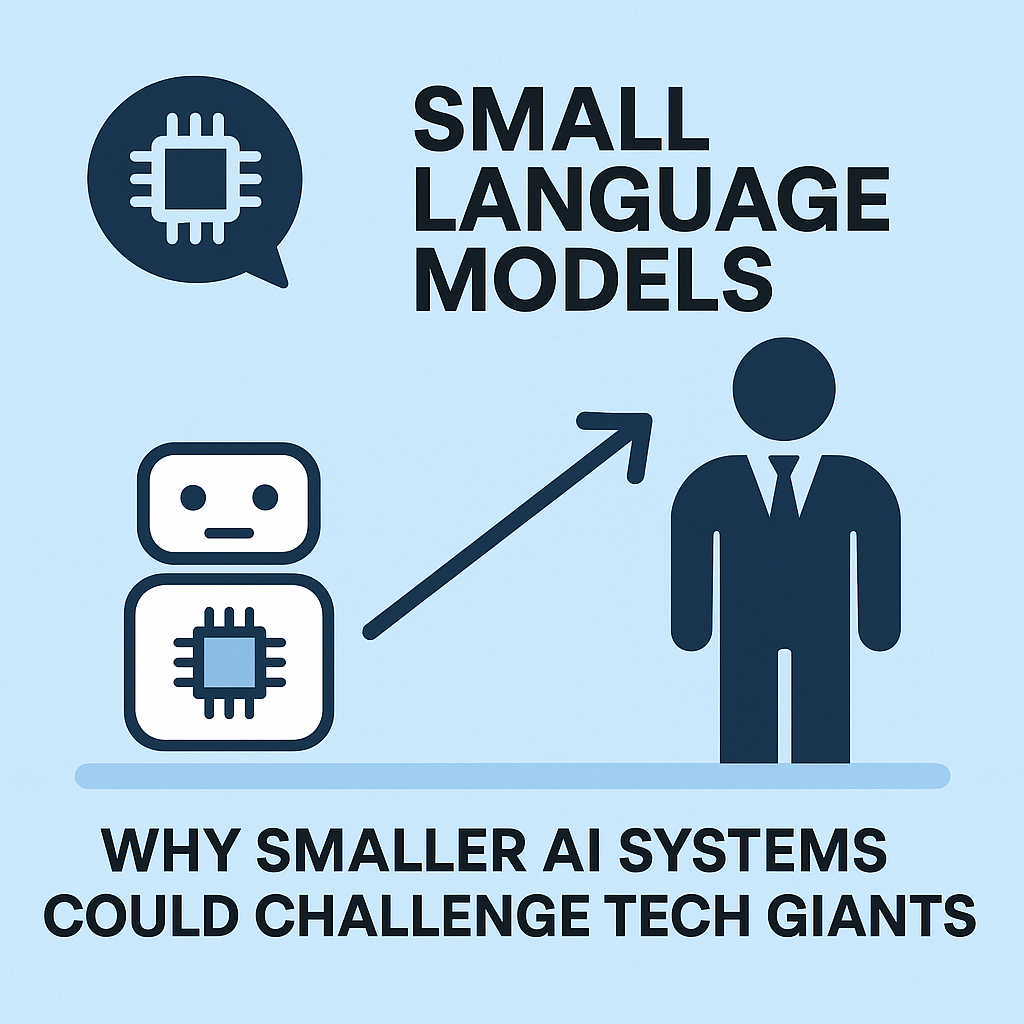
Small Language Models: Why Smaller AI Systems Could Challenge Tech Giants
The AI boom of the last few years has often felt like a race toward bigger and bigger models—more parameters, more compute, more impressive benchmarks. But the reality of deployment is changing. While “frontier” models continue to advance, a parallel trend is accelerating quietly: smaller language models are becoming surprisingly capable, increasingly efficient, and easier to integrate into real products.These “small language models” aren’t simply scaled-down versions of the biggest systems. In many cases, they’re purpose-built for specific tasks, optimized for low latency, fine-tuned on specialized data, and packaged in ways that make them far more accessible to startups, mid-sized companies, and developers worldwide. That’s why smaller AI systems could challenge—sometimes even outcompete—tech giants in the markets that matter most: everyday usability, cost, speed, privacy, and control.
What Are “Small Language Models”?
“Small language model” is a relative term, but it generally refers to models that have far fewer parameters than top-tier foundation models. Instead of needing massive compute and expensive cloud infrastructure, smaller models can run efficiently on modest servers—and in some cases, even on consumer hardware or edge devices with the right setup.Depending on the architecture and use case, “small” might mean tens of billions of parameters, or even fewer. But size alone doesn’t define usefulness. What really matters is how effectively a model can handle targeted tasks such as:
Customer support chat with company-specific tone
Document summarization and extraction
Drafting emails, reports, and marketing copy
Code assistance inside a defined codebase
Translation for specific language pairs and domains
Search-and-answer over proprietary content
On-device voice assistants for privacy-sensitive scenarios
In other words, smaller language models win when the product requirements are clear and the model is tuned for the job.
Why Smaller Models Are Becoming a Big Deal
To understand why smaller models can challenge large tech players, you have to look at what companies actually need from AI. Most businesses don’t need the “best possible” model on a leaderboard. They need a system that performs reliably, can be deployed quickly, stays within budget, and respects constraints like privacy and latency.Smaller language models are attractive because they often deliver strong real-world performance with fewer resources. Several factors are driving this shift:
1) Lower Costs and More Predictable Budgeting
Large foundation models can be expensive to run. Even when hosted by major cloud providers, usage-based pricing and scaling requirements quickly become a major cost center. Smaller models reduce that cost pressure, making AI adoption financially realistic for more organizations.When an AI feature must be available thousands or millions of times per day—like a chat widget—per-request cost matters. Smaller models can allow businesses to:
Increase usage without exploding budgets
Offer more features at the same price
Run continuously for background automation
Experiment faster (and cheaper)
That budget flexibility is a competitive advantage. Companies that can deploy AI broadly can gather better feedback, improve the product, and iterate faster—while bigger competitors may be locked into higher-cost approaches.
2) Faster Responses and Better User Experience
Latency is the difference between “cool demo” and “daily tool.” Smaller models generally generate text faster and can be tuned for quick interactions. This is crucial for live applications like:
Real-time customer support
Interactive coding assistance
Sales enablement chat
Live tutoring or language practice
In-product guidance and automation
When users get answers instantly, AI becomes part of their workflow. That adoption increases retention and data generation, which further improves systems. In competitive markets, speed can matter as much as raw capability.
3) Easier Customization for Specific Industries
Big models can be powerful, but customization is hard. Smaller models can be fine-tuned more effectively for narrow domains. Teams can train or adapt a model using industry-specific knowledge, writing style rules, terminology, and workflow constraints.For example, a healthcare scheduling assistant needs careful formatting and strict policy compliance. A legal document summarizer needs to preserve citations and key facts. A finance assistant might require robust guardrails around advice and risk language.Smaller models can be tuned to align outputs with domain requirements—sometimes with less overhead than adapting a giant system. As a result, they can deliver better “fit” for the customer’s actual problem.
4) Privacy and On-Premises Deployment
Many organizations—especially in regulated industries—can’t freely send all data to external servers. Smaller models can be deployed on-premises, in private cloud environments, or even on edge devices. That reduces privacy risk and can help organizations meet compliance requirements.When customers can keep sensitive data internal, smaller-model vendors gain trust and open doors that large model providers sometimes find difficult to navigate. This is especially relevant for:
Healthcare and insurance
Government and public sector
Legal firms and compliance teams
Manufacturing and industrial operations
Enterprise HR and internal knowledge bases
In many cases, the ability to run AI locally becomes a selling point that outweighs the benefits of using a large model.
5) Strong Performance Through Smarter Training, Not Just Bigger Size
One of the most important insights in modern AI is that “bigger” is not the only path to “better.” Performance can come from smarter approaches such as:
Fine-tuning on task-specific datasets
Retrieval-Augmented Generation (RAG) using company documents and search
Instruction tuning to improve how the model follows prompts
Tool use (calling APIs, calculators, and databases)
Quantization to run models efficiently
Guardrails to enforce safe, structured outputs
With these techniques, smaller models can appear “more capable” than their parameter count suggests, because the system design provides the missing context and constraints.
How Smaller Models Are Reshaping Product Design
Small language models aren’t just changing how AI is built—they’re changing what AI products look like. Instead of one monolithic model doing everything, developers can create systems with modular components:
A small model for drafting
A retrieval system for grounding answers in real documents
A classifier for routing requests (e.g., billing vs. troubleshooting)
A policy engine for compliance checks
A tool layer for actions like refunds, ticket creation, or search
This “orchestration” approach can outperform a generic assistant because the system is tailored. It reduces hallucinations, improves consistency, and keeps responses aligned with business rules.
Why This Could Challenge Tech Giants
Big tech companies have advantages: massive engineering teams, distribution power, and access to capital. But smaller-model ecosystems introduce a different kind of competition—one that can be faster, more specialized, and closer to customer needs.Here are several ways smaller language models can challenge industry giants:
1) The “Capability Gap” May Be Smaller Than Expected
Many real-world tasks don’t require frontier-level reasoning. They require correct, clear responses, good formatting, and the ability to follow instructions. If a smaller model achieves “good enough” quality with better speed and lower cost, it can win large portions of the market.For customers, switching costs often depend on integration quality and ROI. If a smaller-model solution improves productivity while staying within budget, it can displace bigger offerings.
2) Startups Can Launch Faster
Startups don’t typically have the resources to train or host huge models. Smaller models level the playing field. Teams can experiment with product-market fit sooner, deploy quickly, and iterate based on user feedback.When companies can build and refine AI features at startup speed, they can carve out niches—like vertical assistants for specific industries—before giants fully respond.
3) Vendor Diversity Reduces Lock-In
Major platforms can create lock-in through proprietary APIs, pricing structures, and ecosystem dependencies. Smaller-model providers and open ecosystems can offer more flexibility—different hosting options, portability, and control over training data and deployment.In enterprise buying decisions, flexibility is a competitive advantage. Customers may prefer solutions that allow them to adjust models or architectures without rewriting everything from scratch.
4) Better Governance for Enterprises
As AI becomes more widely used, governance becomes a deciding factor. Smaller models can be paired with robust monitoring, structured outputs, and internal audit trails. Teams can more easily track what data is used and how responses are generated—especially when deployed on-premises.This can be especially attractive to organizations that want AI innovation without sacrificing control.
The Role of RAG: Making Small Models Feel Big
One of the most important accelerators for smaller-model success is Retrieval-Augmented Generation (RAG). Instead of relying only on a model’s training data, RAG connects the model to external information sources—such as documents, knowledge bases, or databases—then instructs the model to use that retrieved content when answering.This approach helps with:
Accuracy (answers grounded in real documents)
Freshness (new content can be added without retraining)
Consistency (outputs align with organizational policies)
Compliance (responses can be limited to approved sources)
When combined with a smaller language model, RAG can deliver surprisingly high-quality results. The model becomes the “reasoning and writing engine,” while retrieval provides factual context.
Real-World Use Cases Where Small Models Shine
To make this trend tangible, here are practical scenarios where smaller language models often outperform or beat bigger alternatives on overall product metrics:Customer Support Copilots: A model can draft responses, suggest troubleshooting steps, and summarize ticket history—while a rules engine ensures policy compliance.Sales and Marketing Assistance: Generate tailored emails and proposals using brand voice templates, product catalogs, and approved claims.Internal Knowledge Assistants: Answer employee questions using internal wikis, manuals, and tickets, with citations back to sources.Content Moderation Drafting: Classify and suggest edits for user-generated content based on policy categories.Codebase Helper Tools: Assist developers by summarizing relevant files and suggesting function usage inside a specific repository.Language Practice and Tutoring: Provide explanations and feedback quickly, with chat logs stored safely within the organization or on-device.
What Tech Giants Should Do (and What They May Be Doing Already)
It’s not that large model providers are standing still. Many are exploring smaller variants, distillation techniques, and optimized architectures to reduce cost and improve deployment. The competitive shift is more about changing priorities than abandoning big models entirely.Giants that win may focus on:
Offering cost-effective smaller models or tiers
Strengthening retrieval and enterprise governance features
Providing seamless integration tools for developers
Investing in on-device and privacy-preserving deployments
Making customization easier for vertical needs
But the opening for challengers remains real. If customers can get the outcomes they want—faster, cheaper, and with more control—then size alone won’t guarantee market dominance.
The Future: AI That Fits the Real World
The next phase of AI won’t be defined only by which model scores highest. It will be defined by which systems deliver measurable value across thousands of workflows—under real constraints.Small language models are part of that future because they align with how businesses actually operate: limited budgets, strict compliance requirements, and a constant demand for speed and reliability. When smaller models are paired with retrieval, tool use, and governance, they can become the backbone of practical AI products—especially those built by teams who move quickly and focus on a specific customer outcome.So while tech giants will continue to innovate, smaller AI systems may win the day in the places where AI matters most: the places where cost, latency, privacy, and customization determine success. And that’s how smaller language models could challenge—by outperforming on the metrics that real users feel every day.
Final Thoughts
Small language models aren’t replacing big ones overnight. Frontier systems will keep pushing boundaries. But smaller models are rewriting the competitive landscape by enabling fast deployment, targeted specialization, and more practical integration. In many scenarios, that’s exactly what businesses want.If you’re building AI products—or choosing tools for your organization—don’t just ask, “How big is the model?” Ask instead, “How well does it solve the problem, within our constraints?” Increasingly, smaller language models are answering that question better than anyone expected.