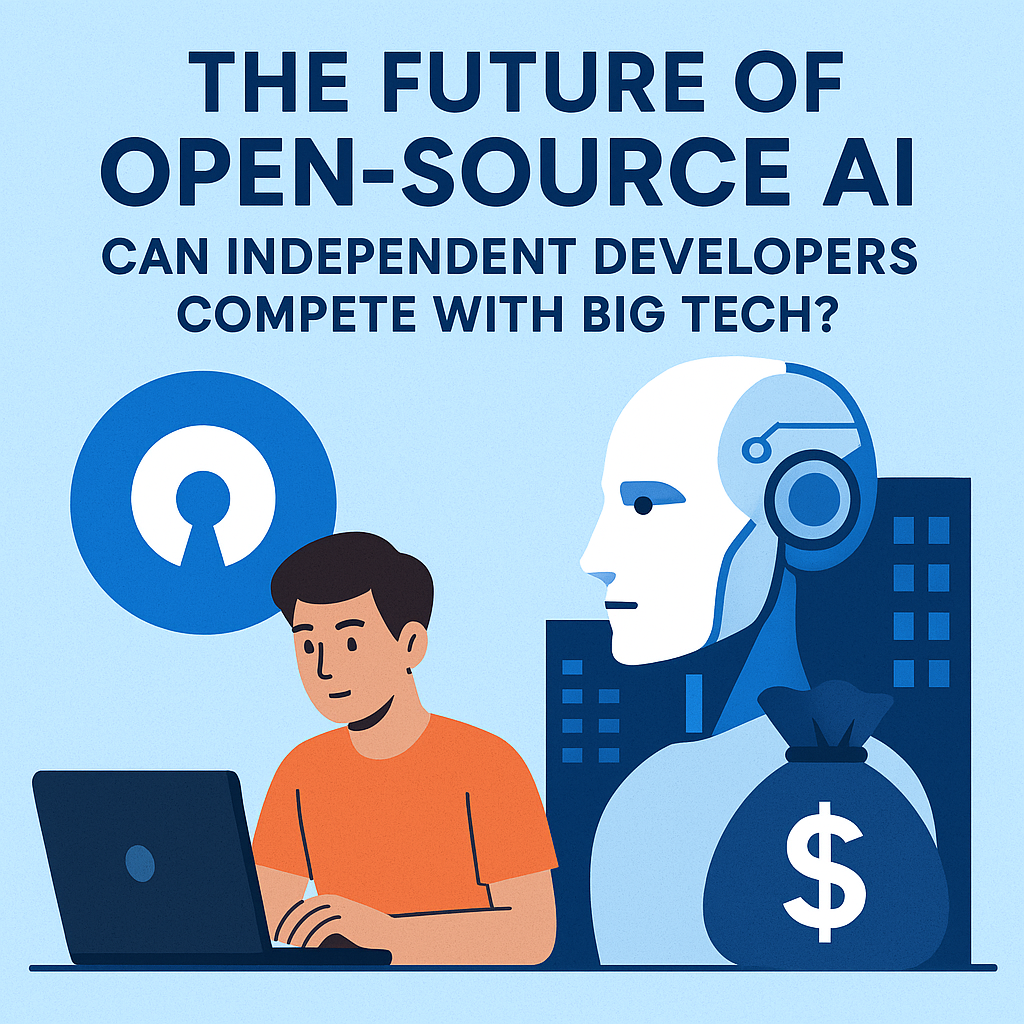
The Future of Open-Source AI: Can Independent Developers Compete With Big Tech?
Open-source AI is having a moment—and not just the kind that fades after a flashy demo. Today, independent developers, research groups, small startups, and community maintainers are building models, tools, datasets, and deployment frameworks that power real products. Meanwhile, Big Tech continues to release foundation models, cloud platforms, and developer ecosystems at a pace that can feel unstoppable. So the question is no longer whether open-source AI will matter. It already does. The real question is: Can independent developers compete with Big Tech in the future?The honest answer is: they can’t compete in every way—and they don’t need to. The future of open-source AI is less about replacing corporate giants and more about reshaping the landscape so that innovation doesn’t require monopoly-scale resources. In this post, we’ll explore the opportunities open-source developers have, the barriers they face, and the strategies that help smaller teams win.
1) Why Open-Source AI Is Accelerating
Open-source AI is growing for several reasons that align with the realities of modern development:1. Demand for flexibility: Businesses want models and tools that can adapt to their data, workflows, and compliance needs. Open-source helps them avoid vendor lock-in.2. Lower cost experimentation: Developers can prototype and iterate without paying for every test run at scale.3. Community-driven improvements: When people can inspect, modify, and contribute, bugs get fixed faster, performance improves steadily, and new features emerge.4. Safety and transparency incentives: Open research enables better scrutiny, reproducibility, and audits—especially important for regulated industries.In other words, open-source isn’t just a “nice to have.” It’s a development model that fits modern software culture: collaborative, modular, and fast-moving.
2) What “Compete With Big Tech” Really Means
Big Tech often competes on scale: training compute, massive datasets, distribution, and integrated cloud services. Independent developers don’t have the same access. But competition doesn’t have to mean “outspend the giant.” It can mean dominating niches where smaller teams are uniquely strong.In practice, independent developers can compete when they:Build specialized solutions (e.g., vertical models for healthcare coding, customer support automation, legal document summarization, robotics, or scientific discovery).Offer better control (privacy, auditability, custom pipelines, on-prem deployment, deterministic behavior, or fine-tuning workflows).Move faster in iteration cycles by responding to community needs and shipping improvements continuously.Provide ecosystem leadership through tooling—evaluation harnesses, inference engines, adapters, quantization methods, and integration libraries.In the AI world, “winning” can look like becoming the default stack for a type of work—even if your model isn’t the biggest on the leaderboard.
3) The Open-Source Advantage: Composability Wins
One underrated factor is that open-source AI encourages composability. Instead of a single monolithic product, developers can assemble systems from modules:Model selection (base model or fine-tuned model) + retrieval (RAG) + orchestration (agents/workflows) + tool calling + guardrails + evaluation + monitoring.Big Tech may offer “all-in-one” systems, but open-source ecosystems excel at combining components in ways that match specific constraints. A hospital system, for example, might require strict audit logs, data residency, and deterministic outputs—while a startup might need rapid experimentation and cost efficiency. Open-source lets teams tailor the pipeline.Independent developers can turn this into a competitive edge by focusing on the “glue” layer: frameworks and libraries that make it easy to build reliable AI applications.
4) The Hard Truth: Compute, Data, and Talent Are Bottlenecks
Even with open-source momentum, there are challenges that independent developers can’t ignore.
Compute Costs
Training state-of-the-art models is expensive. Even fine-tuning large foundation models can be costly depending on size and approach.
Data Access and Licensing
High-quality training and domain data often requires partnerships, legal clarity, and careful curation. Big Tech has scale and negotiating power to acquire datasets and run at massive volume.
Talent and Time
Top AI engineering is scarce. A small team can’t cover every specialty—modeling, evaluation, security, deployment, product design, and community management—without careful focus.So, how do independent developers overcome these bottlenecks? The key is to compete where big advantages can be turned into leverage—and where scale isn’t the only variable.
5) Where Independent Developers Can Win
Here are several areas where smaller teams are likely to outperform or become essential.
A) Domain-Specific Models and Fine-Tuning
Not every use case requires training from scratch. Many businesses need specialized performance, and fine-tuned models can deliver that—especially with strong evaluation and targeted datasets.Independent developers can also build “model packs” that include fine-tuned weights, training recipes, data preprocessing scripts, and evaluation benchmarks. That makes adoption easier and reduces risk for users.
B) Reliability, Evaluation, and Monitoring
Big models can be impressive, but production AI requires more than clever prompts. Independent teams can offer:• Robust evaluation suites (accuracy, safety, hallucination rates, latency, cost-per-task)• Regression testing for prompt and model changes• Monitoring tools for drift, abuse patterns, and output qualityWhen an open-source project helps teams prove that an AI system is reliable, it becomes a strategic asset. That’s competition on trust—not just capabilities.
C) Lightweight Inference and Quantization
For many applications, the “best” model isn’t the biggest. It’s the one that runs fast enough and cheaply enough on available hardware. Independent developers can lead in:• Quantization techniques that preserve quality• Efficient inference runtimes• GPU/CPU optimizations and deployment pipelinesBig Tech may optimize for cloud scale, but independent developers can optimize for edge devices, local servers, and offline environments—where control and privacy matter.
D) Privacy-Preserving and On-Prem Solutions
Some industries can’t send sensitive data to third-party APIs. Developers who provide open-source pipelines for on-prem RAG, secure logging, and access control can create strong demand. Even if Big Tech offers hosted options, the “right answer” for many organizations is still local control.
E) Community-Led Ecosystems
Open-source wins when it becomes a platform. That means maintainers can build an ecosystem around their tooling:• Templates for common apps (chatbots, document assistants, code copilots)• Plugins for popular frameworks• Clear contribution guidelines• Documentation that helps newcomers ship quicklyOver time, ecosystem lock-in can happen in open source too. Users stay because switching costs rise—not because of licensing power, but because workflows become standardized.
6) The Rise of Smaller Models (and Why It Matters)
Another reason independent developers can compete: the center of gravity is shifting. Instead of “bigger is better,” many teams are realizing that smaller, well-tuned models plus retrieval and tools can beat generic large models for specific tasks.This unlocks a major advantage for smaller teams: experimentation at smaller scales. You can iterate faster, test more ideas, and improve quality through smarter workflows—like better context selection, structured outputs, and tool-based reasoning.Big Tech will likely keep releasing larger models, but open-source communities can still win by building practical systems that deliver excellent outcomes at a fraction of the cost.
7) Monetization: How Open-Source Projects Can Survive
AdSense-friendly content often emphasizes business realities, and open-source AI must also pay bills. Independent developers can monetize without abandoning the open-source ethos.Common sustainable approaches include:Dual licensing: keep core components open while offering enterprise features under a commercial license.Paid support and services: companies pay for implementation, integration, audits, or training.Hosted versions: offer an API or managed service while keeping the code open.Grants and community funding: some projects thrive through foundations and sponsor programs.Enterprise partnerships: align with organizations that need specific deployment and compliance.The goal isn’t to out-market Big Tech; it’s to create value that users are willing to fund because it solves real problems.
8) The Role of Safety and Governance
If open-source AI is going to shape the future, it needs governance. Independent developers can compete by building safety into the product layer:• Content filtering and policy enforcement• Tool permissions and sandboxing• Data usage transparency• Evaluation against harmful behaviorsBig Tech has entire safety divisions, but independent developers can still innovate. The open-source model allows researchers and practitioners to contribute safety research and practical guardrails directly to the ecosystem.
9) A Practical Strategy for Independent Developers
If you’re building open-source AI projects and wondering how to compete, here’s a practical roadmap:
1) Choose a wedge problem
Pick one area where you can deliver clear, measurable improvement. Examples: “better summarization of legal contracts,” “faster local transcription,” or “reliable structured extraction from PDFs.”
2) Prioritize evaluation early
Don’t wait until the model is perfect. Define success metrics, create benchmarks, and add automated tests so progress is visible.
3) Make adoption effortless
Provide setup scripts, Docker images, clear docs, and sample apps. Great technology that nobody can integrate won’t compete.
4) Build for production
Include logging, tracing, retries, rate limits, caching, and fallback strategies. Production readiness is a competitive advantage.
5) Collaborate and cultivate maintainers
Open-source durability comes from community. Create a contributor pipeline, recognize contributions, and keep the roadmap transparent.
10) So… Can Independent Developers Compete?
Yes—but with the right mindset. Independent developers are unlikely to outcompete Big Tech on raw scale for training and global distribution. However, the open-source future isn’t a single race; it’s many parallel races across reliability, specialization, transparency, cost efficiency, governance, and ecosystem design.Big Tech will continue to lead in certain areas: compute-heavy training runs, platform-level distribution, and broad product suites. Independent developers can lead where agility, customization, and trust matter more than scale. And increasingly, those “smaller wins” compound into long-term dominance within specific niches.In the next phase of AI, the most valuable skill might not be inventing the largest model. It might be building the most effective, reliable, and ethically aligned system that real people can deploy.
Conclusion: Open Source Isn’t Just a Feature—It’s the Competitive Landscape
The future of open-source AI is bright, and competition is already happening—just not in the way many people expect. Independent developers can compete with Big Tech by delivering specialized tools, production-grade reliability, efficient deployment, and transparent governance. They can also outpace giants in iteration and community-driven improvement.If you’re building in this space, focus on measurable value, practical adoption, and durable ecosystems. Big Tech will bring scale. Open source will bring flexibility and trust. And together, they’ll shape an AI future that isn’t controlled by a single company—one contribution at a time.